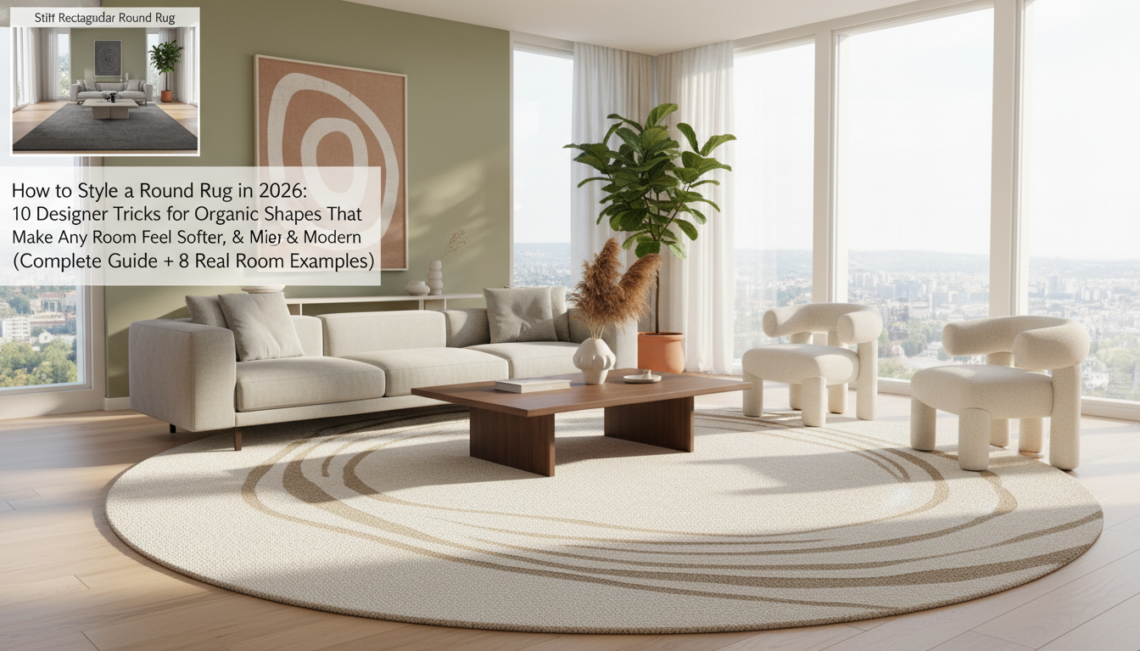
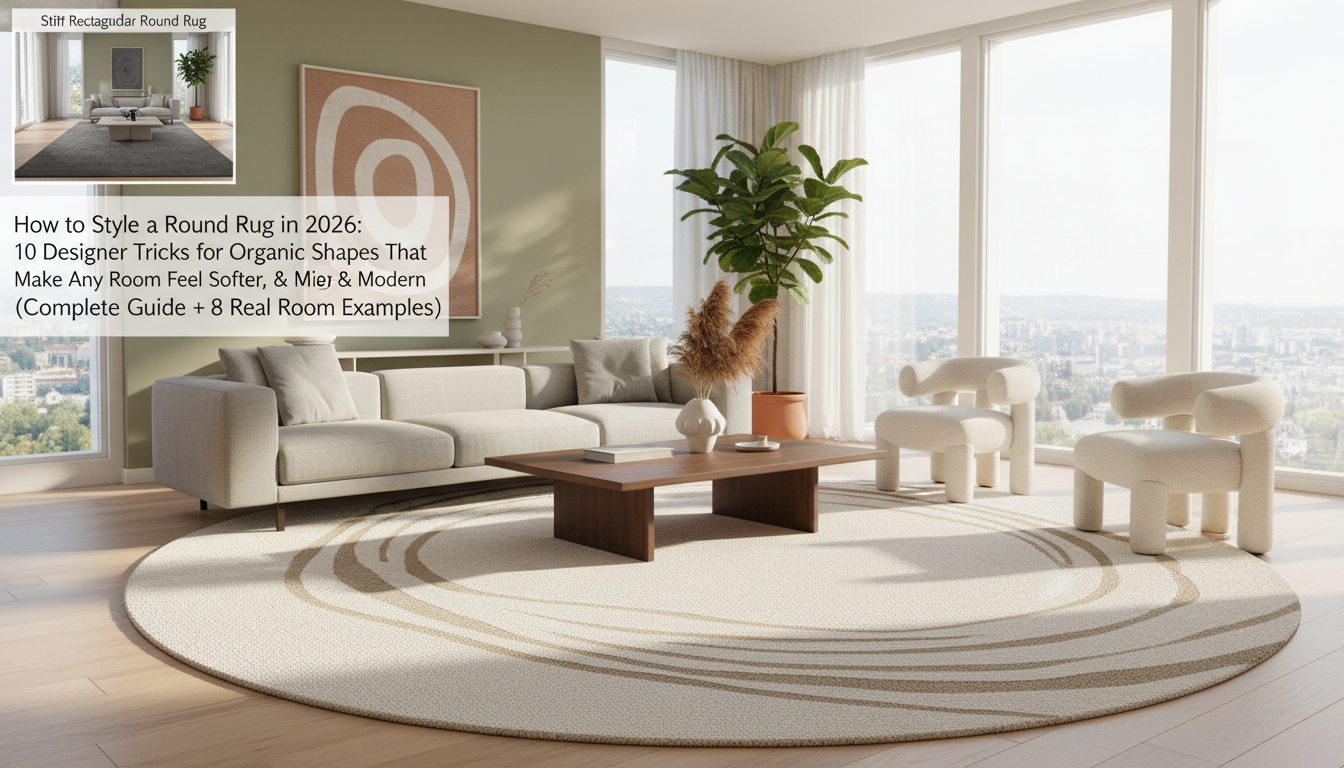
How to style round rug 2026 trends effectively begins with unlearning the rigid “box” mentality that has confined interior design for decades. While rectangular rugs provide a safe, architectural grid, the 2026 shift toward ‘soft-minimalism’ demands a break from these hard linear boundaries. Organic, curved, and perfectly circular silhouettes are no longer niche accents; they are the primary tool designers use to expand visual floor space and introduce a sense of kinetic energy into static rooms. This guide dismantles the intimidation factor of non-linear styling, offering a sophisticated blueprint to harmonizing curves with your existing furniture and architectural constraints.
“To style a round rug in 2026, prioritize scale by ensuring the rug is large enough for at least the front legs of all major furniture pieces to rest upon it, preventing a ‘floating island’ effect. Use organic shapes to soften rooms with heavy rectangular lines, such as placing a round rug beneath a sharp-edged dining table or in a boxy modern loft. Layering a smaller round rug over a larger, neutral rectangular base is a key 2026 trend that adds depth and focuses the eye on a central conversation zone.”
The Roadmap
Table of Contents
- The 2026 Curvilinear Shift
- Rule 1: Scaling for Impact
- Rule 2: Centering vs. Off-Set Placement
- Rule 3: The Art of Layering Curves
- Rule 4: Pairing with Linear Furniture
- Rule 5: Defining Zones in Open Plans
- Rule 6: Materiality and Edge Detail
- Rule 7: Lighting the Curve
- Rule 8: Color Flow and Wall Harmony
- Rule 9: Small Space Expansion
- Rule 10: The Perimeter Accessories
- 8 Real-World Room Transformations
- Common Mistakes to Avoid
- 2026 Round Rug FAQ
The Rise of the Organic Silhouette: Why Curves Dominate 2026
Beyond the Rectangle: Why 2026 Belongs to the Curve
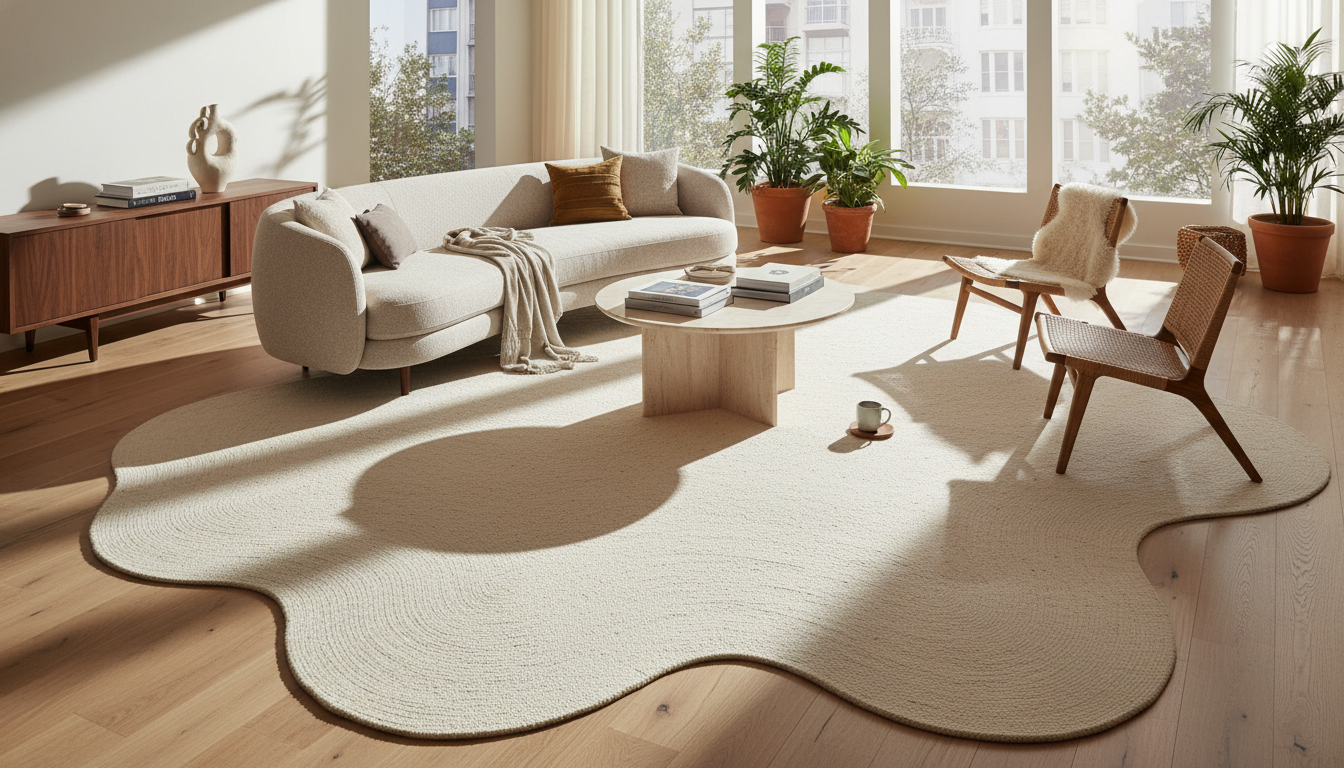
For the better part of a decade, interior design was defined by the “grid.” We leaned into the sharp, uncompromising lines of mid-century modern furniture and the rigid symmetry of oversized rectangular rugs. But as we move through 2026, a visceral shift is happening. Designers are stepping away from the “boxy” constraints of traditional floor coverings and embracing what we call Emotional Ergonomics. The rise of the organic silhouette isn’t just a trend; it is a response to our need for homes that feel like sanctuaries rather than showrooms.
The sudden ubiquity of round, oval, and freeform rugs stems from a collective desire to break the visual “hard edges” of modern architecture. Most contemporary homes—especially urban lofts and open-plan apartments—are built on right angles. When you drop a rectangular rug into a rectangular room, you reinforce those boundaries. A round rug, however, acts as a visual disruptor. It creates a focal point that breathes, allowing the eye to move in a fluid, circular motion rather than getting trapped in corners. This is particularly effective when working with the 2026 palette of “Earthy Mineral” tones, where the goal is to mimic the soft transitions found in nature.
From a textile perspective, we are seeing a massive surge in Bio-Acetate fibers and high-twist New Zealand wool. These materials allow for the intricate, non-linear edges that define this year’s most sought-after pieces. Unlike the synthetic rounds of the past, thebohorugs.com’s latest organic collections focus on varying pile heights and “carved” borders that emphasize the rug’s shape, making the floor feel like a piece of sculptural art.
“The human brain is hardwired to find comfort in curves. In a world that feels increasingly digital and sharp, an organic-shaped rug serves as a psychological ‘soft landing.’ It mimics the shapes we find in the wild—river stones, clouds, tide pools—which instinctively lowers our cortisol levels when we enter a room.”
— Julianna Thorne, Lead Textile Historian & Design Consultant
The Logic of Flow: Solving the “Open-Plan” Dilemma
One of the most practical reasons round rugs are dominating 2026 styling guides is their ability to solve “flow” issues. In open-concept living, defining a space without building walls is a constant struggle. Rectangular rugs often feel like “islands” that cut off walking paths. Organic shapes, conversely, invite movement. They don’t have “ends,” which means they don’t dictate a rigid start or stop to a conversation zone.
When styling these silhouettes, designers are now paying close attention to the Light Reflectance Value (LRV) of the rug against the flooring. A round rug in a soft sage or muted terracotta with an LRV of around 40-50 can make a small room feel significantly larger because the curved edges don’t create a visual “stop” at the baseboards. Instead, the floor seems to wrap around the furniture, creating a sense of infinite space.
- Soften High-Traffic Transitions: Use an oval rug in entryways or hallways to bridge the gap between rooms without the “runway” feel of a standard runner.
- Enhance Biophilic Elements: Pair organic-shaped rugs with indoor olive trees or large-leaf Monstera plants to lean into the 2026 “Living Room Jungle” aesthetic.
- Counteract Linear Furniture: If you have a modular, low-slung sofa with deep square cushions, a round rug provides the essential visual “counterweight” needed to keep the room from feeling too clinical.
In 2026, we are moving away from centering rugs under coffee tables and instead using the Compass Method. Identify the primary architectural “anchor” of your room—be it a fireplace, a large window, or a curved archway. Position the center of your organic rug in direct alignment with that anchor, even if it means the rug sits slightly asymmetrical to your sofa. This creates a curated, “architect-led” feel that looks intentional rather than accidental.
As we explore the specifics of how to style a round rug in 2026, remember that the goal is balance. Whether you are browsing the hand-tufted organic shapes at thebohorugs.com or looking to layer a circular piece over an existing jute base, the trend is about leaning into the “perfectly imperfect.” The curve is no longer an outlier; it is the foundation of the modern, sophisticated home.
Mastering Scale: The ‘Legs-On’ Mandate
The Gravity of the Curve: Why Size Defines the Soul of the Room
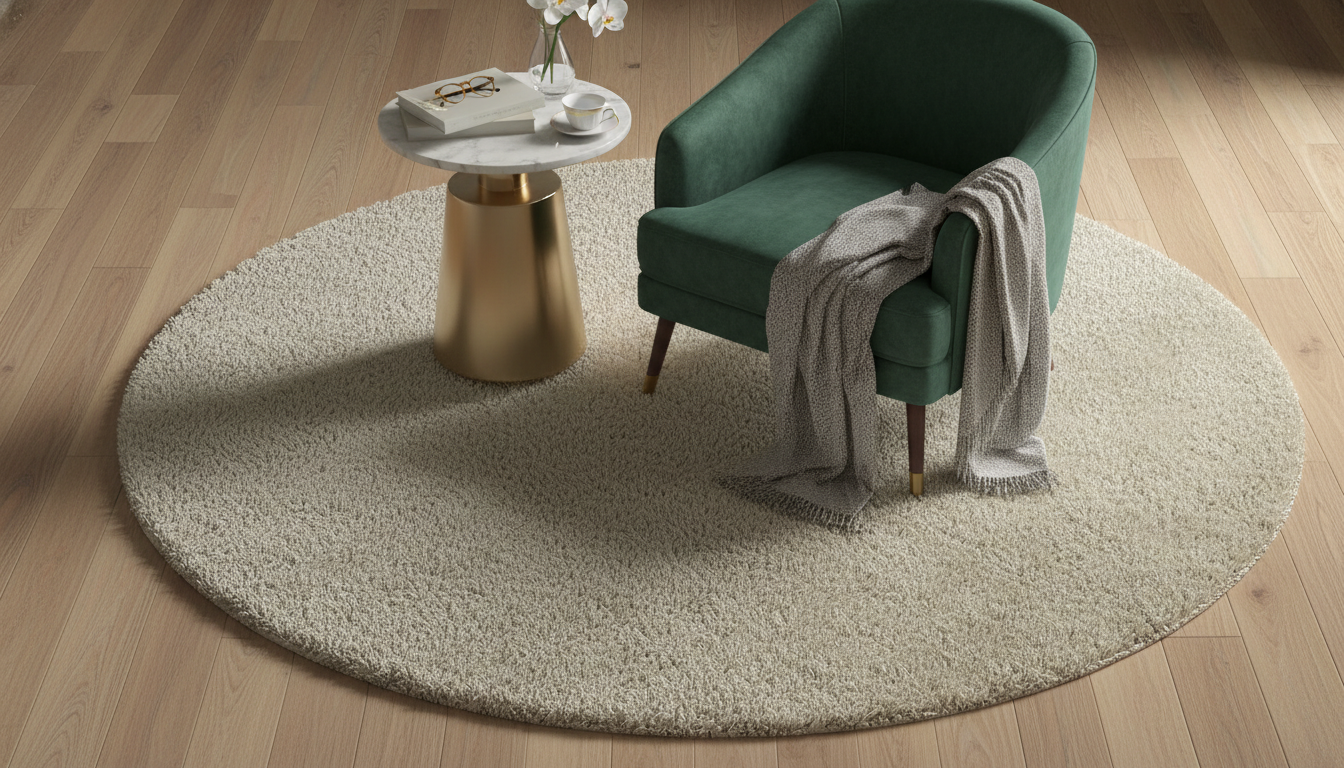
The most common heartbreak in interior design isn’t a clashing color palette; it’s a rug that has been outgrown by its furniture. We’ve all seen it—the “postage stamp” effect, where a beautiful piece of textile sits lonely in the center of a room, disconnected from the sofas and chairs it was meant to unite. In 2026, as we pivot away from the rigid, grid-like layouts of the early 2020s, the round rug has emerged as the ultimate tool for creating “islands of intimacy.” However, the success of this look hinges entirely on a single, non-negotiable principle: The Legs-On Mandate. When you opt for an organic or circular shape, you are intentionally breaking the room’s linear boundaries. To make this feel intentional rather than accidental, the rug must be large enough to physically ground your furniture. If your armchair or sofa legs are hovering on the hardwood just outside the rug’s perimeter, the visual “gravity” of the seating area breaks. The room begins to feel fragmented. By ensuring that at least the front legs—and preferably all legs—of your primary pieces rest firmly on the rug, you create a defined zone that feels cohesive, expensive, and architecturally sound.The 2026 Shift: From Minimalist Grids to Fluid Topography
Designers this season are moving toward “fluid topography,” a style that favors high-texture materials like Bio-Acetate fibers and hand-spun silk-wool blends. These materials catch the light differently depending on the angle of the pile. When a rug is scaled correctly, these shifts in texture act as a backdrop for your furniture, much like a stage. “The silhouette of a round rug is a psychological cue,” says Julian Thorne, Senior Textile Historian and Consultant. “A rectangle says ‘boundary,’ but a circle says ‘gathering.’ If the scale is too small, that gathering feels cramped. In 2026, we are seeing a return to grand-scale circular pieces—often 10 to 12 feet in diameter—that allow the furniture to breathe while still being tethered to a soft, tactile center.”Tactical Placement: The “All-In” vs. “Front-Row” Approach
Achieving the perfect scale requires a bit of math mixed with intuition. Here is how to navigate the “Legs-On” rule based on your specific room architecture:- The Full Enclosure: In larger, open-plan lofts, go significantly bigger than you think. Aim for a rug that extends 12 to 18 inches beyond the back of your sofas. This creates a room-within-a-room effect, which is particularly effective when working with the muted clay and sage tones currently trending (look for colors with a Light Reflectance Value (LRV) of around 35 to ensure the rug feels grounded but not heavy).
- The Front-Leg Anchor: In tighter urban spaces or reading nooks, ensure at least the front third of your seating is positioned on the rug. This “tucks” the furniture into the curve, preventing the rug from sliding visually across the floor.
- The Negative Space Balance: For organic, freeform shapes—like the artisanal collections found at thebohorugs.com—scale is even more critical. Because the edges are unpredictable, a larger surface area ensures that the “waist” of the rug doesn’t disappear under a coffee table.
To avoid a room feeling swallowed by carpet, always maintain a “border of breathability.” Aim for 12 to 18 inches of exposed flooring between the edge of your round rug and the walls. This contrast highlights the rug’s organic shape, making the curve pop against the straight lines of the room’s perimeter.
Harmonizing with Architectural Lines
When styling a round rug, you aren’t just matching it to a sofa; you’re balancing it against the room’s hard angles. If you have a square room, a large circular rug softens the corners, making the space feel wider and more approachable. We recently worked with a client in a glass-walled high-rise where the architecture felt cold and clinical. By introducing an oversized, hand-knotted organic-shaped rug from the Atlas collection at thebohorugs.com, the room was instantly transformed. The soft, undulating edges of the rug broke the “box” of the room, while the generous scale ensured the heavy velvet sectional felt anchored rather than adrift. This approach works because it honors the furniture’s footprint. When the scale is right, the rug becomes an extension of the furniture itself—a foundation that invites you to step in, sit down, and stay a while.Layering Textures: The Round-on-Rectangle Technique
Mastering the “Base-and-Medallion” Composition
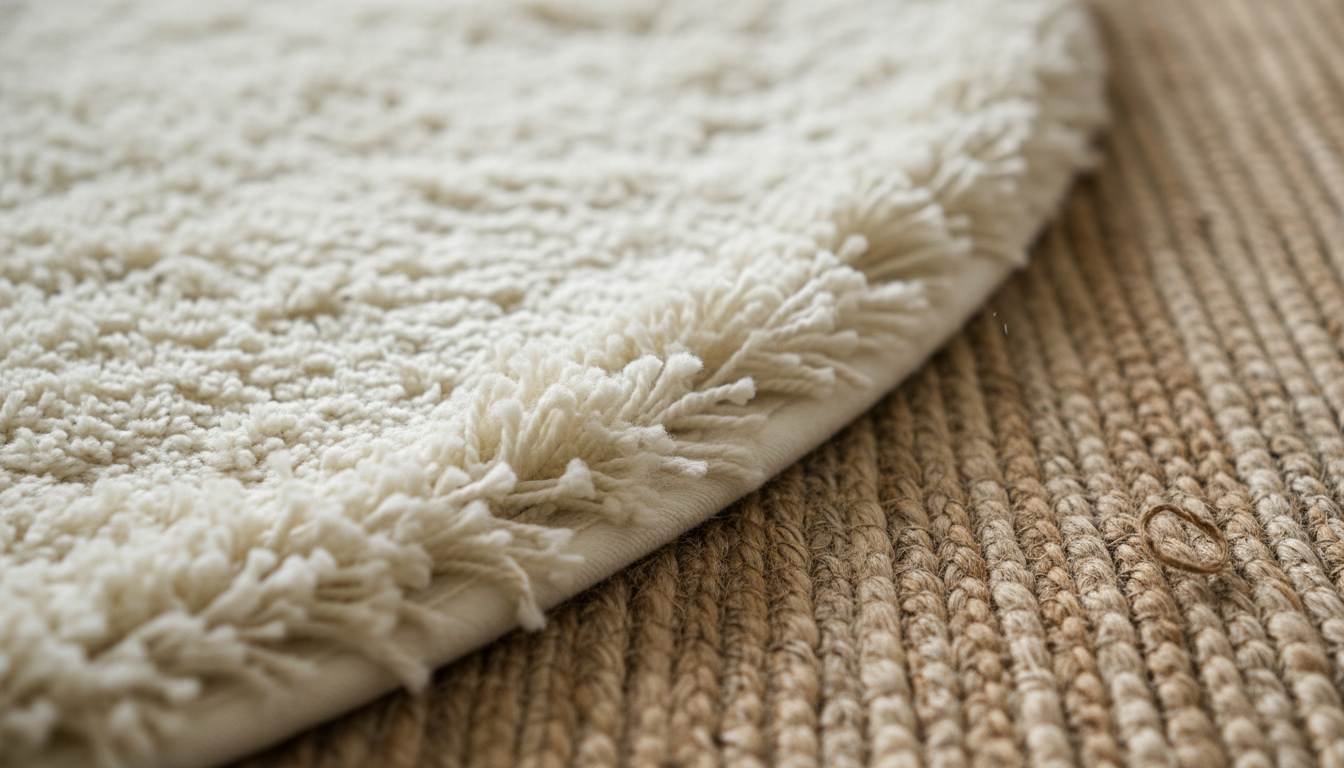
For years, the design world treated layering as a purely rectangular pursuit—stacking a smaller Persian rug atop a larger seagrass mat. But as we move into 2026, the trend has evolved into something far more architectural. How to style a round rug over a rectangular base isn’t just about covering floor space; it’s about breaking the “grid” of a room. By placing a circular or organic-shaped rug over a sprawling, low-pile rectangle, you create a visual focal point that acts like a pedestal for your furniture.
Think of the rectangular base as your canvas and the round rug as the masterpiece. This technique is particularly effective in open-concept lofts where “zones” often feel jagged or unfinished. A large, neutral wool base in a Light Reflectance Value (LRV) of 75—something like a pale parchment or soft stone—provides the necessary boundary. When you drop a 6-foot round rug with a higher pile height on top, you immediately signal that this specific spot is meant for relaxation. It’s a design trick often seen in high-end projects from Milan to Manhattan, where the goal is to soften the “boxiness” of modern architecture.
The Material Contrast: Sisal Meets Bio-Acetate
The secret to making this look feel curated rather than cluttered lies in the tactile juxtaposition. In 2026, we are seeing a massive shift toward Bio-Acetate fibers and recycled silk blends for the top layer. These materials have a lustrous, almost liquid sheen that contrasts beautifully against a rugged, matte base like hand-woven jute or sisal.
“We’re moving away from flat, one-dimensional flooring,” says Julianne Vance, a Senior Textile Consultant. “The most successful rooms this year utilize what I call ‘The Vertical Shift.’ By layering a plush, hand-knotted organic shape from the Atlas Mountains over a flat-weave base, you’re adding three inches of textural height. This doesn’t just look better—it changes the acoustics of the room, making it feel whisper-quiet and expensive.”
To keep the space from feeling overwhelmed, ensure your base rug is at least 30% larger than your round top layer. This “reveal” of the base material creates a frame that grounds the organic shape, preventing it from looking like it’s “floating” aimlessly in the center of the room.
Harmonizing Tones and Undertones
When selecting your duo, pay close attention to the warmth of your floor. If you have cool-toned white oak floors, a warm beige base rug can feel “muddy.” Instead, look for a base with silver or charcoal undertones to bridge the gap. Then, use the round rug to introduce your accent color. A sage green organic rug—a color that has dominated 2026 palettes due to its biophilic roots—pops beautifully against a cool gray base without clashing with the architecture.
For those looking to source these specific pairings, the curated collections at thebohorugs.com offer a range of artisanal, hand-knotted round rugs designed specifically with layering in mind. Their “Organic Curve” series features the soft, irregular edges that are hallmark to this year’s aesthetic, ensuring your home feels like a bespoke gallery rather than a showroom.
- The Anchor: Use a low-pile, high-durability rectangular rug (like jute or flat-weave wool) as the foundation.
- The Accent: Choose a round rug with a contrasting texture—think high-pile shag, carved wool, or silk blends.
- The Placement: Offset the round rug slightly to one side of the rectangle to create a more dynamic, “designer” flow rather than centering it perfectly.
This approach isn’t just about aesthetics; it’s a practical solution for how to style larger rooms that feel cold. The double-layering provides an extra thermal barrier and a degree of comfort underfoot that a single rug simply cannot match. It invites guests to linger, softening the hard lines of mid-century modern sofas or industrial metal coffee tables.
8 Real-World Case Studies: From Lofts to Nooks
1. The Manhattan Micro-Loft: Softening Industrial Edges
In this 600-square-foot Chelsea loft, the challenge was a “box-within-a-box” feel. With polished concrete floors, a structured gray mid-century sofa, and stark white walls (specifically a high-reflectance White Dove with an LRV of 85), the space felt clinical.
The solution was a 9-foot round bouclé rug in a warm pearl tone. By placing the front legs of the sofa and a marble pedestal coffee table on the rug, the sharp corners of the room seemed to recede. The homeowner noted that the circular shape “broke the grid,” making the narrow living area feel significantly wider. The heavy texture of the bouclé added a much-needed layer of acoustic dampening, a common struggle in industrial conversions.
2. The Austin Open-Plan: Defining the “Floating” Dining Room
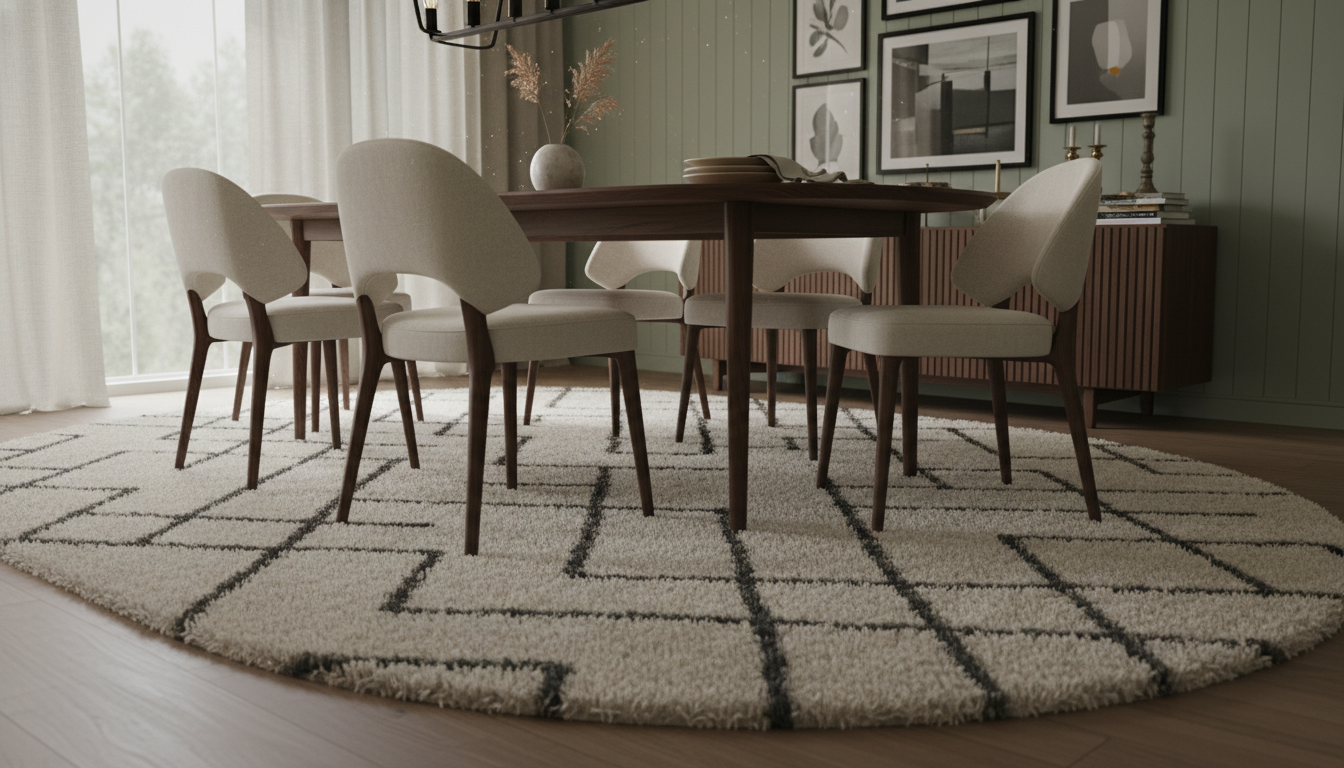
Open-concept living often suffers from a lack of identity. In an Austin new-build, the dining table sat awkwardly between the kitchen island and the living area. A traditional rectangular rug felt like it was cutting the room in half.
Designers opted for an oversized oval rug crafted from a 2026-favorite: a blend of jute and sustainable Bio-Acetate fibers for a silk-like sheen. The oval shape mirrored the rounded edges of the walnut dining table, creating a cohesive “island” of furniture. Because the rug didn’t have sharp corners, it didn’t impede the natural walking path (the “flow”) from the kitchen to the patio, making the entire floor plan feel more fluid.
3. The Savannah Sanctuary: Organic Shapes for Deep Rest
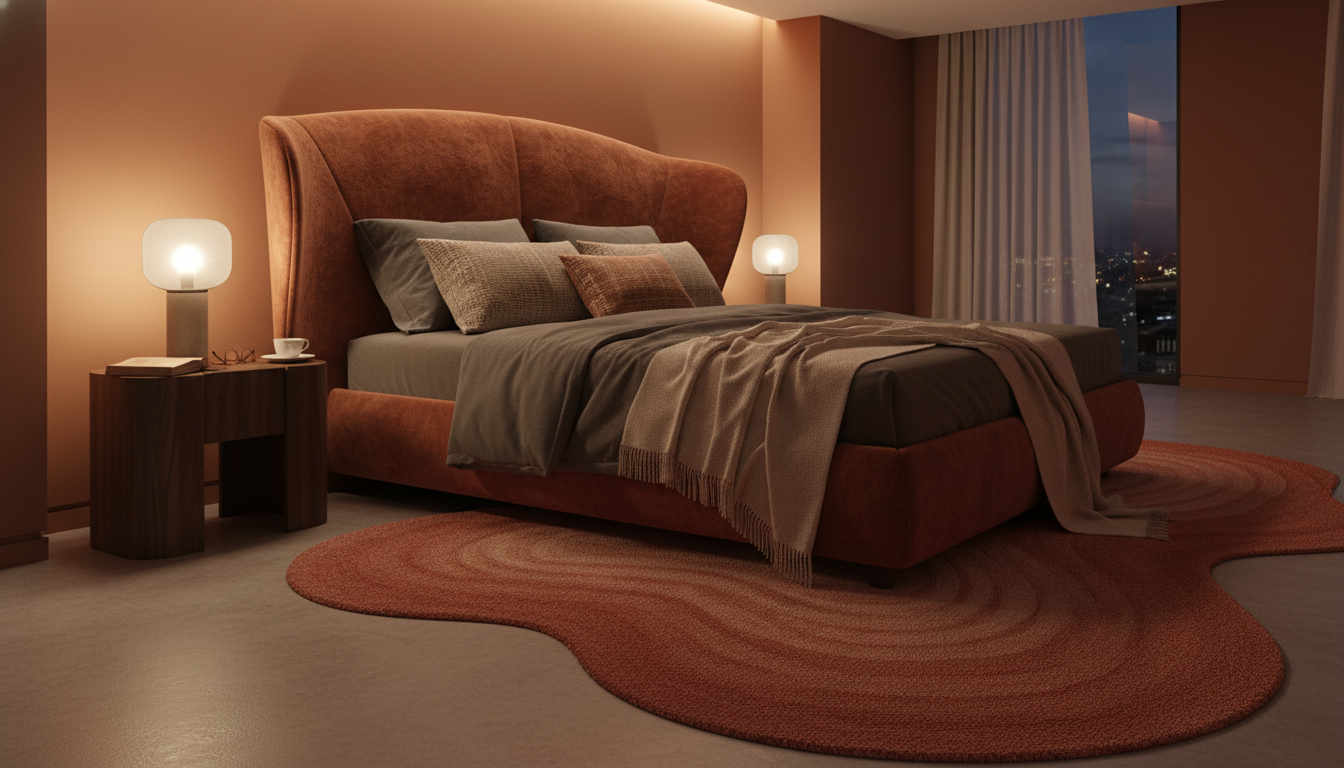
In a bedroom featuring deep Sage Green walls (a moody LRV of 32) and a curved velvet headboard, a standard rug felt too formal. The goal was “biophilic comfort.”
We introduced a freeform, organic-shaped rug from thebohorugs.com that looked almost like a large, soft river stone. Positioned partially under one side of the bed and extending out into the room, it broke the symmetry of the space. This “asymmetrical grounding” is a major 2026 trend. It provides a soft landing for feet in the morning while echoing the natural, unstudied beauty of the Atlas Mountains’ hand-knotted traditions.
“We are seeing a massive departure from ‘centered’ living. In 2026, the most sophisticated rooms use organic rug shapes to lead the eye toward windows or architectural quirks, rather than just pointing at the television.”
— Elena Vance, Lead Designer at Studio Curv
4. The Chicago Reading Nook: The Power of the Zone
A transitionary corner in a high-rise apartment often becomes a “dead zone.” Here, a single cognac leather armchair and a floor lamp felt isolated against the neutral walls.
A medium-sized (6-foot) round rug in a high-pile oatmeal shag transformed the corner into a destination. By centering the chair on the rug, the furniture suddenly had a “reason” to be there. The circle acted as a visual anchor, creating a room-within-a-room. This is a masterclass in using scale to create intimacy—the rug doesn’t need to be big; it just needs to be bold enough to claim the space.
5. The Suburbia Reimagined: Layering Curves Over Tradition
Large family rooms with L-shaped sectionals are notoriously difficult to rug. A rectangle big enough to fit a sectional often swallows the room. In this Dallas home, the designer used a layering trick that will dominate 2026 styling.
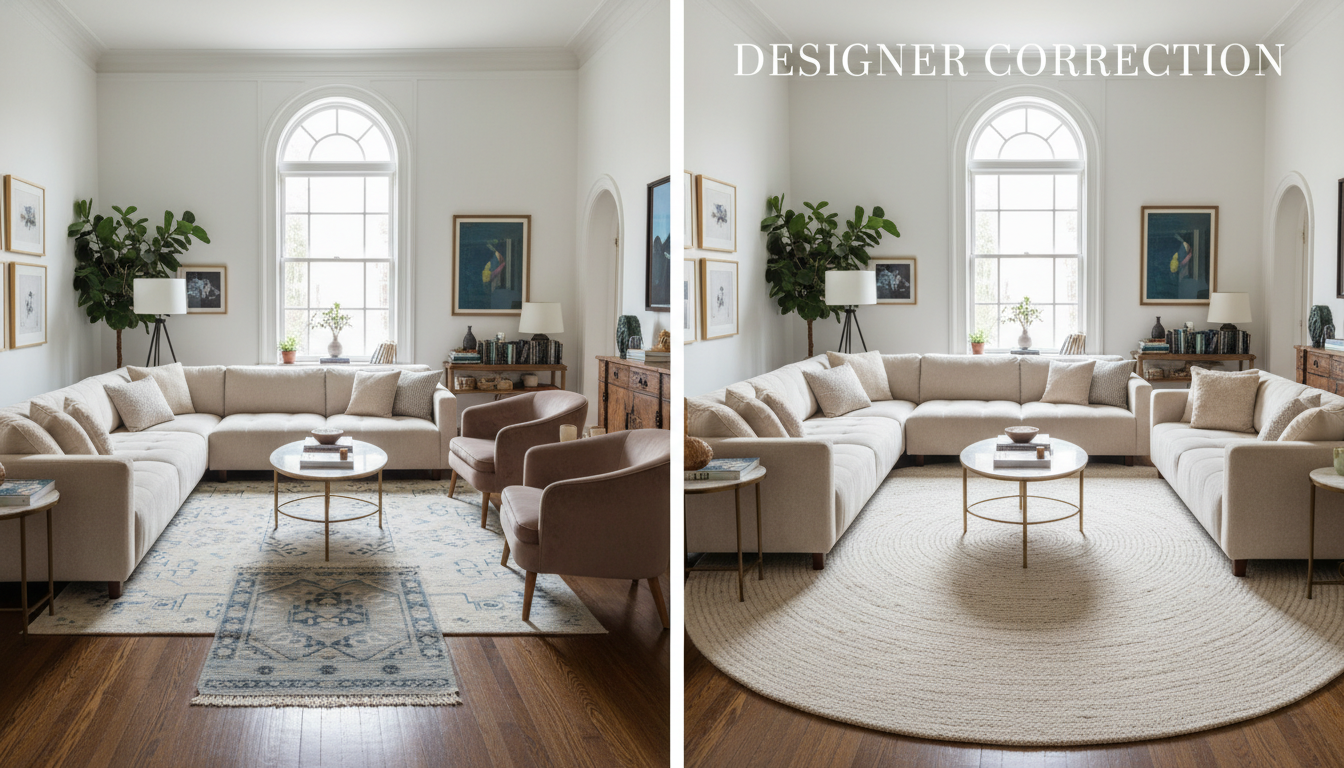
They started with a low-profile, wall-to-wall neutral sisal. On top, they layered a 7-foot round rug with a subtle, tonal sunburst pattern. The round rug was tucked into the “L” of the sectional, creating a focal point for the coffee table. This added visual depth and a “designer touch” that made the mass-market sectional look like a custom piece of furniture.
6. The Indoor-Outdoor Flux: Blurring the Balcony Line
Modern architecture in 2026 often features floor-to-ceiling sliding glass doors. In this Los Angeles condo, the living room opened onto a small curved balcony.
To create a seamless transition, the owners chose two identical round performance rugs—one inside and one outside. The circular shape repeated the curve of the balcony railing. Because round rugs lack a “directional” weave, they don’t lead the eye in a straight line out the door; instead, they make the indoor and outdoor spaces feel like one continuous lounge. Using UV-stabilized recycled PET yarns ensured the colors stayed vibrant despite the heavy California sun.
7. The Portland Creative Studio: Minimalist Focus
For a home office with white walls and a floating oak desk, a rectangular rug felt too much like a “cubicle.” The creative professional living here wanted a space that felt like a gallery.
They selected a round rug with a Bauhaus-inspired geometric pattern in muted terracotta and slate. By placing the desk half-on and half-off the rug, they created a sense of movement. The rug didn’t just sit there; it interacted with the furniture. The circular lines helped to break the monotony of long work hours, providing a visual “recharge” every time they looked down.
8. The London Lounge: Mastering Maximalism
Maximalism in 2026 is about “controlled chaos.” In a South Kensington flat filled with patterned wallpaper, velvet curtains, and antique find, a rectangular rug would have competed with the wall lines.
An organic-shaped rug in a deep, monochromatic navy was the anchor. The irregular, hand-cut edges of the rug felt like an art installation. By keeping the rug a solid (but deeply textured) color, it provided a “resting place” for the eye amidst the surrounding patterns. This demonstrates how an organic shape can actually bring order to a busy room by acting as a soft, sculptural foundation that doesn’t demand the same alignment as a grid-based rug.
Whether you are trying to fix a cramped layout or simply want to soften the atmosphere of a modern build, these examples prove that the “right” rug is often the one that breaks the mold. You can explore these artisanal silhouettes and find your own perfect anchor at thebohorugs.com.
Architectural Harmony: Matching Rug Undertones to Your Palette
The Science of Light Reflectance and Pigment Depth
To master this, you must look beyond the primary color of the rug. Every textile has a “hidden” undertone—usually a tertiary pigment like a bruised violet, a warm peach, or a cool slate gray. Designers in 2026 are increasingly focused on **Light Reflectance Values (LRV)**. If your walls are a high-LRV “Cloud White” (reflecting more light), a round rug in a dense, low-LRV “Misty Obsidian” or “Deep Cedar” creates a grounding weight that prevents the room from feeling like it’s floating. When choosing a piece from thebohorugs.com, pay attention to the fiber’s reaction to light. **Bio-Acetate blends** and hand-spun wools often have a multi-tonal quality. A rug that looks “beige” at noon might reveal a subtle sage green undertone at dusk. You want that green to harmonize with the pigments in your wall paint—perhaps a “Dusty Eucalyptus” or a “Warm Limestone”—rather than fight against it.Balancing Warm and Cool Architectural Elements
The most successful 2026 interiors play with temperature contrast to create depth. If your room features cool-toned architectural elements—such as polished concrete floors, steel window frames, or “Nordic Ice” walls—an organic-shaped rug in a warm, earthy palette like **Desert Clay** or **Toasted Honey** provides much-needed soul. The curve of the rug softens the “industrial” chill, while the warm undertones make the hard surfaces feel intentional rather than sterile. Conversely, if you are styling a room with warm oak flooring and “Parchment” walls, a round rug with cool, silvery undertones can prevent the space from looking “muddy.” This push-and-pull of temperature is what gives a room that elusive, high-end designer feel.“We are seeing a massive shift toward ‘Living Neutrals’—colors that change based on their environment. A round rug acts as a color anchor; it pulls the surrounding wall tones toward it. If you choose a rug with a subtle blue undertone for a room with gray walls, you’ll suddenly see those walls transform into a sophisticated slate. It’s about chemical harmony, not just visual matching.”
— Julian Thorne, Senior Textile Historian & Color Consultant
Before committing to a large-scale organic rug, pin your wall paint swatches and a sample of your sofa fabric to a board. Take this board to the space where the rug will live. Watch how the light hits the floor at 4:00 PM. If your wall color has a yellow base and your rug has a pink-red base (common in many “terracotta” styles), the room will feel vibrating and unsettled. Aim for “sister” undertones—colors that share a common base pigment—to ensure the round shape feels like a natural extension of the architecture.
The Role of Texture in Color Perception
Remember that texture alters how we perceive color. A high-pile, hand-knotted rug from the **Atlas Mountains** will absorb more light, making its colors appear deeper and richer. A flat-weave organic rug will reflect more light, making its undertones appear sharper and more dominant. When styling your space, use the rounded perimeter of the rug to “frame” the floor color. The gap between the edge of a round rug and the baseboards is where the architectural harmony is won or lost. Ensure the floor’s undertone (the orange in honey oak or the blue in gray laminate) doesn’t clash with the rug’s primary “bleed” color.The ‘Bullseye’ Pitfall: Avoiding Poor Centering
The Floating Island vs. The Grounded Anchor
The most common misstep I see in high-end residential projects isn’t the choice of the rug itself, but rather the “Bullseye Effect.” This happens when a round rug is placed dead-center in a room without any relationship to the furniture surrounding it. In the design world, we call this a “floating island”—it feels untethered, making the room feel fragmented rather than cohesive. In 2026, the trend has shifted toward Fluid Geometry, where the rug acts as a gravitational pull for your furniture, not just a decorative dot in the middle of the floor.
To avoid the bullseye look, you must break the urge for perfect architectural symmetry. Instead of centering the rug to the walls, center it to the primary seating group. If you’re styling a curved sofa—perhaps one upholstered in a high-LRV (Light Reflectance Value) cream bouclé—the rug should tuck under the front third of the piece. This creates a sense of “visual gravity” that keeps the eye moving across the room rather than getting stuck in a circular loop at the center of the parquet.
Mastering the “Off-Axis” Alignment
When working with the artisanal, hand-knotted pieces found at thebohorugs.com, designers are increasingly opting for an off-axis placement. This involves intentional overlapping. For instance, in a minimalist primary suite with a Light Reflectance Value of 65 (a soft, airy sage or mist), a round rug shouldn’t just sit at the foot of the bed. It should be skewed slightly to one side, perhaps layered under a single lounge chair and a portion of the bed frame. This breaks the “target” visual and makes the organic shape feel like a natural extension of the architecture.
“The secret to 2026 styling is treating the round rug as a sculptural element rather than a floor covering. By pulling the rug off-center and allowing furniture to ‘bite’ into its perimeter, you create a spatial rhythm that feels curated rather than staged.”
— Elena Moretti, Lead Textile Historian & Interior Consultant
Beyond the placement, consider the material’s interaction with light. We are seeing a massive surge in Bio-Acetate and Silk-blended fibers that offer a subtle sheen. When these rugs are centered poorly, the light hits them uniformly, which can look flat. However, when tucked partially under a heavy walnut coffee table or a velvet chaise, the varying heights create shadows and highlights that emphasize the rug’s premium texture and “hand-carved” pile depths.
To ensure your round rug feels integrated, aim for at least 30% of its surface area to be covered by furniture. Whether it’s the legs of a dining chair or the corner of a sectional, this overlap anchors the rug and prevents it from appearing as if it’s drifting away. For organic shapes, increase this to 40% to ground the irregular edges against the room’s straight lines.
If you find yourself struggling with a room that feels “stiff,” the fix is rarely a different color—it’s a change in orientation. Try rotating the rug fifteen degrees or pulling it six inches further under the sofa. You’ll notice the room’s energy shifts immediately. This approach is particularly effective with the regenerative wool collections seen this season, where the natural variations in the yarn demand a more relaxed, asymmetric arrangement to truly shine.
Elevate Your Space
Discover the artistry of handmade luxury. Each rug is a masterpiece of tradition and modern design.
Expert Q&A
What size round rug do I need for a living room with a sectional?
For a sectional, look for a round rug with a diameter of at least 8 to 10 feet. The curve should tuck under the ‘L’ of the sofa and extend far enough to ground the coffee table and any opposing armchairs.
Can I put a round rug in a square room?
Yes, a round rug is actually one of the best ways to soften the harsh geometry of a square room. It breaks the visual monotony and makes the space feel more fluid and less boxed-in.
Does a round rug work under a rectangular dining table?
While it can be done for an avant-garde look, it is generally recommended to pair round rugs with round or oval tables. For a rectangular table, an oval rug is a more sophisticated choice that mirrors the table’s length while softening the corners.
How do I style a round rug in a small apartment entry?
Choose a round rug that leaves at least 6 inches of floor space visible around the perimeter. This creates a ‘halo’ effect that makes the entryway feel intentional and larger than it is.
Are organic, freeform rugs harder to clean than circles?
The shape does not affect cleanability, but the edges might. Ensure your vacuum has a height adjustment for the varied pile heights often found in organic-shaped 2026 rug designs.
Can I layer two round rugs on top of each other?
This is a high-level designer trick. Use two different sizes and textures (e.g., a large flat-weave sisal and a smaller offset sheepskin) to create a sculptural, tiered look.
How do I stop a round rug from curling at the edges?
Use a high-quality, custom-cut round rug pad that is roughly 1 inch smaller than the rug. For thinner rugs, silicone corner grippers applied along the curve are highly effective.
Do round rugs look good on top of carpet?
Absolutely. A round rug can define a seating area within a larger carpeted room. Use a ‘carpet-to-carpet’ grip pad to prevent the rug from shifting or ‘walking’ across the room.
What is the best material for a round rug in 2026?
Sustainability is key in 2026. Look for Tencel, recycled wool, or organic cotton blends that offer a soft sheen and high durability while maintaining the rug’s structural curve.
Should a round rug be centered in the room or on the furniture?
Always prioritize centering the rug on the main furniture grouping (like the coffee table or the bed) rather than the center of the room’s floor space.
Written by TheBohoRugs Interior Design Team
Experts in handmade rugs, boho interiors, and modern home decor.
