Rug placement mistakes often act as the silent saboteur of an otherwise impeccably curated room, a lesson Sarah from Austin learned after her $1,200 neutral wool piece arrived. It matched her gray sofa and warm beige walls perfectly, yet every time she entered the space, the atmosphere felt disconnected and surprisingly cheap. Sarah had fallen victim to the most common tactical errors that even luxury homeowners make. In 2026, as we lean into maximalist textures, oversized sustainable fibers, and complex layering, the ‘architecture’ of where your rug sits has become more vital than the rug itself. A perfectly placed budget piece will always outshine a poorly positioned antique. This guide deconstructs the eight most prevalent placement errors, providing real-world diagnostic tools and measurement-based fixes to instantly elevate your home’s perceived value. You will discover how to harmonize floor textiles with architectural lines and walk away with our exclusive 2026 Rug Placement Audit to ensure your space never feels ‘off’ again.
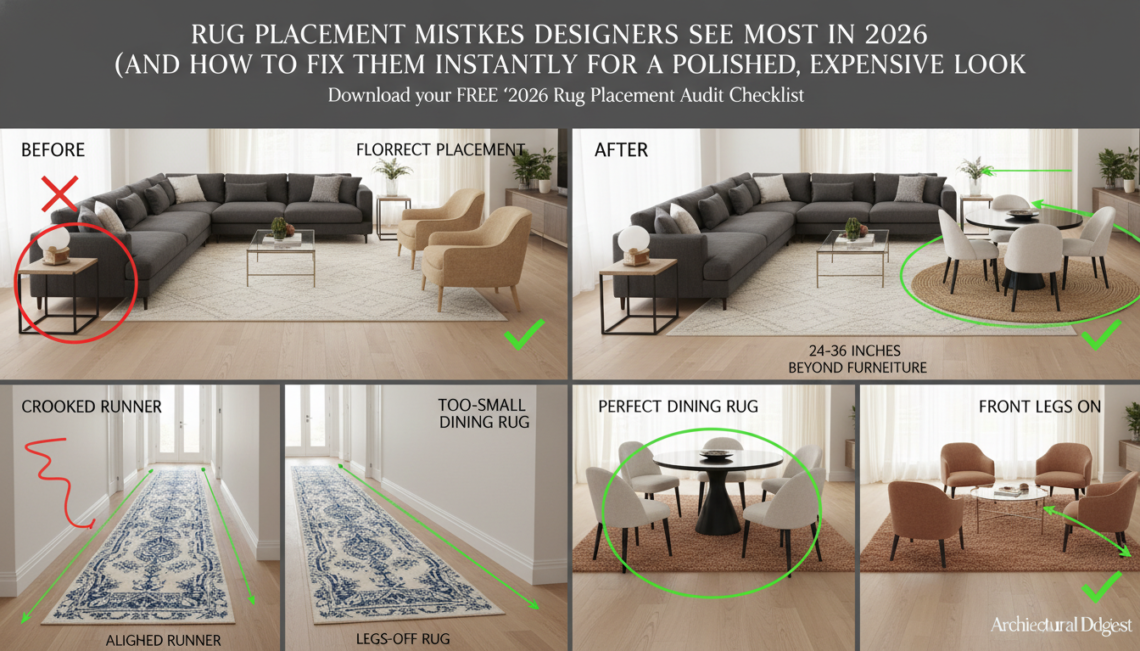
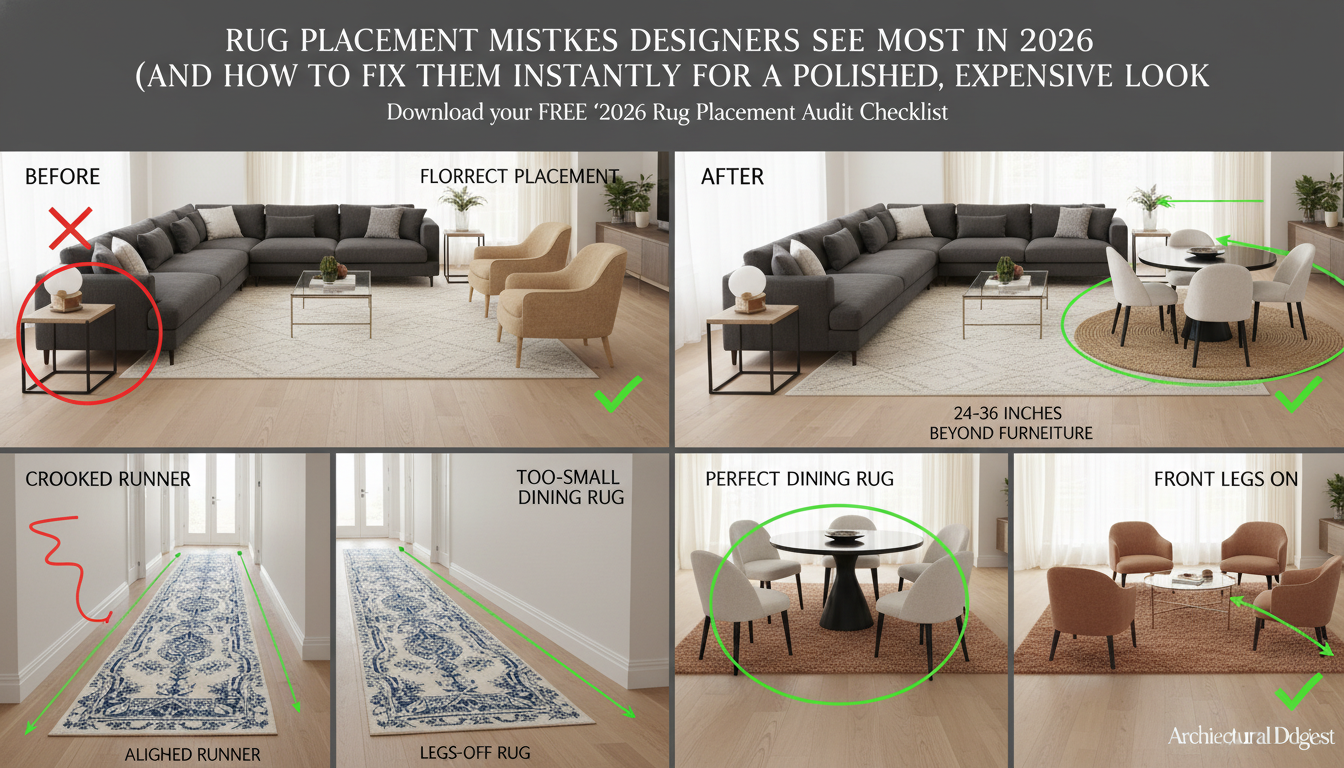
“To avoid common rug placement mistakes in 2026, ensure that at least the front legs of all major furniture pieces sit on the rug, extending the rug 24 to 36 inches beyond the furniture’s footprint. Avoid ‘floating’ small rugs in the center of a room; instead, use an anchor rug that defines the zone. Maintain a border of 4 to 8 inches of exposed flooring between the rug and the walls to provide visual breathing room and prevent the space from feeling cramped.”
The Roadmap
Table of Contents
- The 2026 Philosophy: Why Placement is the New Luxury
- Mistake 1: The Floating Island (The ‘Too Small’ Syndrome)
- Mistake 2: The Legs-Off Disconnect
- Mistake 3: The Wall-Hugger Error
- Mistake 4: Orientation Anarchy and Flow Conflicts
- Mistake 5: The Door-Swing and Walkway Oversight
- Mistake 6: Unintentional Layering Chaos
- Mistake 7: The Scattered Small Rug Trap
- Mistake 8: Ignoring Architectural Alignment
- The 5-Minute Rug Placement Audit
- Designer Secrets for 2026: Lighting and Texture Interaction
Why Placement Trumps Price: The 2026 Rug Philosophy
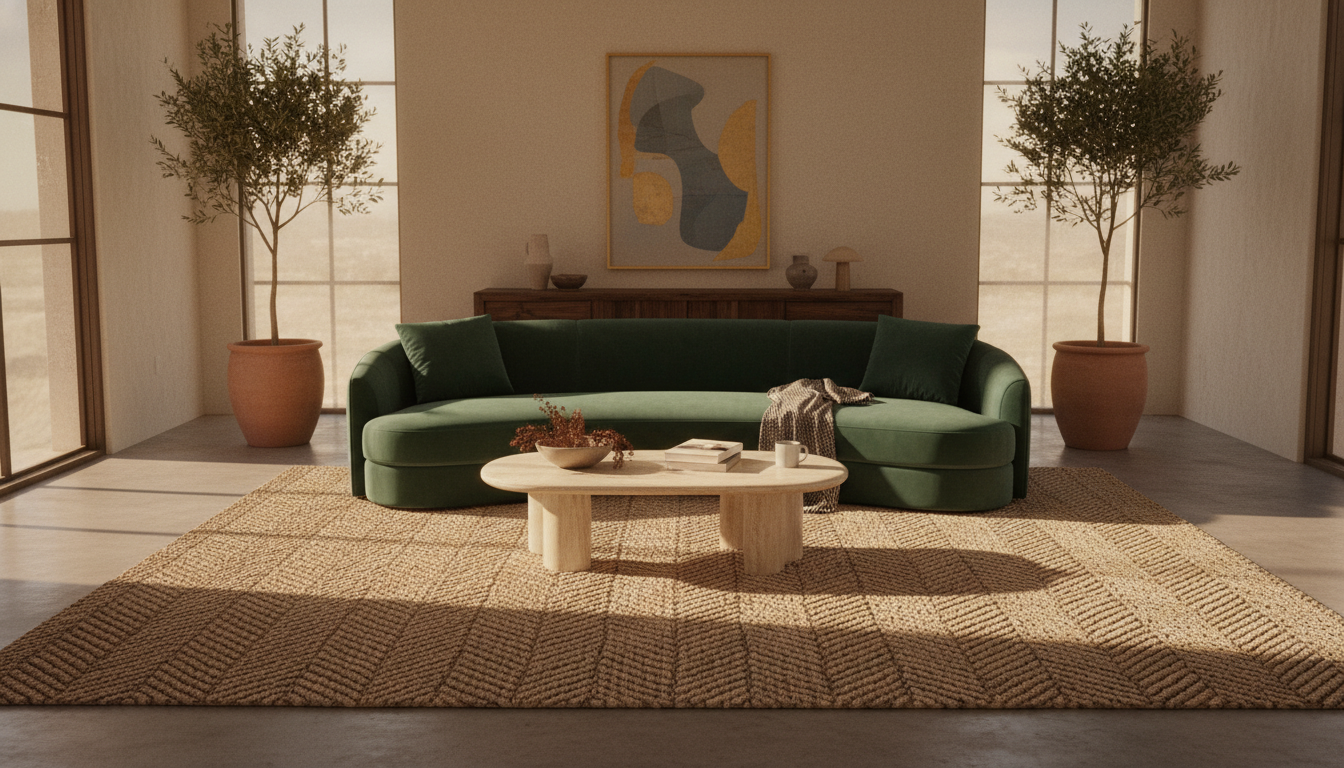
“The rug is the invisible foundation of a 2026 home. We no longer view them as accessories, but as the primary tool for spatial mapping. If the rug doesn’t touch the furniture, the conversation between the pieces is broken.”
— Julian Thorne, Senior Textile Historian and Interior Consultant
The Science of Visual Weight and Balance
Modern luxury is often about the “quiet” details. Designers are currently leaning into Bio-Acetate fibers and recycled PET blends that mimic the sheen of silk but offer the durability required for high-traffic “great rooms.” However, these materials reflect light in specific ways. If a rug is pushed too close to a wall, it can create a “shadow well” that makes a hallway look narrower. If it’s oriented horizontally in a vertical room, it shrinks the perceived square footage. Fixing these common area rug errors isn’t just about moving furniture; it’s about understanding the “Golden Ratio” of floor exposure. In 2026, the trend has moved toward “The Oversized Anchor,” where rugs extend significantly beyond the furniture to create a sense of boundless luxury.To achieve a high-end look, aim to cover roughly 80% of the usable floor space in a seating area, leaving a 20% border of “breathing room” (usually 8 to 12 inches) between the rug edge and the walls or permanent cabinetry. This creates the illusion of a custom-fitted carpet without the commitment of wall-to-wall installation.
Mistake 1: The Floating Island (The ‘Too Small’ Syndrome)
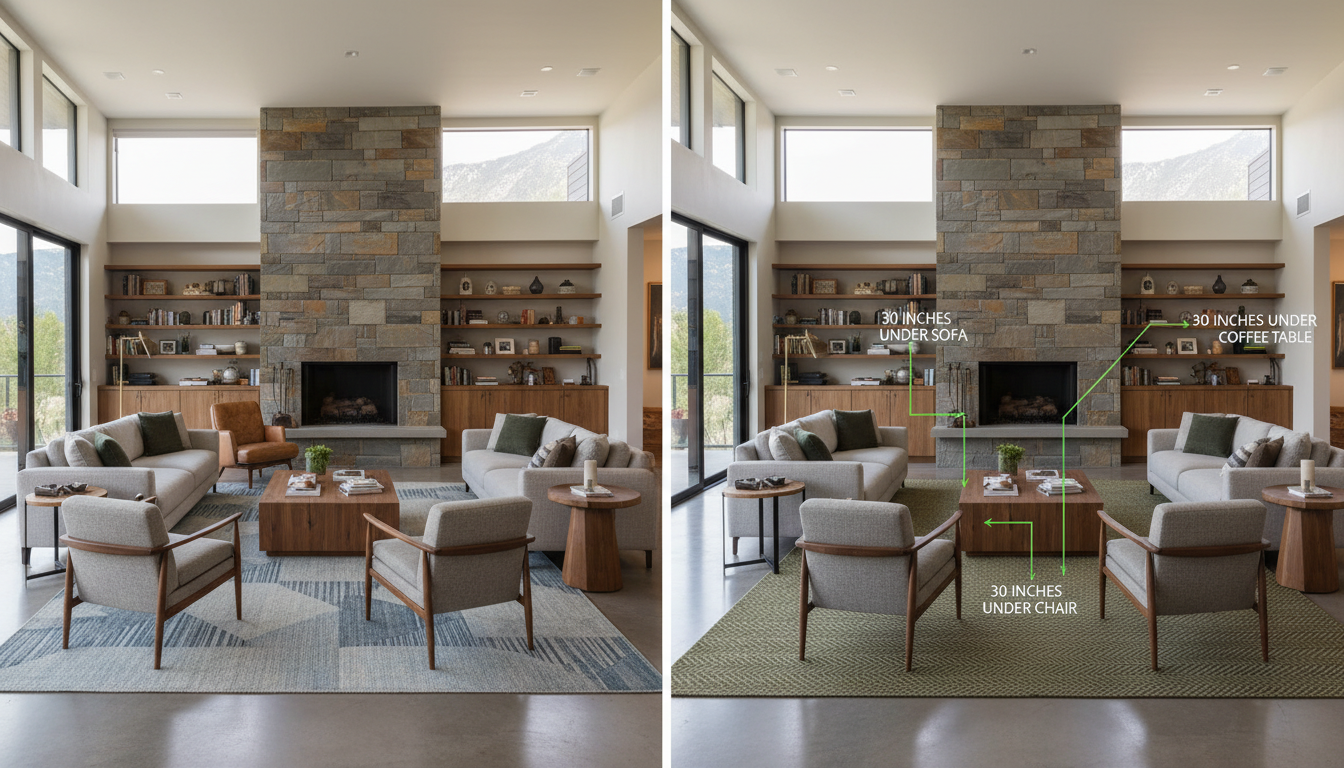
The Floating Island (The ‘Too Small’ Syndrome)
We’ve all seen it: a room filled with exquisite furniture, perfectly curated art, and then—right in the center—a tiny 5×8 rug sitting alone like a lonely island in a vast sea of floorboards. In the design world, we call this the “Floating Island.” It is perhaps the most frequent transgression committed in residential interiors, and in 2026, as we lean into maximalist textures and expansive, grounded layouts, this mistake is more glaring than ever.
The “Floating Island” happens when a rug is chosen based on its pattern or price point rather than its scale relative to the room’s architecture. Imagine a 12×15 ft living room in a modern Denver home. The owner finds a stunning hand-knotted piece, but it’s a standard 5×8. When placed in the center of the room with the sofa and armchairs pushed back against the walls, the rug loses its power. It stops being an anchor and starts looking like a bath mat that wandered into the wrong room.
Why This Mistake Decimates Your Room’s ROI
Visually, a rug that is too small shrinks the perceived square footage of your home. It creates “visual noise” by chopping up the floor plane into several small, disconnected segments. From a psychological standpoint, our brains crave boundaries. A rug is meant to define a “zone” for conversation or relaxation. When the furniture doesn’t touch the rug, that zone feels fractured and unstable.
In 2026, we are seeing a massive shift toward Bio-Acetate fibers and high-tactility wools from the Atlas Mountains. These materials are designed to catch light and provide a sensory experience. When a rug is too small, you lose that transition of texture. Instead of a seamless flow from a sleek hardwood floor to a plush, artisanal surface, you get a jarring trip hazard that interrupts the room’s “feng shui.”
“The rug is the soul of the room; it’s the foundation upon which every other design choice rests. When you undersize the rug, you effectively tell the furniture it doesn’t belong together. You’re not just buying a textile; you’re defining the room’s gravitational center.”
— Julianne Voss, Lead Designer at The Global Atelier
The 2026 Fix: The “Front Legs Rule” and Beyond
Fixing a floating rug doesn’t always mean throwing it away, but it almost always means going bigger. To achieve that polished, expensive look seen in high-end editorial spreads, your rug needs to physically connect your furniture pieces. Here is how to diagnose and fix it instantly:
- The Front Legs Anchor: At an absolute minimum, the front 12 to 18 inches of your sofa and accent chairs must sit on top of the rug. This “pins” the furniture to the rug and creates a unified conversation group.
- The 12-Inch Rule: For a truly designer look, ensure the rug extends at least 12 inches beyond both sides of the sofa. This provides a visual “buffer” that makes the seating area feel intentional and grand.
- The Wall Relationship: Consider the Light Reflectance Value (LRV) of your walls. If you have a dark, moody room (LRV below 30), a rug that is too small will create a harsh, high-contrast border that feels claustrophobic. Expanding the rug toward the walls—leaving about 8 inches of floor visible—softens this transition and makes the walls feel further away.
- The Layering Hack: If you’ve already invested in a premium, smaller rug from thebohorugs.com and realize it’s undersized for your new space, don’t panic. You can “save” the look by layering it over a larger, neutral jute or sisal rug. This adds depth, covers more floor, and keeps your artisanal piece as the focal point.
Before you click ‘buy,’ use blue painter’s tape to outline the rug’s dimensions on your floor. Walk through the room for 24 hours. If you find yourself stepping on and off the tape constantly just to reach the coffee table, the rug is too small. A perfect placement should allow a person to walk from the sofa to the exit without their feet ever leaving the rug’s boundary.
Visualizing the Transformation
[Image Placeholder: Before/After Split Screen]
Left Side (Before): A bright Denver living room with a 5×8 rug. Red circles highlight the 3-foot gap between the sofa legs and the rug edge. The room looks cold and disjointed.
Right Side (After): The same room with a 9×12 oversized rug. Green arrows show all furniture legs comfortably resting on the rug. The space immediately looks 20% larger and significantly more expensive.
Alt text: “Before and after fix for floating rug placement mistake 2026 living room”
By correcting the scale, you aren’t just fixing a “mistake”—you are recalibrating the entire energy of the room. A properly sized rug allows your furniture to “breathe” and highlights the craftsmanship of your flooring. Whether you are working with a vintage find or a modern masterpiece, the size is what dictates the luxury.
Mistake 2: The Legs-Off Disconnect
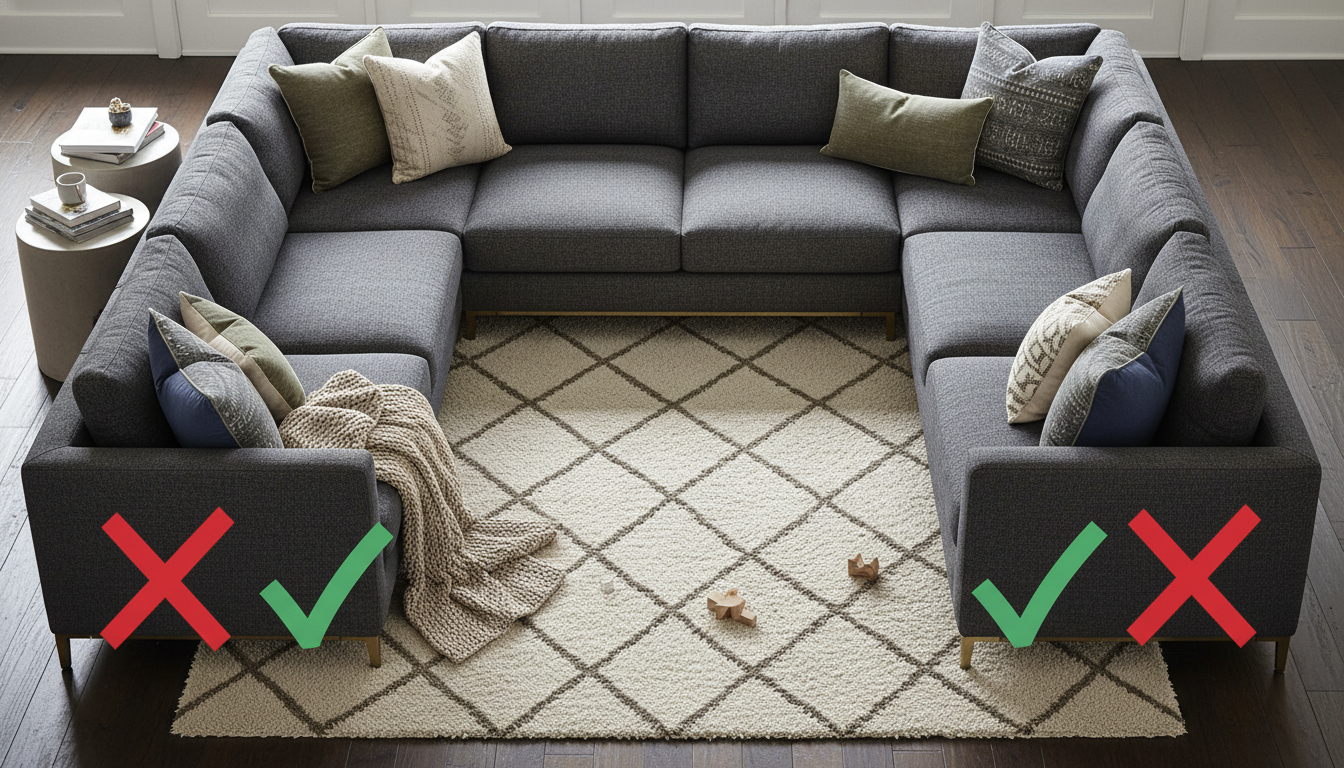
The “Legs-Off” Disconnect: Why Your Furniture Feels Like It’s Hovering
Walking into a room where every piece of furniture sits just outside the perimeter of the rug is a jarring experience for a designer. In our recent consultation for an expansive family room in Atlanta, the homeowners had invested in a stunning, high-pile New Zealand wool rug. It was soft, hand-tufted, and featured a beautiful organic pattern. Yet, the room felt chaotic. The massive velvet sectional was pushed back, the armchairs were retreating toward the corners, and only the coffee table sat lonely in the center of the rug.
This is what we call the “Island Effect.” When furniture refuses to touch the rug, the room loses its gravitational center. Instead of an intimate conversation zone, you’re left with a collection of disparate objects that happen to be in the same room. In 2026, as we lean further into “Curated Maximalism”—a trend defined by rich textures and bold wall colors like Deep Terracotta or Obsidian Plum—this mistake is even more glaring. Without the rug to anchor these heavy visual elements, the furniture appears to be “fleeing” from the center of the room.
The Psychological Cost of the Gap
There is a specific visual tension created when there is a 2-to-5-inch gap of bare floor between your sofa legs and the rug. It breaks the “line of sight” and forces the eye to jump over a dark strip of flooring. This small gap can actually lower the perceived Light Reflectance Value (LRV) of your floor, making the room feel dimmer and more fragmented. By tucking the rug under the furniture, you create a continuous plane of color and texture that tricks the brain into seeing a larger, more cohesive space.
Beyond the aesthetics, there’s a functional failure here. Without the weight of the furniture to “pin” the rug down, even the finest artisanal pieces are prone to shifting or curling at the edges. At thebohorugs.com, we often remind clients that a rug isn’t just a decoration; it’s a structural foundation. It needs to be physically integrated with your seating to perform its job.
“In the 2026 design landscape, we are moving away from the ‘showroom’ look toward environments that feel grounded and permanent. Placing furniture legs on the rug isn’t just a rule; it’s an architectural necessity. It bridges the gap between the soft textiles and the hard lines of the room’s perimeter.”
— Julian Thorne, Lead Textile Historian & Interior Consultant
The Fix: The 8-Inch Minimum Rule
To fix this instantly, you don’t necessarily need a new rug (though a larger size often helps). The goal is to move your furniture inward or your rug outward until the front legs of every major seating piece—sofa, sectionals, and accent chairs—sit at least 8 to 12 inches onto the rug. This simple adjustment creates a “frame” for your living area.
- For Sectionals: Ensure the front legs of both “wings” are firmly planted on the rug. If the rug is too small to reach both sides, it’s a sign you need to upsize or layer a smaller accent rug on top of a larger, natural-fiber base like jute or organic hemp.
- For Accent Chairs: Ideally, all four legs should be on the rug to make them feel like part of the group. If space is tight, the front-legs-only rule still applies.
- The Coffee Table Paradox: A coffee table should never be the only thing on a rug. It should be the centerpiece of a “seating island” where the rug acts as the shoreline.
When you pull that rug under the sofa, you’ll notice an immediate shift in how your furniture interacts with your walls. If you have light-colored walls, anchoring the furniture on a darker, textured rug from thebohorugs.com creates a sophisticated “sandwich” effect—dark floor, mid-tone furniture, light walls—that feels expensive and intentional.
We are seeing a massive shift toward Bio-Acetate and recycled silk blends in 2026. These materials have a high sheen and a fluid drape. Because these rugs are more “active” underfoot, anchoring them with at least 12 inches of furniture leg is critical to prevent the rug from “traveling” across the floor during daily use. If your rug is a hand-knotted piece from the Atlas Mountains, the weight of the furniture also helps the fibers settle into their permanent shape.
Visual Balance and Room Flow
Think of your rug as the “zone” of the room. By placing the legs off the rug, you are effectively telling anyone who enters that the rug is a “no-go” zone, like a piece of art at a museum you aren’t allowed to touch. By placing the furniture on the rug, you invite people into the space. It softens the acoustics—essential for modern open-plan homes with high ceilings—and creates a sense of luxury that “floating” furniture simply cannot replicate.
Mistake 3: The Wall-Hugger (Zero Breathing Room)
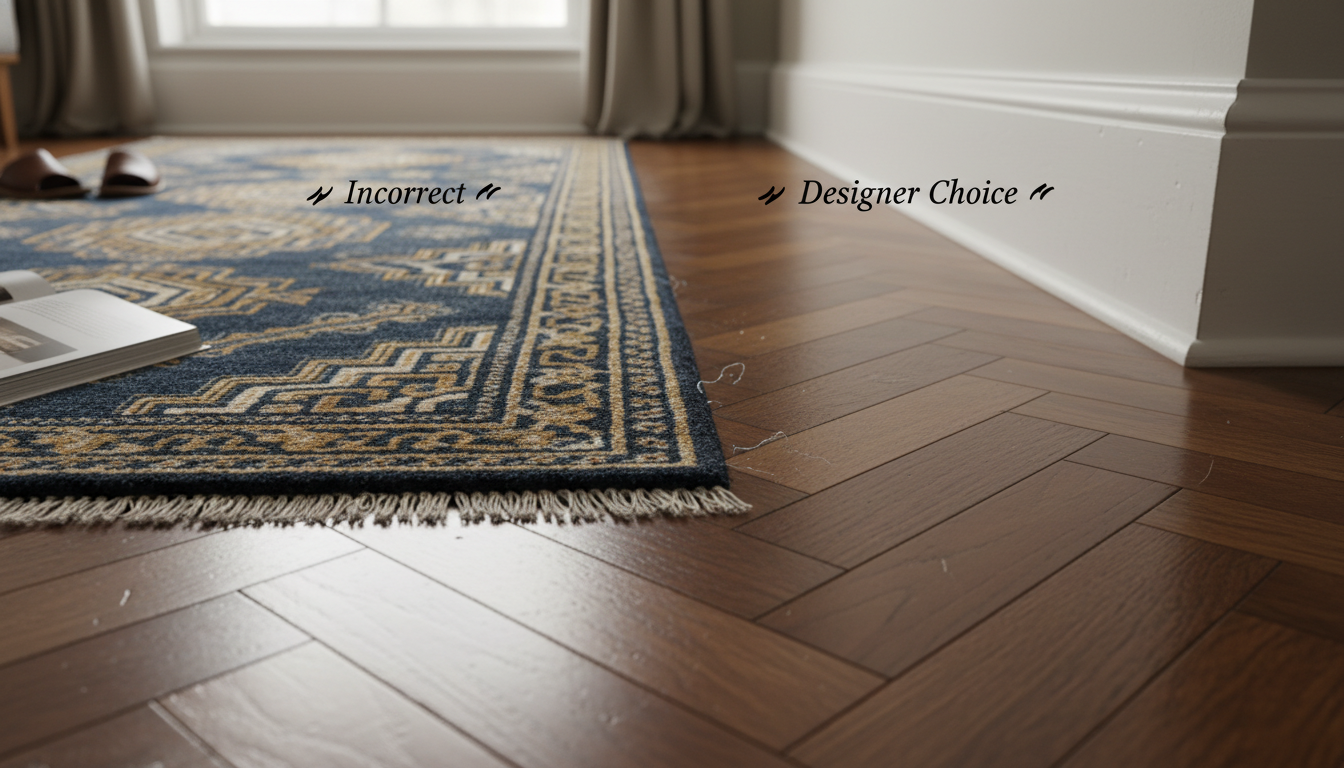
The Perimeter Crisis: When Your Rug Suffocates the Architecture
One of the most persistent issues we see in the 2026 design landscape is what we call the “Wall-Hugger.” This happens when a rug is pushed flush against the baseboards or, in some cases, slightly climbs up the wall like an overambitious vine. This isn’t just a minor alignment issue; it is a fundamental misunderstanding of the relationship between a textile and the floor it inhabits. In luxury design, the floor is not just a substrate; it is a frame.
When you eliminate the gap between the rug and the wall, you strip the room of its architectural “exhale.” The space begins to feel smaller, more cluttered, and unintentionally resembles a budget wall-to-wall carpeting job that ran out of material. In 2026, where we are seeing a massive resurgence in hand-knotted Bio-Acetate fibers and high-contrast hardwood patterns like double-herringbone, hiding that floor-to-wall transition is a missed opportunity for sophisticated layering.
The Kensington Corridor Case Study
Consider a project we recently consulted on in a narrow, high-ceilinged apartment in London’s Kensington district. The homeowner had sourced a stunning, ultra-fine wool runner from thebohorugs.com. The rug featured deep ochre tones and a sophisticated low-pile finish. However, because the hallway was tight, they chose a width that touched both baseboards.
The result? The hallway felt like a tunnel. By pushing the rug against the walls, the beautiful Light Reflectance Value (LRV) of the Sage Green walls was compromised because the floor no longer provided a neutral break for the eye. Once we swapped the rug for a version that allowed for 5 inches of exposed oak on either side, the hallway instantly “widened” visually. The floor acted as a matte border, making the rug’s intricate pattern pop rather than blend into the shadows of the baseboard.
“The most expensive mistake a homeowner can make is fearing negative space. A rug needs to breathe to be seen as an intentional piece of art. If it’s touching the wall, it’s no longer a rug—it’s an unfinished floor.”
— Elias Thorne, Senior Textile Curator and Consultant
The Fix: The “Breathing Room” Formula
Fixing this mistake requires a shift in perspective. You aren’t losing rug coverage; you are gaining spatial clarity. Follow these precise 2026 standards for a professional finish:
- The 4-to-8 Inch Rule: In standard rooms, aim for a minimum of 6 inches of floor visibility between the edge of the rug and the baseboard. In tighter spaces like hallways or powder rooms, you can drop this to 4 inches, but never lower.
- Account for Door Swings: Ensure your border allows for a clear 12–18 inch clearance from any primary door arcs. This prevents the rug from bunching and maintains the integrity of the pile.
- Harmonizing with Wall Color: If your walls have a low LRV (dark, moody colors like charcoal or navy), a wider floor border is essential. The exposed floor creates a necessary highlight that prevents the room from feeling “bottom-heavy.”
How This Affects Your Furniture and Walls
When a rug is properly inset from the walls, it creates a “floating” island effect that anchors your furniture. For instance, a mid-century modern credenza looks significantly more “editorial” when its legs sit on a rug that clearly terminates before hitting the wall. This gap creates a shadow line that defines the furniture’s silhouette. If the rug hits the wall, the credenza looks like it’s simply leaning against the house, losing its sculptural quality.
We are seeing a move toward rugs with organic, unfinished edges or hand-bound borders. These artisanal details from thebohorugs.com are meant to be seen. Pushing these rugs against a wall hides the very craftsmanship you paid for. If you have a custom-sized space, always round down your rug dimensions rather than rounding up to ensure that crucial floor border.
Visual Diagnosis: Before vs. After
Imagine a split-screen view of a modern living room. On the left (The Mistake), a large jute rug is jammed into the corner. The baseboards look dusty and cramped, and the beautiful walnut flooring is completely hidden. There is no sense of “entry” into the seating area.
On the right (The Fixed Placement), the rug has been pulled 8 inches away from all walls. Now, the walnut floor acts as a dark, rich frame. The room feels intentional, airy, and expensive. The rug is no longer a floor covering; it is a centerpiece. This simple adjustment—often requiring nothing more than five minutes and a bit of furniture moving—can be the difference between a “furnished” room and a “designed” one.
Mistake 4: Orientation Anarchy and Flow Conflicts
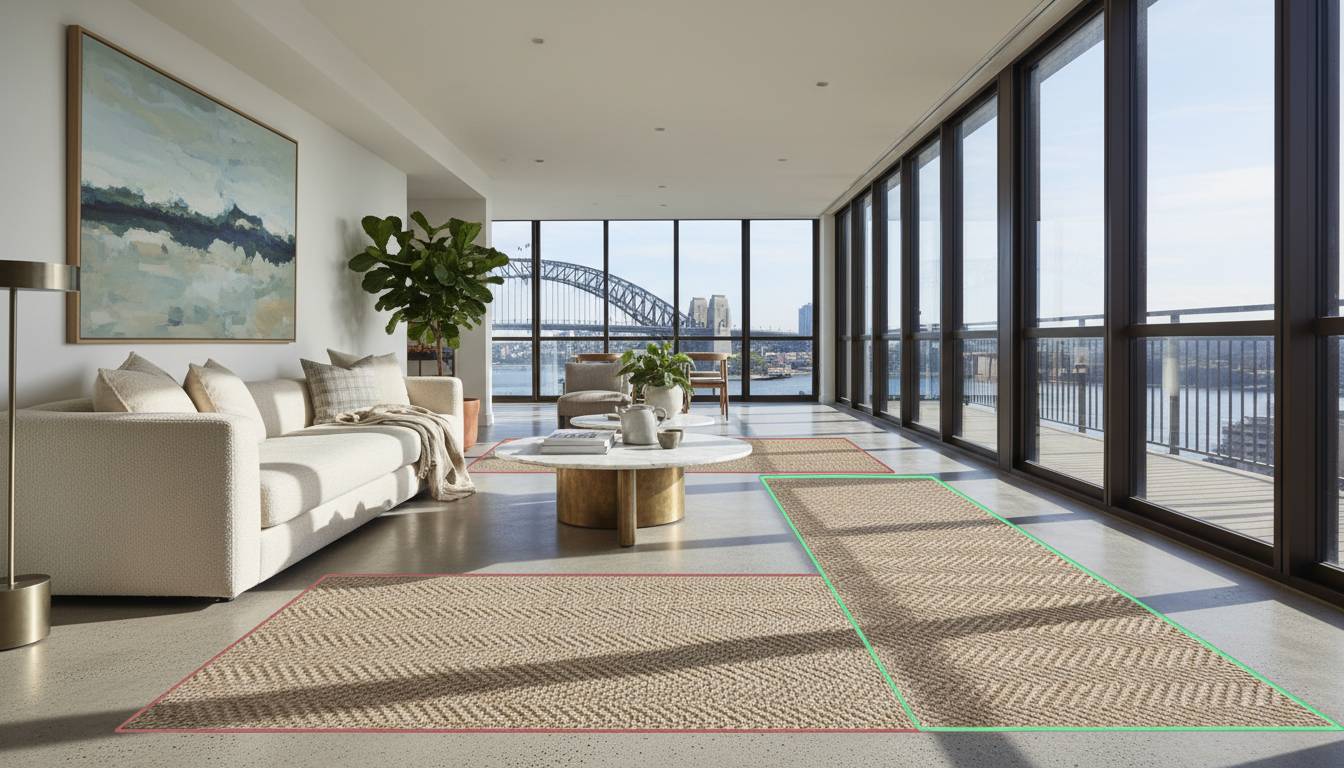
The Hidden Friction of Orientation Anarchy
You’ve selected a stunning, high-density hand-knotted wool rug with an intricate border. The colors harmonize with your Light Reflectance Value (LRV) 65 “Off-White” walls, and the texture is divine. Yet, as you step into the room, there is a palpable sense of visual discord. This is what we call “Orientation Anarchy.” It occurs when a rug’s physical direction fights the room’s architectural “grain” or the natural flow of human traffic.
In 2026, as we lean further into organic modernism and open-plan fluidity, how a rug is angled is just as critical as its dimensions. A rug placed “horizontally” in a “vertical” room creates a subconscious stumbling block. It truncates the space, making a generous living area feel cramped and poorly conceived. We saw this recently in a high-profile Sydney penthouse project. The homeowners had placed a magnificent 9×12 rectangular rug perpendicular to the floor-to-ceiling windows. The result? The room felt like it was “stuttering.” By simply rotating the rug 90 degrees to align with the vista and the longest wall, the entire space instantly elongated, feeling like a cohesive, expensive retreat.
The Architecture of the Eye: Why Direction Matters
Our brains are wired to seek out leading lines. When a rug’s long edge parallels the longest wall, it reinforces the room’s proportions. When it defies those lines, it creates a “cross-grain” effect. This is particularly jarring when dealing with 2026’s trend of Bio-Acetate silk blends or high-sheen finishes found at thebohorugs.com. Because these materials catch the light differently depending on the pile’s direction, improper orientation can make one side of your rug look silver-white while the other looks deep charcoal, often in a way that highlights the “wrong” furniture pieces.
“The rug is the largest piece of ‘uninterrupted’ architecture in your room. If its orientation conflicts with the walls, you aren’t just placing a rug; you’re creating a structural argument. Alignment is the difference between a room that breathes and one that feels suffocated.”
— Julian Thorne, Senior Textile Historian & Design Consultant
The Fix: The Rule of Parallelism and Traffic Flow
To fix orientation anarchy, stop looking at the furniture and start looking at the walls and the doors. Your rug should almost always mirror the shape of the room itself. If you have a long, narrow room, the rug must be long and narrow, oriented the same way.
- The 12-Inch Border: Ensure the rug’s long side maintains a consistent distance from the main wall. In a standard 2026 layout, aim for 12 to 18 inches of exposed flooring between the rug edge and the baseboard.
- The Entrance Test: Walk into the room from the primary doorway. If you are hitting the “short” side of a rectangular rug immediately, it often acts as a visual wall. Aligning the rug so you walk “along” its length creates an inviting, expensive-feeling flow.
- The Laser Level Method: For open-plan spaces where walls are distant, use the “sightline” of your largest furniture piece (usually the sofa). Use a laser level or painter’s tape to ensure the rug is perfectly parallel to the sofa’s back frame. Even a two-degree tilt will be magnified once your coffee table is placed.
We are seeing a move toward asymmetrical patterns and “directional weaves.” When placing these, the “heavy” end of the pattern should be positioned away from the entrance to draw the guest into the room. If the rug has a “sheen” (common in Eco-Viscose or Bio-Acetate), place the “light” side (where the pile leans away from you) facing the primary seating area for maximum luxury impact.
Harmony with Furniture and Walls
Proper orientation doesn’t just fix the floor; it anchors your vertical elements. A rug oriented correctly acts as a visual “pathway” that connects your seating to your art. For instance, if you have a statement gallery wall, orienting the rug to lead the eye toward that wall creates a curated, gallery-like atmosphere.
When the rug’s orientation is off, your furniture looks like it’s drifting. A sofa sitting atop a “cross-grain” rug looks temporary, almost like it’s waiting to be moved. By aligning the rug with the architecture, you ground the furniture, making the heavy pieces feel lighter and the overall aesthetic feel like a bespoke commission rather than a collection of random purchases.
If you’re struggling with a room that feels “off,” the solution might not be a new rug, but a simple 90-degree turn. This adjustment ensures that the exquisite craftsmanship of an artisanal piece—like those curated by the experts at thebohorugs.com—is given the architectural respect it deserves.
Mistake 5: The Door-Swing and Walkway Oversight
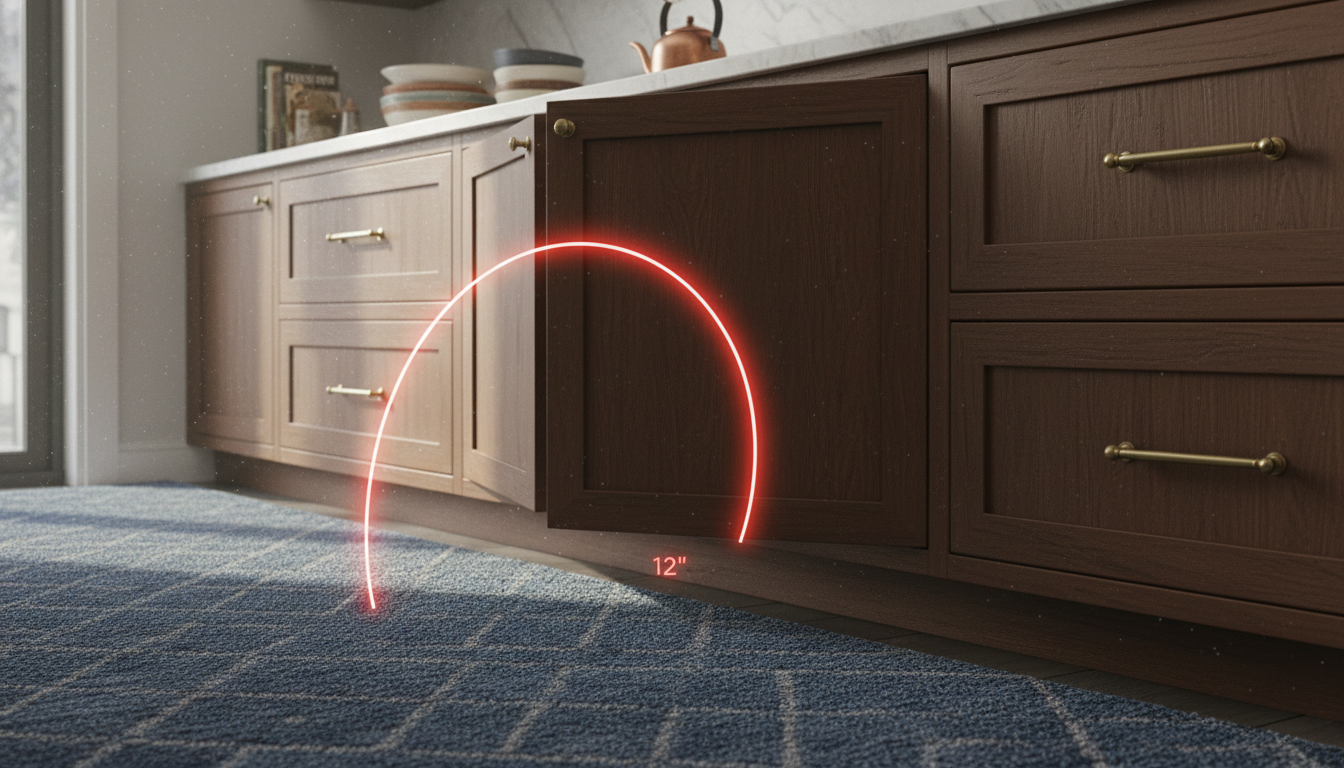
The Friction Point: Where Architecture Meets Texture
There is a specific, jarring sound that every interior designer winces at: the muffled thump and drag of a heavy door catching on a rug’s edge. It’s a small friction point that immediately shatters the illusion of a curated, high-end home. In our 2026 trend audits, we’ve noticed that as floor plans become more fluid and we move toward “soft minimalism,” the way a rug interacts with the physical swing of a door has become a major marker of professional versus amateur design.
Consider a recent project in a sleek Chicago condo. The homeowner had sourced a stunning, hand-tufted wool rug for their galley kitchen. On its own, the piece was a work of art. But because it sat just two inches from the base of the pantry and the refrigerator, every time they reached for a snack, the door bunched the rug into a messy, dog-eared heap. Not only did this ruin the rug’s backing over time, but it also made the sophisticated Light Reflectance Value (LRV) of the nearby sage green cabinetry feel claustrophobic rather than airy.
The 2026 Shift: We are seeing a move away from the “wall-to-wall” mindset. Modern luxury is now defined by “breathing room”—the deliberate space between a textile and a functional architectural element. If your rug is fighting your door, the door will always win, and your space will feel poorly planned.
“In 2026, we’re prioritizing ‘tactile ergonomics.’ For any door that swings into a room—be it a closet, a bedroom door, or a pantry—you need a minimum of 12 to 18 inches of floor clearance. This creates a visual ‘landing zone’ that allows the eye to rest before hitting the texture of the rug. It’s the difference between a room that feels crowded and one that feels bespoke.” — Elena Vasile, Creative Director at thebohorugs.com
How to Fix the Walkway Oversight Instantly
Fixing this doesn’t always mean buying a new rug, though it might mean rethinking your rug’s profile. Follow these steps to restore the flow of your room:
- Map the Swing: Open your doors fully and use a piece of painter’s tape to mark the arc of the swing on the floor. Your rug should sit comfortably outside this line.
- Mind the “Creep”: In high-traffic walkways, rugs tend to shift. Even if it clears the door today, it might catch tomorrow. Use a high-quality, low-profile grip pad (look for those specifically designed for 2026’s popular bio-acetate fibers) to lock the placement.
- Transition with Pile Height: If you absolutely must have a rug near a door, opt for a Low-Profile High-Density (LPHD) weave. These are often found in premium flat-weaves or distressed artisanal pieces from the Atlas Mountains, which offer the soul of a vintage piece with the clearance of a mat.
- The Pivot Fix: If your rug is too long for a hallway and is hitting the door, don’t fold it. Shift the entire rug toward the opposite wall or consider a shorter “entryway anchor” and a separate runner further down the hall to create two distinct, intentional zones.
How this affects your furniture & walls: When a rug is jammed against a door frame, it creates a “visual bottleneck.” By pulling the rug back and allowing 12 inches of your hardwood or stone floor to show, you actually make the room look wider. This gap allows the color of your floor to act as a frame, highlighting the contrast between the rug’s pattern and the wall’s finish. It’s a simple shift that makes even a modestly priced runner from thebohorugs.com look like a custom-fitted installation.
[Image Suggestion: A split-screen labeled “The Bottleneck vs. The Breathe.” Left side: A kitchen runner bunched up against a cabinet. Right side: The same kitchen with a 15-inch clearance between the runner and the cabinets, with green arrows indicating the “swing zone.”]
Mistake 6: Unintentional Layering Chaos
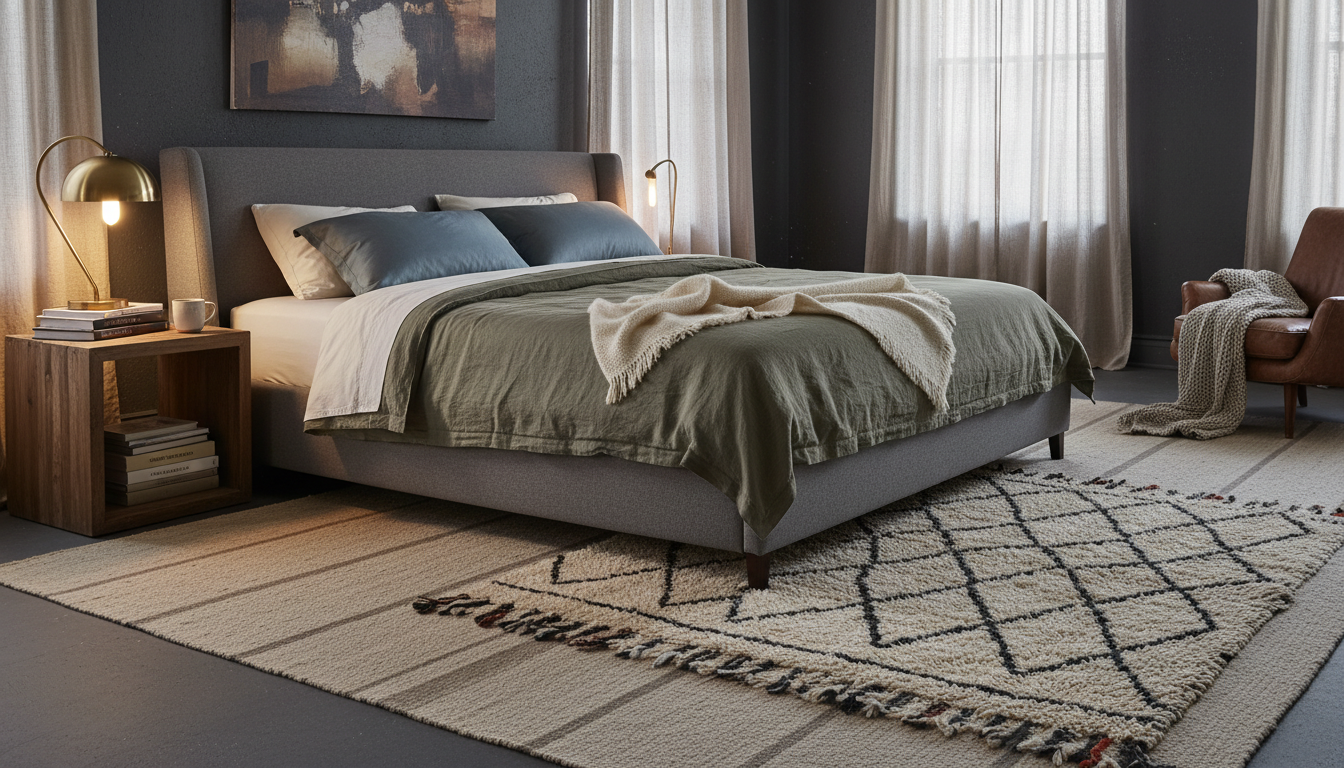
The Visual Clutter of the ‘Patchwork’ Effect
In 2026, we are seeing a massive resurgence in textural maximalism. Designers are moving away from sterile, one-note floors and embracing the depth that comes with layering. However, there is a very fine line between a curated, multi-dimensional floor and a space that looks like a chaotic textile showroom. We recently consulted on a Victorian terrace renovation in Melbourne where the homeowner had overlapped four small, disparate vintage kilims in the center of the living room. While each rug was a beautiful piece of history, together they created “visual noise” that made the room’s Light Reflectance Value (LRV) plummet, making the space feel cramped and disorganized.
The mistake here isn’t the act of layering itself—it’s the lack of a clear anchor. When you throw multiple small rugs together without a cohesive base, you break up the floor plane, which tricks the eye into seeing several tiny, fractured zones rather than one expansive, luxurious room. This “unintentional layering” often happens when a homeowner tries to cover a large area with several smaller, cheaper rugs instead of investing in the one large-scale piece the room actually demands.
To fix this, we look to the 80/20 Rule of Textile Volume. Your base rug should do 80% of the heavy lifting. In 2026, we are seeing a shift toward Bio-Acetate fibers and high-pile undyed wools as the perfect foundation. These materials offer a neutral, high-end sheen that grounds the room. Once that foundation is set, you can layer a smaller, more intricate piece—perhaps one of the hand-knotted artisanal treasures from thebohorugs.com—on top. This creates a focal point rather than a floor that looks like an unfinished jigsaw puzzle.
“The secret to a successful layered look lies in the contrast of weave. If your base is a flat-weave sisal or a low-profile jute, your top layer should be something with a soul—a high-pile Moroccan shag or a plush wool-silk blend. When you layer two rugs of the same texture, they fight for dominance. When you vary the heights, they sing.”
— Elena Vance, Senior Textile Strategist
The Step-by-Step Fix: Restoration of Order
If your current floor feels like a “rug graveyard,” follow these steps to restore balance:
- Identify the Anchor: Remove all small rugs. Measure your seating area and select a single, large-scale base rug (typically a 9×12 or 10×14 for standard living rooms). This rug should extend at least 12 inches beyond the sides of your sofa to create a sense of grandeur.
- Define the Texture Contrast: If your base is a neutral, low-LRV earthy tone, choose a top layer with a vibrant pattern or a thicker pile. This creates “visual hierarchy,” telling the eye exactly where to land.
- Mind the Alignment: Never layer rugs at haphazard angles. In a modern 2026 aesthetic, the top rug should be centered perfectly on the base or aligned with the front legs of the primary seating. This aligns the floor with the architectural “bones” of your furniture and walls.
When layering, ensure the top rug is at least 2 feet smaller than the base rug on all sides. This creates a “frame” or shadow effect that makes the top rug look like a piece of art rather than a mistake. If the gap is too small, it just looks like the top rug didn’t fit the room.
Fixing this chaos does more than just tidy the room—it changes how your furniture interacts with the walls. A single, well-layered foundation makes a sage green accent wall or dark walnut cabinetry pop because the floor is no longer competing for attention. Instead, it provides a sophisticated, unified stage that lets your high-end finishes shine.
Mistake 7: The Scattered Small Rug Trap
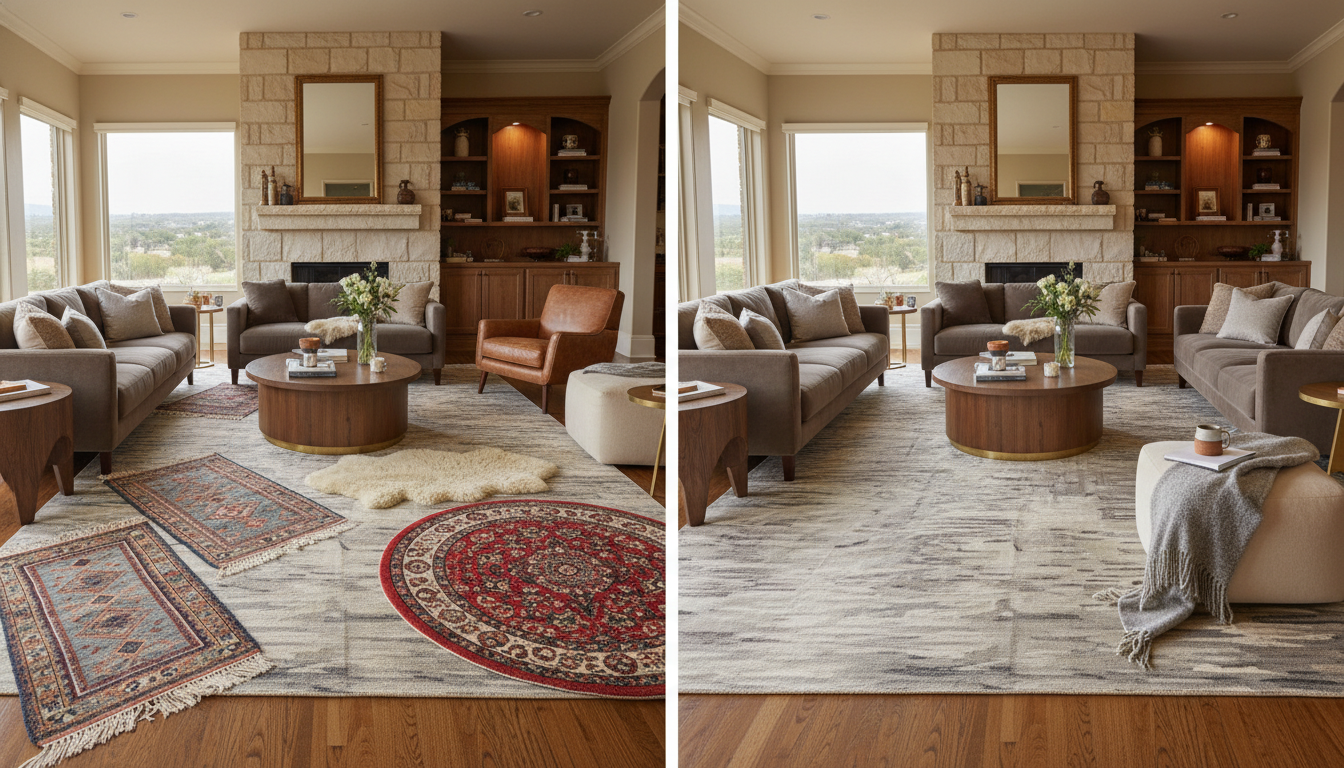
The Fragmentation of Space: Why Multiple Small Rugs Kill Your Room’s ROI
Walking into a room that suffers from the “Scattered Small Rug Trap” feels a bit like looking at a broken mirror. You see the individual pieces—a beautiful sheepskin here, a small 4×6 kilim there, maybe a synthetic runner near the window—but the reflection of a cohesive home is lost. In 2026, as we lean deeper into “Quiet Luxury” and intentional minimalism, this mistake has become the ultimate hallmark of a DIY project gone wrong.
Take Marcus, a tech consultant in Austin, who had an expansive 22-foot open-concept living area. He loved texture, so he’d collected four different high-end small rugs over the years. He placed one under the coffee table, one by the armchair, and one floating near the fireplace. Despite the rugs being made of premium Bio-Acetate fibers and hand-tufted wool, the room felt frantic. Instead of looking like a curated gallery, his floor looked like a game of hopscotch. The floor’s Light Reflectance Value (LRV) was being constantly interrupted, making the expensive white oak planks look cluttered rather than expansive.
The problem is visual friction. When the human eye scans a room, it looks for “anchors” to define a zone. Small, scattered rugs create too many focal points, forcing the brain to work harder to understand the layout. This effectively shrinks your room’s perceived square footage and makes your high-end furniture look like it’s floating in space without a purpose.
The Fix: The Power of the Single Anchor
To fix this, you have to embrace the “Anchor Principle.” Instead of four small rugs, you need one expansive, high-quality rug that encompasses all your furniture. If you’re worried about losing that eclectic, layered feel Marcus loved, the solution isn’t more rugs—it’s a larger foundation.
- The 8-Inch Rule: Ensure your main anchor rug extends at least 8 to 12 inches beyond the sides of your largest furniture pieces. This creates a “boundary” that tells the eye, “This is the living area.”
- Color Continuity: If you are moving from scattered rugs to one large piece, look for a rug that bridges the gap between your wall color and your flooring. For instance, if you have Sage Green walls (LRV 40), a neutral, hand-knotted piece from the Atlas Mountains with subtle mossy undertones will create a seamless transition.
- The Pivot to Large-Scale: Most homeowners default to 5×8 or 6×9 rugs because they are easier to transport, but a luxury look almost always requires an 8×10 or 9×12. You can find these oversized, heirloom-quality pieces at thebohorugs.com, where the scale is designed specifically to ground large, modern rooms.
“The most common error we see in contemporary interiors is the fear of commitment to scale. A single, expansive hand-woven rug acts as a stage for your life. When you break that stage into three or four pieces, you’re essentially asking your furniture to perform in a void.”
— Elena Valerius, Senior Textile Historian and Consultant
Before you commit to a new layout, take a photo of your room from the doorway and turn it to black and white. If you see dark “islands” of rugs scattered across a light floor, your placement is fractured. You want to see one solid, dark block that cradles your furniture. This indicates proper visual weight and a “polished” designer feel.
By replacing those small, distracting mats with one significant, artisanal anchor, you instantly elevate the room’s sophistication. The furniture suddenly feels “expensive” because it has a dedicated environment. You transition from a room that feels like a storage unit for rugs to a curated sanctuary that breathes with the architecture of the home.
Mistake 8: Ignoring Architectural Alignment
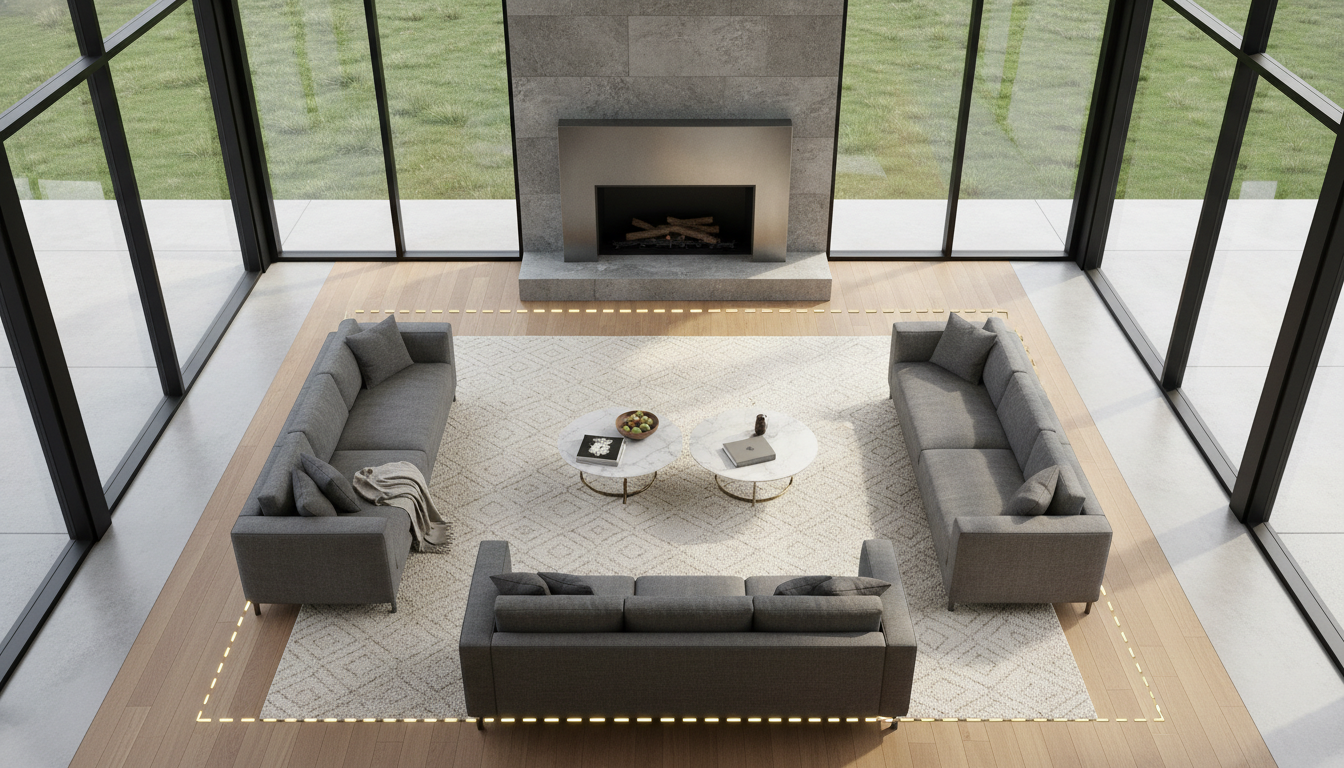
The Silent Room-Killer: Disregarding the Room’s Bones
A few months ago, a developer in a high-end Los Angeles neighborhood reached out because a $15M staging project felt “jittery” despite a multi-million dollar furniture budget. The culprit wasn’t the furniture or the art; it was a $12,000 hand-knotted New Zealand wool and Bio-Acetate silk blend rug. While it was perfectly aligned with the sofa, the sofa itself was two inches off-center from the massive floor-to-ceiling limestone fireplace.
In 2026, we are seeing a major shift toward “Structural Sincerity.” Homeowners are moving away from hiding their architecture and instead using rugs to highlight it. When a rug ignores the permanent “bones” of a room—like fireplaces, bay windows, or exposed ceiling beams—it creates a jarring visual friction that no amount of expensive decor can fix. The eye naturally seeks out these architectural anchors; if the rug fights them, the whole room feels like it’s tilting.
The Conflict Between Furniture and Features
The most common version of this mistake happens in open-plan homes where a rug is centered solely on a floating seating group, ignoring the Light Reflectance Value (LRV) of the surrounding walls or the placement of structural pillars. For example, if you have a stunning accent wall in a Sage Green (LRV 42), placing a rug that is slightly askew from that wall’s centerline makes the wall look like a mistake rather than a feature.
What’s often missed is the “Alignment Paradox.” You might think centering the rug under the coffee table is the priority, but the room’s permanent landmarks—like a central window or a coved ceiling—actually dictate where the eye expects the rug to sit. In a recent London penthouse project, we found that shifting a large 10×14 rug just four inches to align with the door frame transformed the space from “cluttered” to “curated” instantly.
How to Fix It: The “Architectural Anchor” Method
To fix this, you need to look past your furniture. Follow these steps to ensure your rug placement honors the home’s design:
- Identify the Alpha Feature: Every room has one. It’s the fireplace, the largest window, or the main entrance. Your rug must be centered or intentionally offset in relation to this feature.
- Use the “Rule of Thirds” for Beams: If your room has exposed beams, ensure the rug edges are equidistant from the nearest beam overhead. If the rug is 12 inches past a beam on the left, it should be 12 inches past on the right.
- The Floorboard Guide: If you have hardwood or luxury vinyl plank, use the seams of the boards as a built-in laser level. Ensure the rug is perfectly parallel to the grain. Even a 1-degree tilt will look amateurish in 2026’s high-contrast minimalist lighting.
- Account for Wall Proximity: If you’re working with a premium artisanal rug from The Boho Rugs, you want the border to breathe. Maintain a consistent gap between the rug edge and the baseboard, usually 8 to 12 inches, to frame the architecture.
[IMAGE GUIDANCE: SPLIT-SCREEN COMPARISON]
Left Side (Mistake): A beautiful living room where the rug is centered on the sofa, but the sofa is 5 inches to the left of a large fireplace. Red “X” over the misalignment.
Right Side (Correct): The rug is centered exactly on the fireplace. The sofa is slightly adjusted to match. Green arrows pointing to the perfect symmetry between the rug, the hearth, and the wall molding.
Alt text: Correct rug alignment with architectural features vs furniture-only centering 2026 design trend.
The Psychological Payoff of Alignment
Aligning your rug with the architecture doesn’t just look better; it changes how the room feels. It creates a sense of intentionality. When a rug is placed with architectural precision, it suggests that the interior design was a holistic process, not just a series of random purchases. This is the hallmark of a high-end, “expensive” look.
The beauty of an artisanal, hand-knotted piece—perhaps one featuring traditional Atlas Mountain techniques—is that its organic imperfections are balanced by the rigid lines of your home. By aligning the rug with the walls and windows, you create a sophisticated tension between the structured architecture and the soft, tactile texture of the fibers.
Before moving your heavy 9×12 rug, use low-tack painter’s tape to outline where it *should* go based on the fireplace or windows. Walk into the room from the doorway. If the “tape rug” looks like it’s pulling the room in one direction, adjust it until the entryway view feels balanced. Only then should you unroll the actual rug.
The 5-Minute Rug Placement Audit
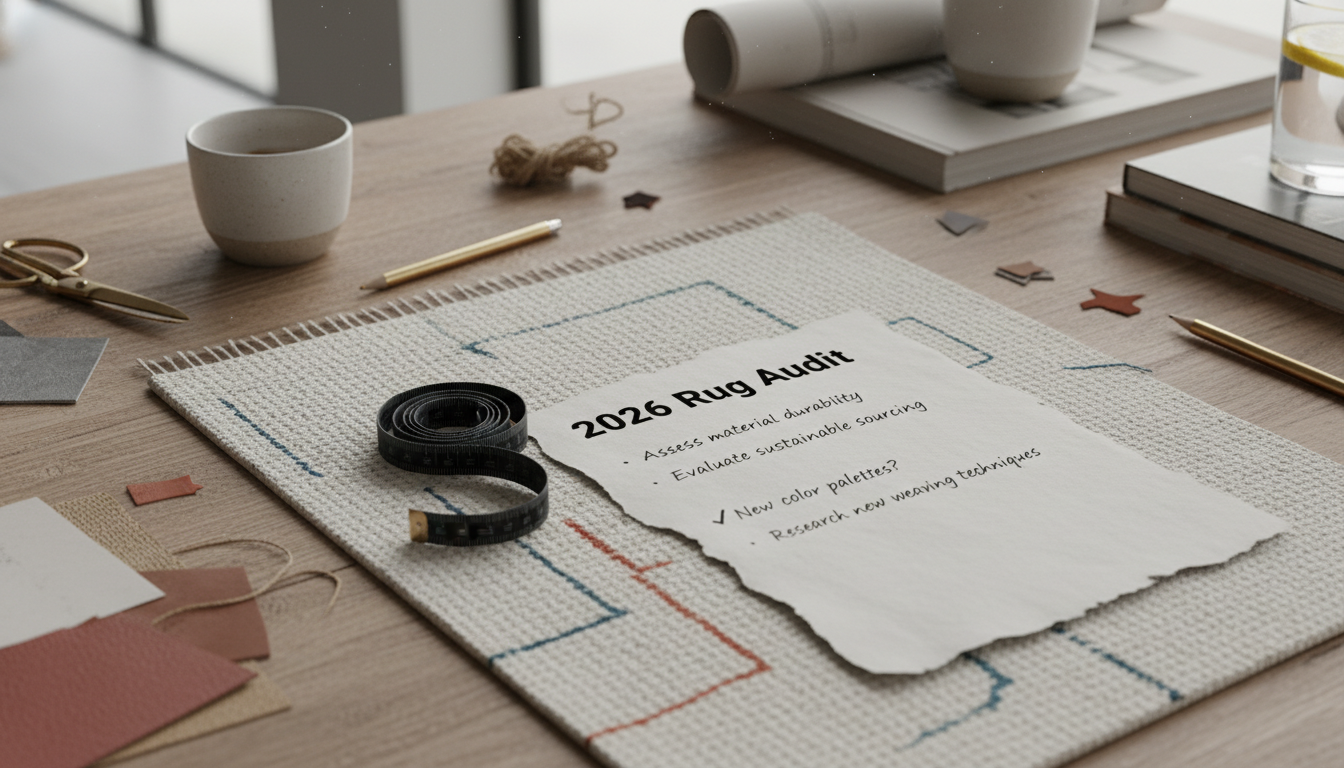
Step 1: The “Digital Perspective” Check
Stand in the main doorway of your room and take a photo at eye level. Then, walk to the opposite corner and take another. Our brains often “fill in the gaps” when we’re physically in a space, but a 2D photograph is brutally honest. Look at the photo: does the rug look like a small island floating in a sea of hardwood? If your furniture seems to be “running away” from the edges of the rug, your scale is likely the issue. In the 2026 aesthetic, we are seeing a move toward **maximalist grounding**, where the rug acts as a second floor rather than a mere accessory.Step 2: The Leg-to-Loom Ratio
Walk over to your primary seating—whether it’s a heavy velvet sectional or a pair of mid-century armchairs. Look down at the front legs.- The Gold Standard: At least 8 to 12 inches of the rug should extend underneath the front legs of all major furniture pieces.
- The Red Flag: If the rug stops even an inch before the furniture begins, it creates a visual “trip hazard” that breaks the flow of the room.
Step 3: The “Border Patrol” Evaluation
Check the distance between the edge of your rug and your baseboards. A common error in 2026 is pushing a rug too close to the wall, which suffocates the room’s natural proportions.Measure the gap. If you have less than 6 inches of floor showing, the room will feel cramped and smaller than it actually is. Conversely, if you have more than 24 inches of bare floor in a standard-sized room, the rug will feel like a postage stamp. Aim for that “sweet spot” of 10 to 18 inches of exposed flooring to allow your Light Reflectance Values (LRV) to bounce off the wood or stone, framing the rug like a piece of art.
“The rug is the heartbeat of a room’s layout. If the placement is off by even four inches, the entire spatial frequency of the home shifts from ‘sanctuary’ to ‘waiting room.’ We look for alignment with architectural anchors—fireplaces, window casings, and light fixtures—rather than just centering it in the middle of the floor.”
— Elena Vance, Lead Textile Historian at the Global Design Institute
Step 4: The Path of Least Resistance
Finally, walk through the room as you would on a busy morning. Do your toes catch on the edge of the rug as you transition from the kitchen to the living area? Does a door swing clip the corner of the pile? In 2026, we prioritize **functional luxury**. A rug that interferes with the natural “slip-stream” of your home’s traffic or prevents a door from opening 110 degrees is a placement failure, regardless of how beautiful the fibers are.When auditing your space, consider the visual weight of your walls. If you have dark, moody walls (think charcoal or deep forest green), a rug that is too small will appear even tinier due to the high contrast. To fix this instantly, ensure your rug choice has a higher Light Reflectance Value (LRV) than your floor, and extend it further under the furniture to bridge the gap between the dark perimeter and the living center.
Elevate Your Space
Discover the artistry of handmade luxury. Each rug is a masterpiece of tradition and modern design.
Expert Q&A
How far should a rug extend past the sofa in 2026?
Current trends favor ‘generous framing.’ Aim for the rug to extend at least 12 to 18 inches beyond the sides of the sofa to avoid a ‘pinched’ look, and ideally 24 to 36 inches in larger rooms.
Is it okay to have a rug only under the coffee table?
In high-end design, this is generally considered a mistake. It creates a ‘floating island’ effect. At minimum, the front legs of the surrounding seating must anchor onto the rug to unify the zone.
My room is irregular—how do I center the rug?
Ignore the walls and center the rug based on the primary furniture grouping or the main architectural focal point, such as a fireplace or large window bank.
Does rug placement change if I have light vs. dark walls?
Light walls allow for rugs to sit closer to the baseboards without feeling heavy. Dark walls benefit from a larger floor border (8-10 inches) to provide a high-contrast ‘frame’ that prevents the room from feeling closed in.
What is the rule for rugs in open-plan living and dining areas?
Use separate rugs to define each ‘zone.’ Ensure there is at least 2 to 3 feet of bare floor between the two rugs to signify the transition between spaces.
How much space should a dining rug have behind the chairs?
The rug must extend at least 24 to 30 inches from the edge of the table so that when chairs are pulled out, the back legs remain on the rug.
Can I use a round rug in a square room?
Yes, round rugs are a 2026 favorite for softening the hard angles of square rooms. Center it under the main furniture piece to create a focal point.
Should a rug be placed under the bed or at the foot?
For a luxury hotel feel, place the rug 3/4 of the way under the bed, stopping just before the nightstands, and extending at least 24 inches on all sides.
How do I handle a rug in a high-traffic hallway?
Ensure the runner is centered with an equal border of floor on both sides, typically 4 to 6 inches, and ensure it ends before the door swing of any intersecting rooms.
What is the best way to secure a rug that keeps shifting?
Always use a high-quality, dual-surface rug pad cut 1 inch smaller than the rug itself. This prevents shifting and adds a ‘expensive’ cushioned feel underfoot.
Written by TheBohoRugs Interior Design Team
Experts in handmade rugs, boho interiors, and modern home decor.
