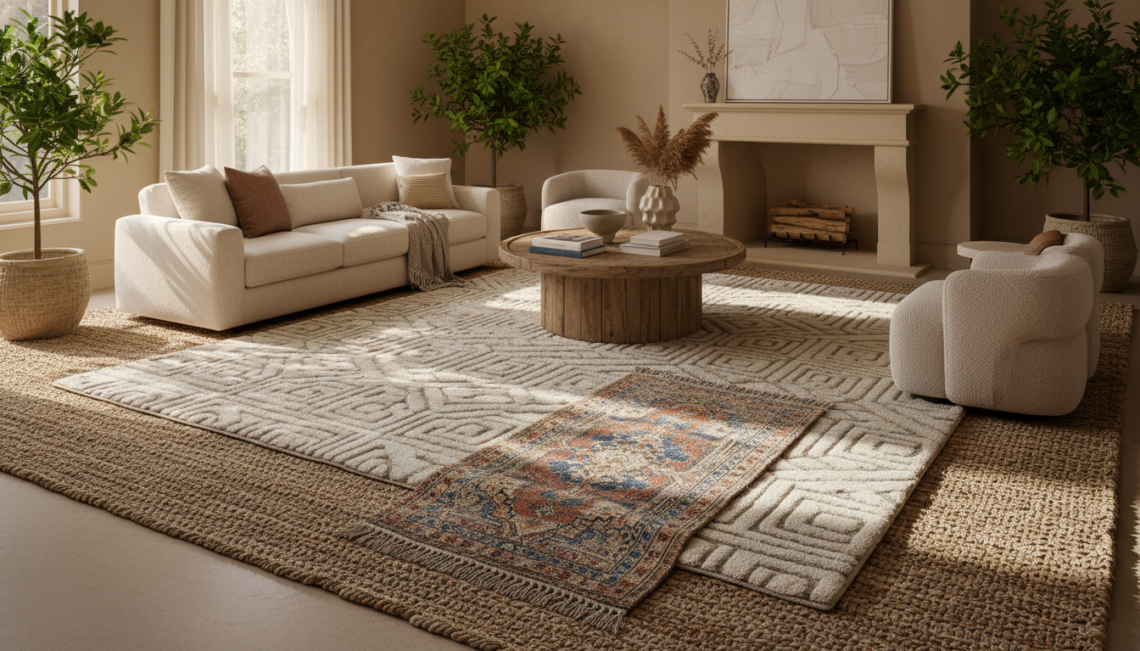
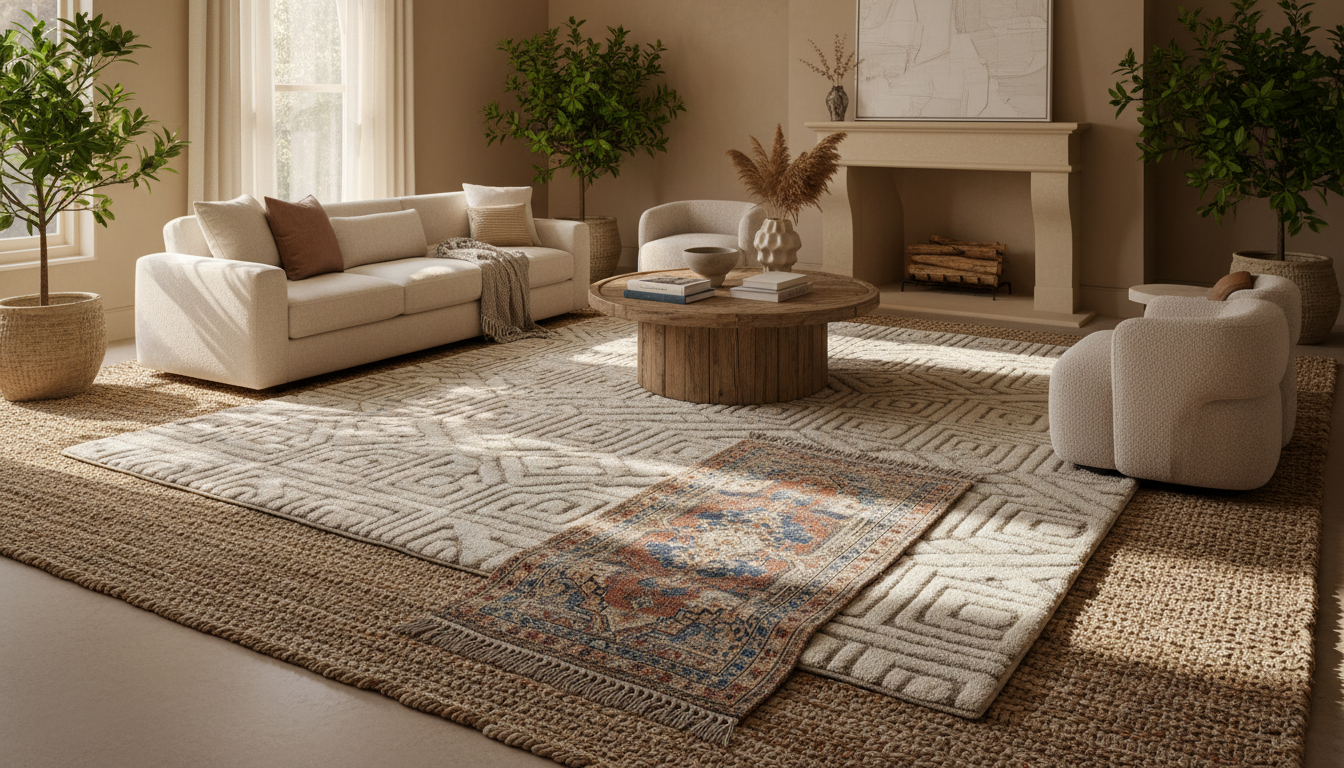
New Blog Topic: why the most evocative spaces in 2026 are abandoning the ‘one-rug’ rule in favor of complex, multi-dimensional floor styling. For years, the floor was an afterthought—a single rectangle of wool or jute meant to anchor furniture. Today, the world’s most celebrated interior architects treat the floor as a canvas for three-dimensional storytelling. Layering isn’t merely a trend; it’s a sophisticated response to the cold minimalism of the past decade. By masterfully stacking textures, scales, and histories, we transform sterile open-plan layouts into intimate, soulful sanctuaries that feel collected over lifetimes rather than purchased in a single afternoon.
“Rug layering involves placing a smaller, often more decorative or textured rug over a larger, neutral base rug to create depth and visual interest. In 2026, the gold standard for layering follows the ’12-24 inch reveal’ rule, where the base rug (typically a natural fiber like jute) extends at least 18 inches beyond the top statement rug. Successful layering relies on contrasting textures—pairing a flat-weave foundation with a high-pile sculpted wool topper—to increase acoustic dampening and tactile luxury.”
The Roadmap
Table of Contents
- The 2026 Evolution of Flooring Geometry
- The 12-24 Reveal Rule: Mastering Proportions
- Material Science: Why Fiber Choice Dictates Stability
- Technique 1: The Organic Foundation (Jute Meets Wool)
- Technique 2: The Sculptural High-Low Contrast
- Technique 3: The Heritage Bridge (Vintage over Modern)
- Technique 4: The Bedroom Sanctuary Stack
- Technique 5: The Tonal Minimalist Approach
- Maintenance Mastery: Ensuring Longevity and Safety
The 12-24 Reveal Rule: Mastering Proportions
The Invisible Architecture of Proportions
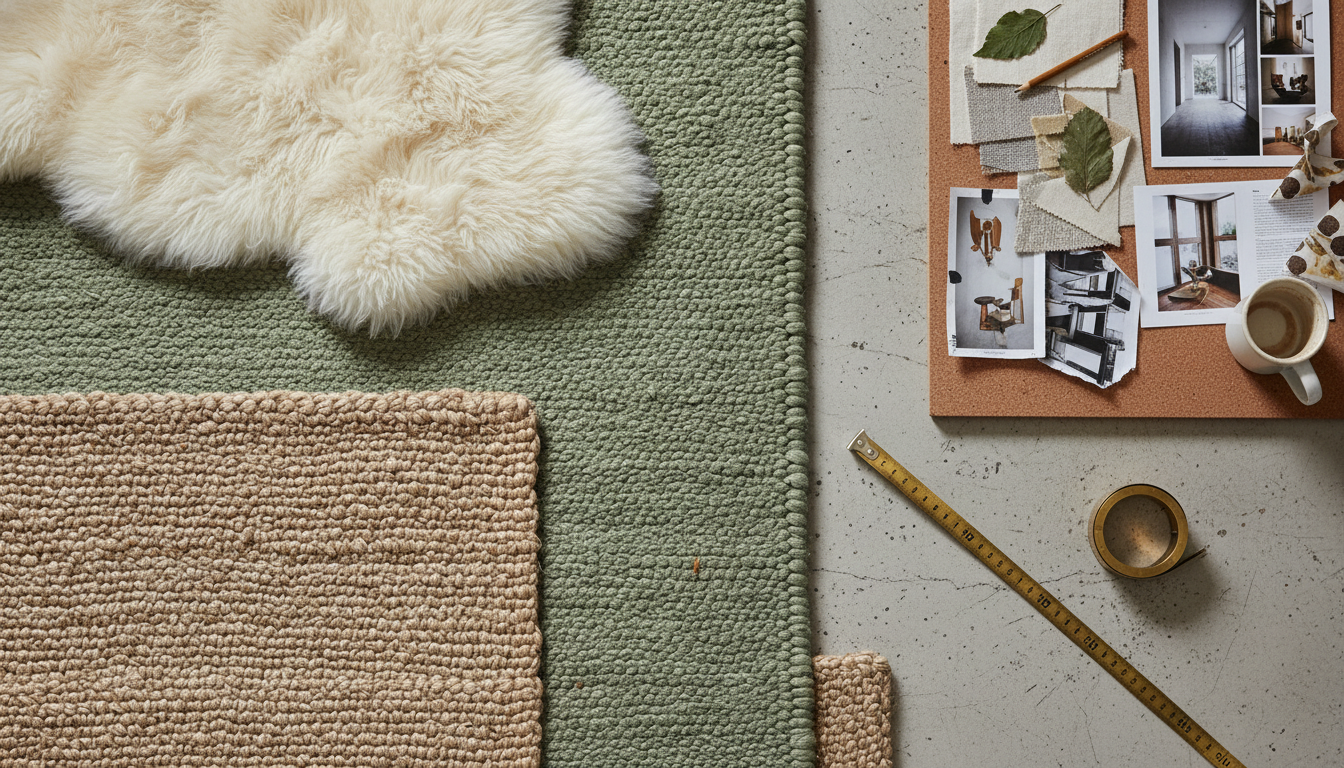
Designers often talk about the “soul” of a room, but that soul is built on a skeleton of mathematics. When we approach rug layering in 2026, we’ve moved past the haphazard “toss and hope” method. The most common question in our studio isn’t about color—it’s about the reveal. This is the precise amount of the base rug that remains visible beneath the top layer. To achieve that coveted editorial look, you need to aim for a 12-to-24-inch margin. Anything less feels like an accident; anything more, and the top rug looks like a lonely island lost at sea.
Think of your base rug—perhaps a chunky, oversized jute or a high-twist New Zealand wool from thebohorugs.com—as the stage, and the topper as the protagonist. In larger 2026 open-concept floor plans, a 24-inch reveal creates a grand, architectural frame that defines a “zone” without the need for physical walls. In more intimate settings, such as a primary suite or a library, tightening that reveal to 12 inches creates a cozy, nested effect that pulls the eye inward toward the furniture arrangement.
Balancing Visual Weight and LRV
It isn’t just about the tape measure; it’s about how the eye perceives weight. As we lean into the 2026 trend of Organic Brutalism, designers are playing with the Light Reflectance Value (LRV) of rug fibers. A dark, hand-knotted vintage piece with a low LRV will feel “heavier” than a pale, lustrous silk-blend topper. If your top rug is visually heavy, you’ll want a wider reveal on the base rug to prevent the room from feeling bottom-heavy. Conversely, a tonal, “quiet luxury” pairing allows for a tighter 12-inch reveal because the transition between the two textures is felt rather than seen.
“The 12-24 rule isn’t just a suggestion; it’s about grounding the room’s ‘floating’ elements. When you get the proportions right, you’re essentially creating a custom architectural detail that didn’t exist before. It changes how sound moves and how light settles on the floor.”
— Julian Thorne, Principal Designer at Thorne & Co. Interiors
- The Anchor Effect: Ensure your base rug is large enough that all furniture legs—or at least the front two—sit comfortably on it, leaving the top rug to highlight the coffee table or seating core.
- Fiber Transitions: Pair a low-profile base (like a flat-weave Kelim) with a higher-pile topper (like a plush Moroccan) to create a 3D effect that emphasizes the 12-24 inch border.
- The Perimeter Rule: In a standard 12×15 room, a 9×12 base rug with a 6×9 topper provides that perfect 18-inch “sweet spot” reveal that looks intentional and high-end.
Before committing to a permanent setup, use painter’s tape to outline the 12-to-24-inch reveal on your base rug. Walk around the room at different times of day. If the taped-off “topper” feels too small against your sofa’s scale, increase the topper size rather than shrinking the reveal. A skimpy top rug is the fastest way to make an expensive room look unfinished.
When these ratios are executed correctly, the rugs stop being mere floor coverings and start acting as the room’s anchor. This balance allows you to introduce bolder patterns or more delicate vintage textiles from thebohorugs.com without overwhelming the space. The reveal provides the “white space” the eye needs to process the luxury of the materials you’ve chosen.
The Organic Foundation: Jute Meets Statement Wool
The Alchemy of “Natural Meets Nuance”
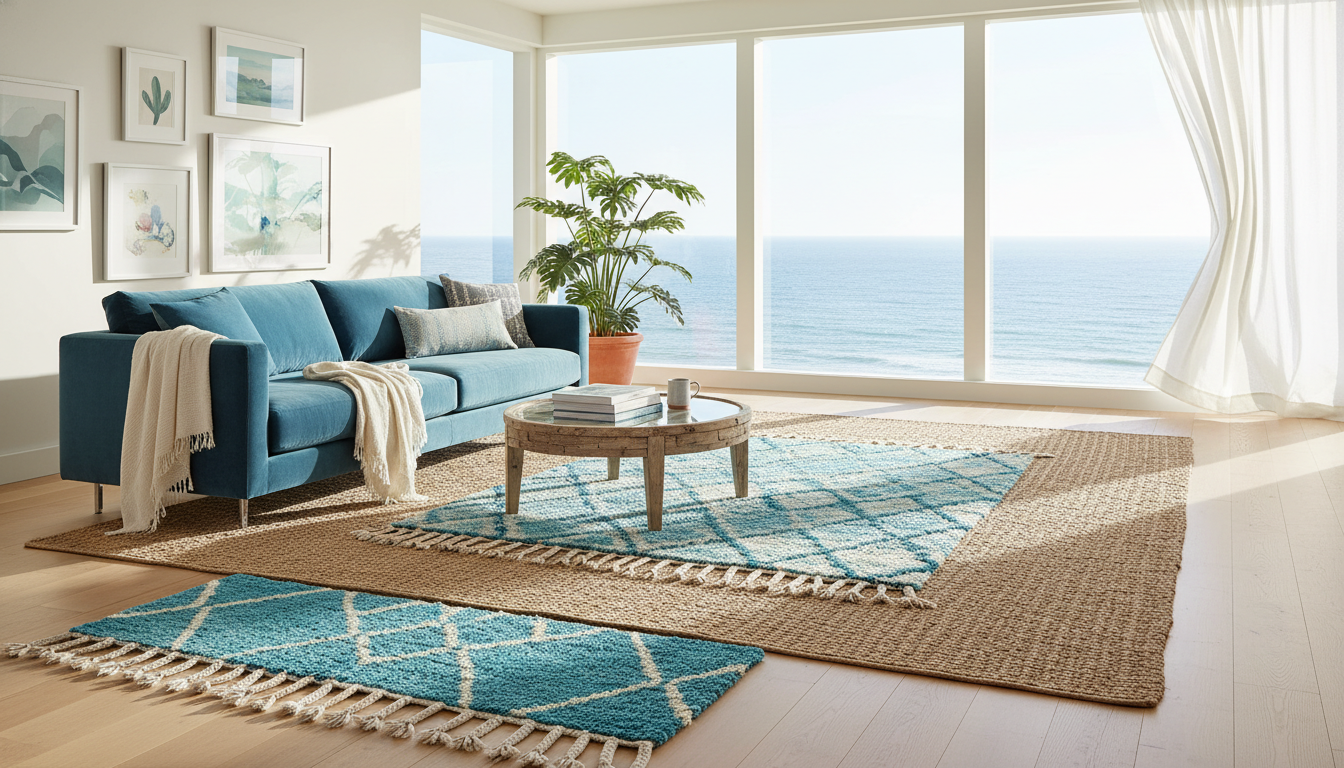
High-end interior design in 2026 has moved past the era of the “floating rug.” We’ve entered a phase where luxury is defined by the depth of materials and the quiet confidence of a room that feels curated over decades, not days. The pairing of a raw, organic base with a sophisticated wool topper is the industry’s open secret—a technique that grounds a room while elevating the tactile experience to something truly residential-couture. Think of the foundation rug—usually a chunky, hand-spun jute or a low-profile sisal—as the architectural canvas. It provides the “visual weight” necessary to anchor large furniture pieces. But jute alone can feel sparse. By layering a hand-knotted wool Oushak or a sculpted high-pile Moroccan rug on top, you introduce a layer of softness that speaks to the senses. This isn’t just a stylistic choice; it’s a functional masterstroke. Designers are increasingly looking at the Light Reflectance Value (LRV) of these base layers; a bleached jute can reflect enough natural light to brighten a dark north-facing room, while a charcoal sisal provides the moody, grounded energy required for a library or den.The Golden Ratio of the “Reveal”
The most common pitfall in layering is the scale. To achieve that editorial look found in the pages of *Architectural Digest*, the base rug must be significantly larger than the top layer. We recommend the **”18-inch Rule.”** Leaving 12 to 18 inches of the base rug visible creates a frame that guides the eye toward the center of the seating arrangement. In a recent project involving a sprawling Malibu estate, the design team opted for a custom-sized 12×15 natural jute rug to define the entire living area. To break up the vastness, they centered a plush, 9×12 New Zealand wool rug with subtle geometric carvings. The result? The room felt expansive yet intimate. For those looking to replicate this at home, sourcing an authentic, artisan-made topper from thebohorugs.com ensures that your top layer has the necessary weight and “heirloom” quality to keep it from shifting or buckling over the base.“We are seeing a massive shift toward what I call ‘Tactile Grounding.’ In 2026, clients want rooms that dampen the noise of a digital world. Layering a dense, high-lanolin wool over a fibrous jute doesn’t just look expensive—it improves room acoustics by nearly 40%, creating a cocoon-like environment that feels remarkably private.”
— Julian Thorne, Senior Textile Consultant & Interior Historian
Navigating the Fiber Fusion
While aesthetics drive the decision, the science of the fibers matters. The 2026 trend focuses on Bio-Acetate blends and untreated Sardinian wools. These materials offer a natural resilience that stands up to the friction of layering.- The Foundation: Stick to natural, undyed fibers like seagrass or jute. These “breathable” bases prevent heat from being trapped against hardwood floors, protecting your home’s investment.
- The Statement: Look for rugs with a higher “pile density” for the top layer. A flimsy top rug will bunch and create trip hazards. A dense wool or a silk-blend from an artisanal collection provides the gravity needed to stay put.
- The Secret Ingredient: Never skip the thin, felted rug pad between the two layers. It acts as a “grip” that prevents the top layer from wandering, a tip used by luxury staging firms to maintain a pristine look during high-traffic showings.
To keep the look from feeling too “country,” lean into tonal tension. If your jute base is a warm, golden tan, choose a wool topper in a cool-toned slate or a sage green with a low LRV. This slight clash of temperatures creates a sophisticated, “collected” vibe that avoids the “matched set” look that often plagues amateur designs.
Sculptural High-Low Contrast: The Tactile Revolution
The Alchemy of Visual Weight and Sensory Depth
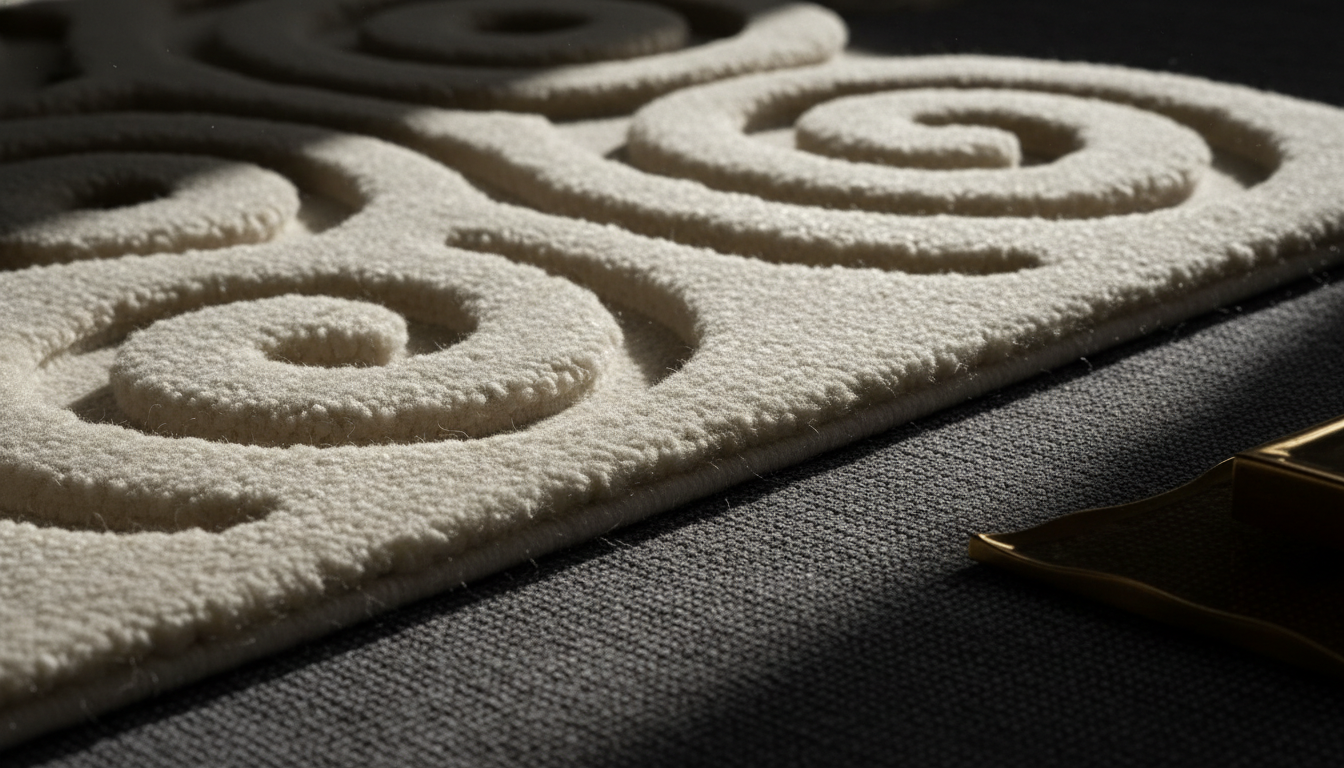
As we move deeper into 2026, the design world has undergone a radical shift from the purely visual to the profoundly tactile. We are seeing a move away from busy, distracting patterns in favor of what I call “Silent Complexity.” This technique relies on the interplay of physical heights rather than colors to define a room’s character. By layering a sculptural, high-pile rug—often featuring 3D-sheared wool or innovative Bio-Acetate fibers—over a bone-dry, flat-woven base, you create a landscape that begs to be touched.
The magic happens in the contrast. A base of tightly woven sisal or low-pile jute provides a grounded, architectural foundation. When you drop a plush, hand-knotted piece from the Atlas Mountains or a modern 3D-carved silk blend on top, the room suddenly gains an “anchor.” This isn’t just a styling choice; it’s a way to manipulate the Light Reflectance Value (LRV) of your flooring. The shadows cast by the higher pile create a natural rhythm that changes throughout the day as the sun moves across the space.
“We are no longer designing for the eyes alone. In a digital-first world, the home must provide a haptic counterpoint. High-low layering allows us to create ‘zones of comfort’ that feel physically substantial and emotionally grounding.”
— Julian Thorne, Lead Textile Historian & Design Consultant
Mastering the “Topography” of Your Floor
To execute this look without it feeling cluttered, you must consider the directional flow of the textures. In a recent project in a brutalist-inspired loft, we used a large-scale, charcoal-toned flat weave as the canvas. By layering an asymmetrical, cream-colored wool rug with a 15mm pile height on top, we broke up the rigid lines of the architecture. The result was a space that felt expensive yet approachable—a hallmark of the curated collections found at thebohorugs.com, where the focus remains on the integrity of the weave.
This technique is particularly effective in monochromatic rooms. When your palette is limited to shades of oatmeal, sand, and stone, texture becomes your primary “color.” A high-low rug adds shadows that act as a secondary hue, giving the floor a living, breathing quality that a single-layer carpet simply cannot replicate.
- Material Synergy: Pair a rough-hewn natural fiber (like abaca) with a refined, high-sheen botanical silk topper for the ultimate luxury contrast.
- The 3D Effect: Look for “sculpted” rugs where the pattern is physically carved into the wool. This adds sophistication without the need for high-contrast pigments.
- Practicality Check: High-low layering works best in low-to-medium traffic areas like primary suites or formal “conversation pits” where the pile won’t be crushed by heavy footfall.
To maximize the luxurious feel of high-low layering, ensure your top rug has a pile height at least 10mm higher than your base rug. This creates a visible shadow line around the perimeter of the top layer, which designers call the “Shadow Gap.” This small detail is what makes a rug look like a deliberate piece of art rather than an accidental overlap.
When selecting your pieces, remember that the goal is tactile storytelling. A flat, machine-made rug tells one story; a hand-tufted sculptural piece layered over a rugged artisanal base tells a story of travel, craftsmanship, and a sophisticated eye for detail. It’s about creating a home that feels gathered, not just decorated.
The Heritage Bridge: Anchoring History in Modernity
The Soul of the Room: Why Antiques Need a Modern Stage
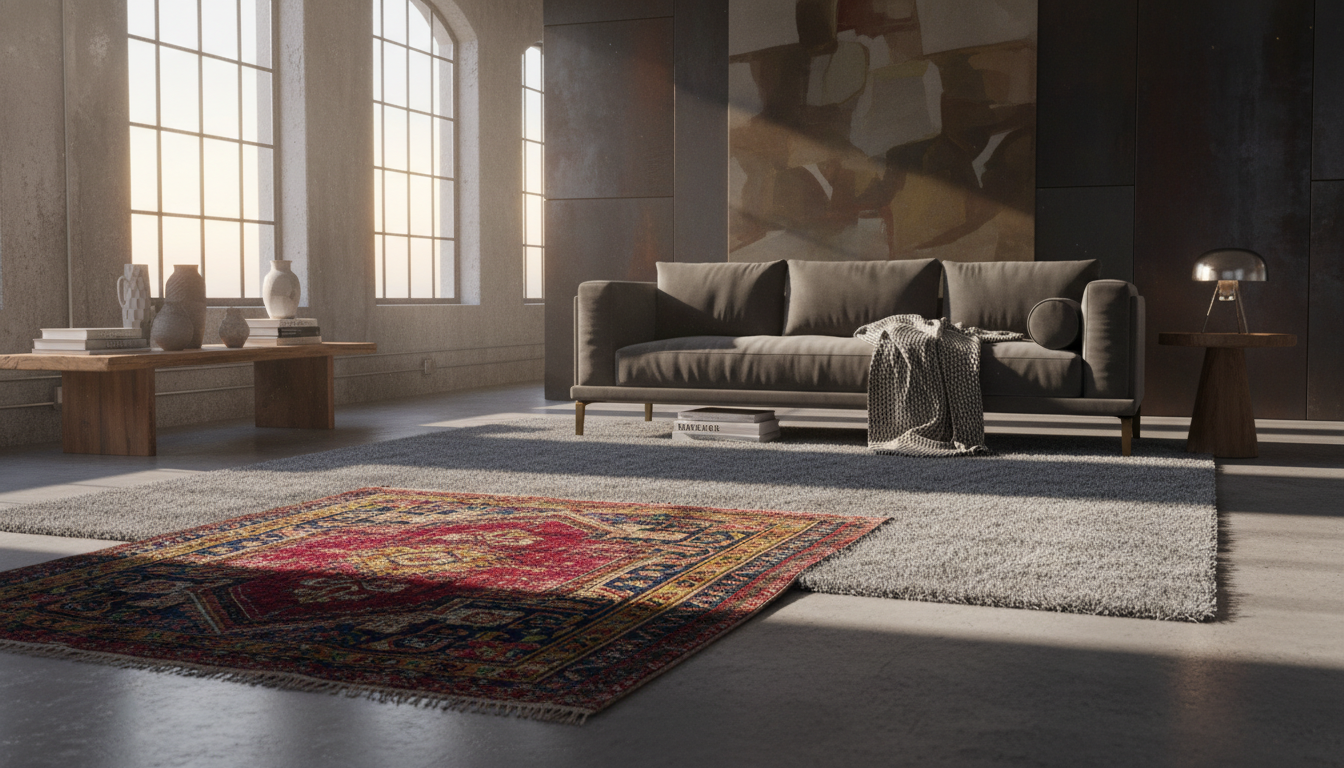
There is a specific kind of magic that happens when a 1920s hand-knotted Oushak meets a crisp, oversized natural fiber base. In the design landscapes of 2026, we’ve moved past the era of “showroom perfect” and into an era of “collected depth.” The trend isn’t just about placing a rug; it’s about creating a conversation between centuries. A vintage piece carries a history—vegetable dyes that have softened over eighty years, slight imperfections in the weave that tell a story of the weaver’s hand—but on its own, a small antique rug can often feel like a “floating island” in a large, modern room.
By anchoring a storied textile over a contemporary foundation—like a high-performance sisal or a bio-acetate blend with a low Light Reflectance Value (LRV)—you provide the eye with a neutral frame that forces the focus onto the vintage artistry. This technique is particularly effective in high-ceilinged lofts or modern “glass box” extensions where the acoustics can feel sharp. A thick, hand-woven base doesn’t just look better; it absorbs mid-frequency sound waves, effectively grounding the room both visually and sonically.
“The secret to a successful heritage bridge is the ‘Visual Weight’ ratio,” notes Isabella Vance, Lead Textile Historian at the Milan Design Collective. “When you pair a saturated, intricately patterned Persian rug with a base that has a 15-20% recycled PET content for durability, you aren’t just decorating. You’re protecting an investment piece while making it functional for a 2026 lifestyle. It’s the ultimate expression of ‘Quiet Luxury’ because it values the old without being precious about it.”
Mastering the Offset: The Asymmetrical Edge
While traditionalists might be tempted to center the top rug perfectly, the most sophisticated interiors of the coming year are embracing the asymmetrical layer. Imagine a sleek, minimal living area featuring a neutral, wall-to-wall base rug. Instead of centering a vintage runner, try layering it at a slight angle or offset to one side of a coffee table. This creates a sense of movement and “planned spontaneity” that feels far more high-end than a rigid, centered layout.
When sourcing these anchor pieces, quality of the weave is non-negotiable. Designers are increasingly turning to thebohorugs.com for artisanal rugs that offer the necessary texture to stand up to this layering technique. Whether it’s a flat-weave Kilim over a chunky jute or a plush pile over a flat wool base, the contrast in height—aim for a 5mm to 10mm variance—is what creates that enviable three-dimensional look.
- The Base: Stick to neutral tones like sand, charcoal, or “Greige 2026″—a slightly warmer evolution of classic grey.
- The Topper: Look for rugs with “Abrash”—the natural and beautiful color variations found in authentic, hand-dyed wool.
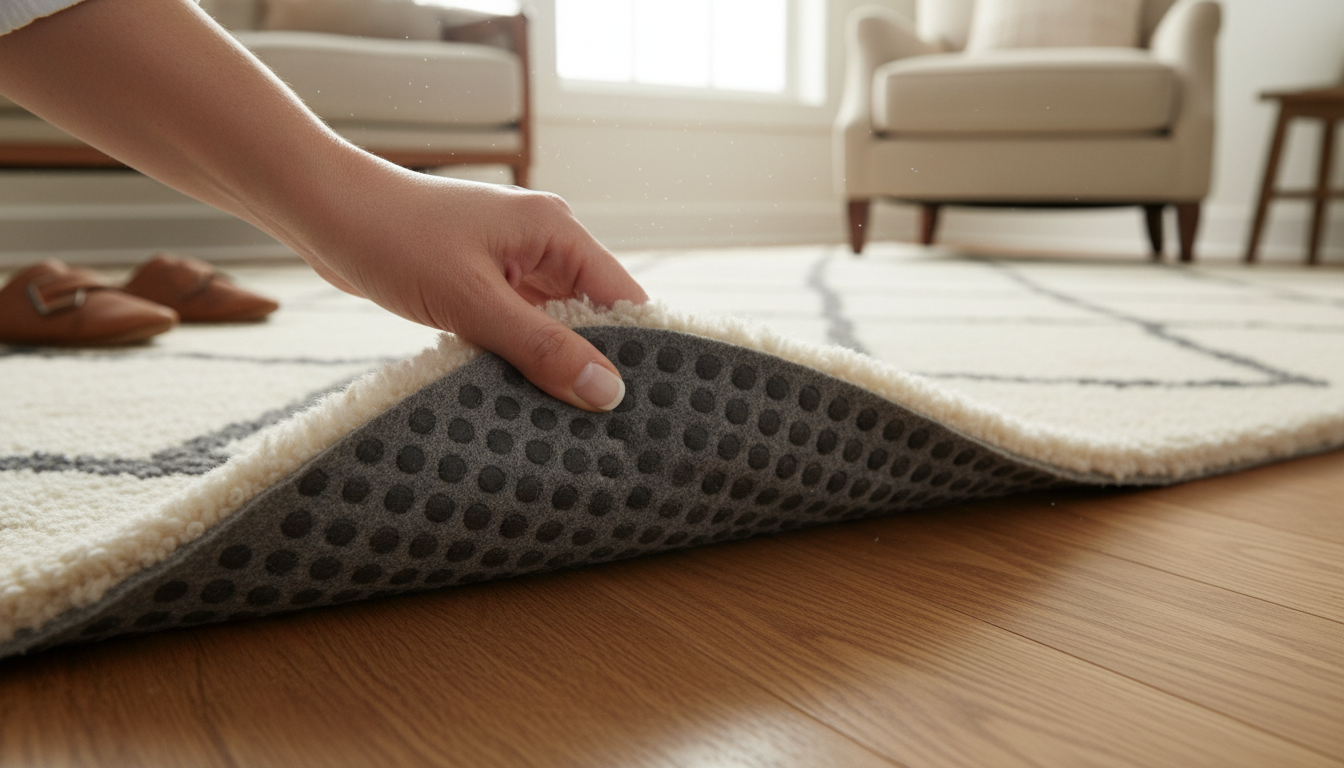
- The Connection: Use a high-quality, 1/8-inch felt pad between the two rugs to prevent “buckling,” a common mistake that ruins the luxury aesthetic.
To ensure your space doesn’t feel cluttered, follow the 2:1 rule of scale. Your base rug should ideally be at least two sizes larger than your vintage topper. For example, a 9×12 natural fiber rug provides the perfect “canvas” for a 5×7 or 6×9 antique. This creates a generous border that acts like a mat in a picture frame, elevating the top rug from a floor covering to a piece of art.
The beauty of this approach lies in its versatility. As seasons change, you can swap the vintage topper for something lighter—perhaps a vibrant flat-weave with hand-spun silk accents—without ever moving the heavy furniture that sits on the base layer. This flexibility is why the heritage bridge remains the highest-ROI styling move for discerning homeowners who want their spaces to feel curated, not just decorated.
The Bedroom Sanctuary: Ergonomic Layering for Comfort
The Architecture of a Morning Ritual
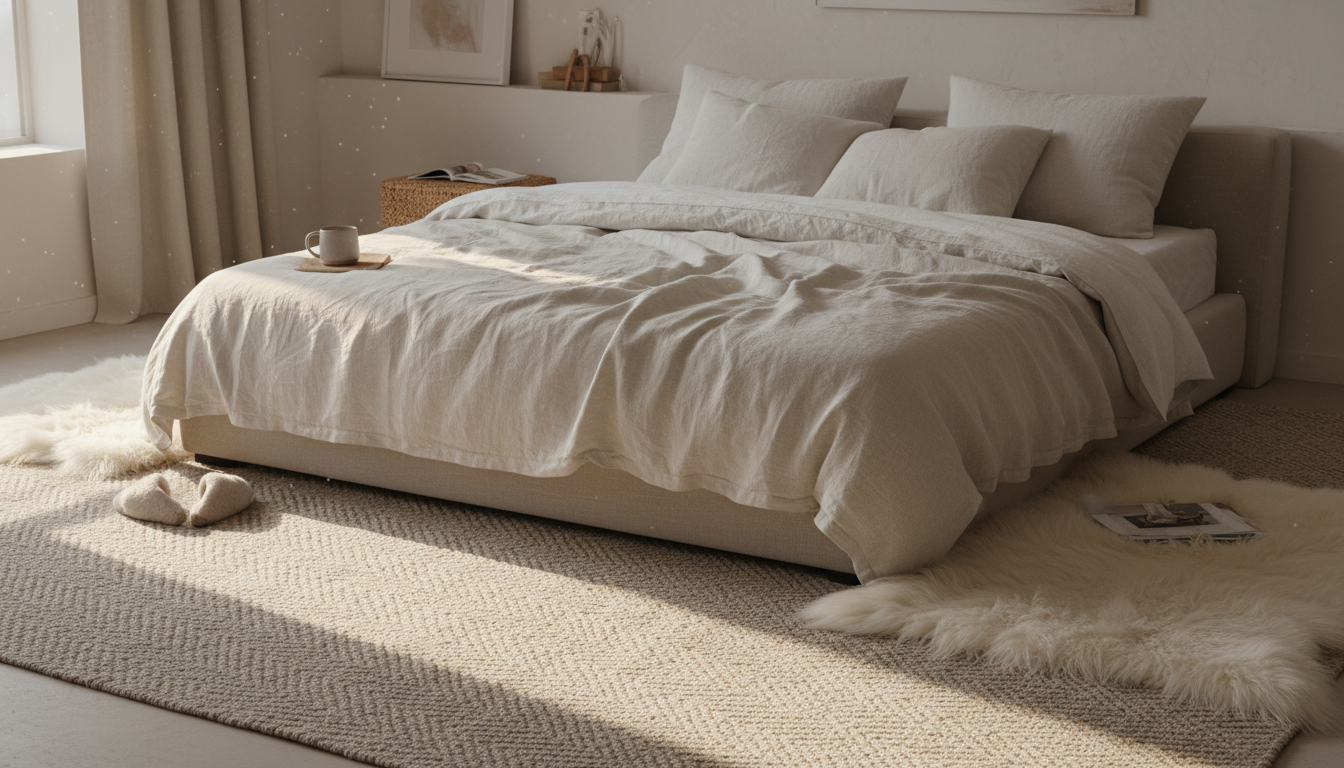
In the high-end residential landscape of 2026, the bedroom has transitioned from a mere sleeping quarter into a “sensory cocoon.” We are seeing a move away from the massive, wall-to-wall area rugs that dominated the early 2020s. Instead, designers are embracing ergonomic layering—a strategy that prioritizes the physical experience of moving through the space. The goal is to create a soft landing for your feet the exact moment you swing them out of bed, without sacrificing the visual “anchor” that a large rug provides to heavy furniture.
Consider the psychological impact of texture. A master suite curated with a large, low-profile jute or flat-weave base provides the necessary Light Reflectance Value (LRV) to keep the room feeling airy. However, placing a plush, hand-knotted pile rug or a high-twist New Zealand wool runner directly where your feet land introduces a secondary layer of acoustic damping. This specific “zonal layering” can reduce ambient noise by up to 40%, a critical metric for deep sleep hygiene in urban environments.
The “Step-Down” Method for Maximum Depth
One of the most effective ways to execute this is through the asymmetrical topper. Rather than centering a second rug perfectly under the bed, try placing a medium-sized, organic-shaped rug—perhaps a piece featuring the 2026 trend of Bio-Acetate silk blends—offset toward the foot of the bed or one side. This creates a lived-in, curated aesthetic that feels like a collection of stories rather than a showroom floor.
- The Foundation: Start with an oversized, low-pile neutral base. This should extend at least 24 inches beyond the sides of a King or Queen frame to ensure the room feels expansive.
- The Sensory Topper: Layer a pair of vintage Oushak runners or a singular high-pile Moroccan shag from thebohorugs.com. The contrast between the ruggedness of a base weave and the ethereal softness of a hand-knotted topper defines the “quiet luxury” look.
- The Transition: Ensure the top layer has a pile height of no more than 0.75 inches to prevent tripping while maintaining that “sink-in” feeling.
“The secret to a successful bedroom layer isn’t just the color palette; it’s the tactile transition. We are seeing a massive shift toward ‘haptic design’ where the friction and softness of the rugs dictate the flow of the room. A silk-touch topper over a structured wool base tells your brain it’s time to decompress.”
— Julian Thorne, Senior Textile Historian & Interior Consultant
To keep the space from looking cluttered, ensure your top layer leaves at least 18 inches of the base rug visible. This “reveal” acts as a frame, highlighting the craftsmanship of both pieces. If you’re using a runner over a base rug, secure it with a premium felt-and-rubber pad to prevent the “creeping” effect that often happens when textiles rub against one another.
Sustainability Meets Sophistication
As we look toward the 2026 design cycle, the materials themselves are becoming a status symbol. Designers are increasingly sourcing rugs that utilize low-impact vegetable dyes and undyed natural wools. When layering in the bedroom, the proximity to your skin makes these non-toxic choices even more vital. By sourcing artisanal pieces—like the hand-picked collections found at thebohorugs.com—you’re not just adding a layer of fabric; you’re adding a layer of ethical craftsmanship that grounds the room’s energy.
This approach also solves the “floating bed” syndrome. By using a darker, more textured base and a lighter, shimmering topper, you create a visual weight that holds the bed in place, even in large, high-ceilinged lofts where furniture can often feel lost. The result is a sanctuary that feels physically supportive and visually profound.
Maintenance Mastery: Friction and Fiber Health
The Physics of the Pile: Managing Under-Layer Friction
When we talk about rug layering, we often obsess over the visual “marriage” of patterns and textures, but the longevity of these high-end installations depends entirely on the invisible physics at play. In the 2026 design landscape, where we see a massive shift toward Bio-Acetate fibers and ultra-fine New Zealand wool, understanding the friction between layers is paramount. A heavy, hand-knotted statement rug placed directly onto a coarse sisal base creates a “sandpaper effect.” Every footfall causes the backing of the top rug to grind against the fibers of the bottom, leading to premature shedding and structural thinning.
Designers are now mitigating this by focusing on the Light Reflectance Value (LRV) and heat retention of the layers. Darker, denser base rugs, like those in deep Charcoal or a low-LRV Forest Green, tend to trap more ambient heat, which can actually make certain synthetic or silk-blend fibers in the topper more brittle over time. To preserve the “soul” of an artisanal piece—perhaps one of the heritage-quality finds from thebohorugs.com—you must ensure the foundation is as technically sound as it is beautiful.
The “Breathable Buffer” Strategy
The secret to a layered setup that lasts decades rather than seasons is the internal ecosystem. In 2026, the industry has moved away from thick, gummy rubber pads which can off-gas and damage hardwood finishes. Instead, we are seeing the rise of needle-punched felt buffers. These thin, breathable membranes sit between your two rugs, acting as a shock absorber that prevents the “creep” or “wave” that happens when a top rug stretches across a textured base.
- Rotate for Equilibrium: Every six months, rotate both the base and the topper 180 degrees. This ensures that sun exposure and “traffic troughs” are distributed evenly across both rugs.
- The Particle Purge: Fine dust acts like tiny shards of glass between rug layers. Once a quarter, peel back the topper and vacuum the surface of the base rug and the underside of the topper.
- Fiber Compatibility: Avoid pairing high-pile “shag” bases with heavy furniture on the top layer, as this can permanently crush the base fibers, creating an irreversible “ghosting” effect if you ever choose to un-layer the room.
“The most common mistake I see is ignoring the ‘bite’ of the rug backing,” says Julian Thorne, Lead Textile Consultant at the London Design Institute. “If your top layer has a stiff, latex-glued backing, it will eventually crumble and dust. For 2026, we are specifying rugs with hand-overcast edges and flexible, soft-back construction. It allows the layers to move in symphony rather than in opposition.”
Preserving the Integrity of Hand-Knotted Investments
High-end layering is a luxury, but it shouldn’t be a sacrifice. If you are layering a vintage Oushak or a modern geometric wool piece from thebohorugs.com, you are dealing with living fibers. These materials need to “breathe.” Natural fibers like hemp and jute are excellent bases because they allow for airflow, preventing moisture from becoming trapped between the layers—a common cause of dry rot in humid climates like the Pacific Northwest or the coastal Southeast.
Think of your rugs as a tailored suit; the base is the canvas, and the topper is the silk. If the canvas is too rough or the silk is too tight, the silhouette fails. By choosing a low-profile, high-density base and a supple, hand-woven topper, you create a space that feels deeply intentional and stands the test of time, both aesthetically and structurally.
Elevate Your Space
Discover the artistry of handmade luxury. Each rug is a masterpiece of tradition and modern design.
Expert Q&A
Can I layer rugs over carpet?
Yes, but stability is key. Use a thinner, flat-weave rug over low-pile commercial or Berber carpet. Avoid layering thick rugs over plush carpeting as it creates a tripping hazard and causes furniture to wobble.
What is the ideal ‘reveal’ for a layered rug look?
Interior designers typically recommend a 12 to 24-inch border of the base rug showing around the top rug to ensure the proportions look intentional rather than accidental.
Will layering rugs damage my hardwood floors?
Not if you use the correct padding. Always place a high-quality felt or natural rubber pad between the bottom rug and the floor to prevent scratching and allow the wood to breathe.
How do I prevent the top rug from bunching or sliding?
The secret is a ‘rug-to-rug’ tape or a very thin double-sided felt pad specifically designed to grip two textile surfaces without adding significant height.
Is rug layering suitable for high-traffic areas like entryways?
It is, provided you choose low-profile materials. A flat-weave kilim over a thin sisal base prevents trips while providing the durability needed for heavy footfall.
Can I layer two rugs of the same material?
You can, but the effect is more subtle. To achieve the 2026 ‘Designer Look,’ we recommend varying the weave—pairing a loop-pile base with a cut-pile topper for visual depth.
How do I clean layered rugs?
Vacuum each layer separately. Once a month, remove the top layer to vacuum the base rug thoroughly, as dust and fine grit can become trapped between the two layers and act like sandpaper on the fibers.
Does layering help with room acoustics?
Significantly. Layering increases the mass of sound-absorbing material on the floor, which can reduce echo and sound transmission by up to 50% in rooms with high ceilings.
Can I layer more than two rugs?
In maximalist or eclectic designs, three layers can work (e.g., a large jute, a medium wool, and a small sheepskin), but ensure the central ‘walking path’ remains clear of too many edges.
What colors work best for the base rug?
Neutral tones like oatmeal, sand, charcoal, or deep olive work best. Think of the base rug as a frame; it should complement the floor and the walls while letting the top rug provide the ‘pop’.
Written by TheBohoRugs Interior Design Team
Experts in handmade rugs, boho interiors, and modern home decor.