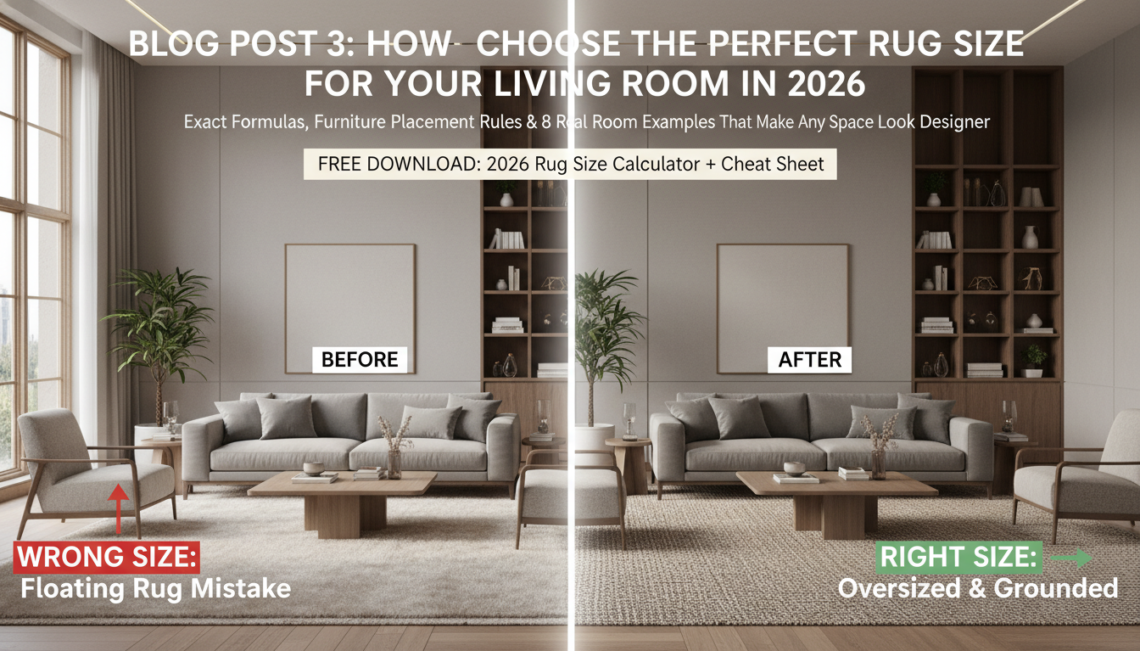
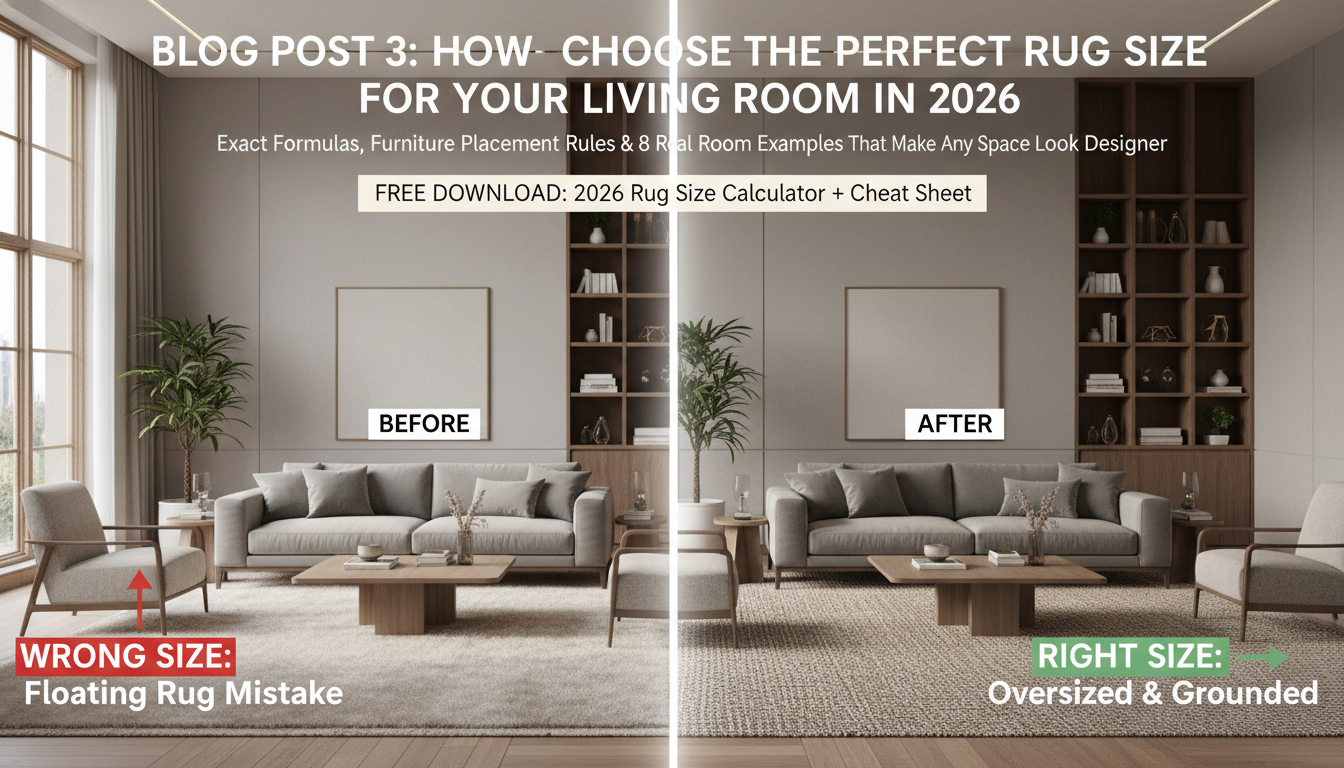
The ‘postage stamp’ rug is officially dead. In the design landscape of 2026, a rug is no longer a mere accessory; it is the architectural foundation of the home. We have moved past the era of floating textiles that disconnect furniture from floor. Today, high-end interior design focuses on the ‘anchored sanctuary’—a concept where oversized rugs create a cohesive, grounded environment that expands the perceived volume of a room. If your rug is too small, your furniture looks like it’s drifting at sea. To achieve the coveted Architectural Digest aesthetic, you must master the geometry of scale. This guide dismantles the guesswork, providing the exact mathematical formulas and placement protocols used by elite designers to ensure every square inch of your living space feels intentional and luxurious.
“To choose the perfect rug size for a living room in 2026, follow the ‘All-Legs-On’ rule for a premium look, or the ‘Front-Legs-Only’ rule for smaller spaces. Use the 2026 standard formula: Measure your seating area and add 24 to 36 inches to the width and length to ensure the rug extends beyond the furniture, creating a grounded anchor. For small rooms, a minimum of 8×10 ft is recommended, while medium and large open-plan spaces typically require 9×12 ft or 10×14+ ft rugs to avoid the ‘floating rug’ design mistake.”
The Roadmap
Table of Contents
- The Psychology of Scale: Why Oversized is the 2026 Standard
- The Golden Formulas: Calculating Your Perfect Footprint
- The Placement Hierarchy: All Legs, Front Legs, or Floating?
- 8 Real-World Visualizations: From Urban Lofts to Open-Plan Manors
- Material Science: How Fiber Choice Dictates Size Requirements
- The Blue Tape Test: Prototyping Your Layout Before Purchase
- Common Pitfalls: Avoiding the ‘Floating Island’ Effect
- The 2026 Rug Size Cheat Sheet for Every Sofa Type
Beyond the Postage Stamp: Why 2026 Demands Scale
The Death of the ‘Floating’ Rug
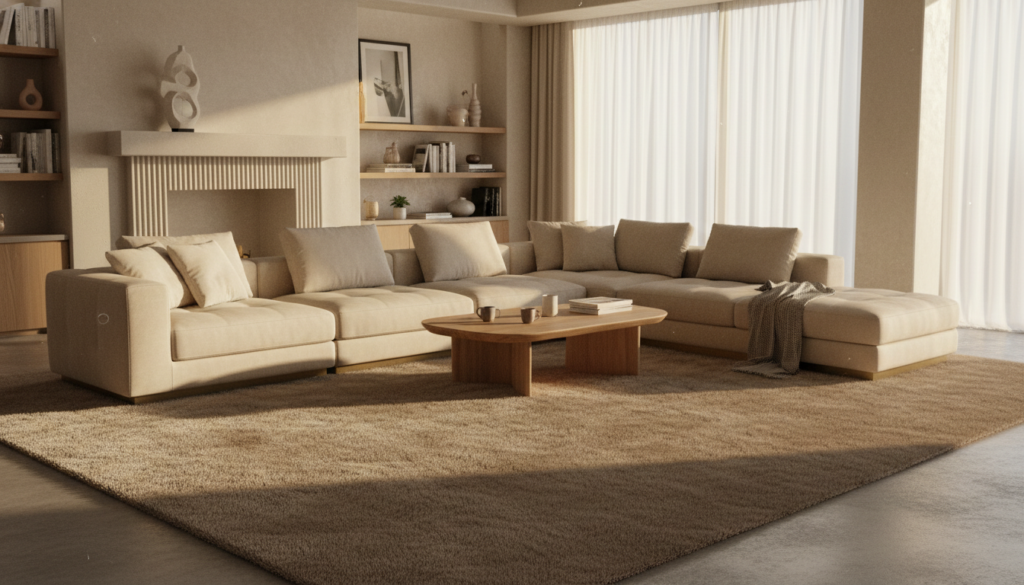
In the current design landscape, a rug that stops short of your furniture’s legs creates a visual “island” effect that actually shrinks your living room. When the rug is too small, your eyes track the hard lines of the floor between the sofa and the carpet, making the seating area feel disconnected and restless. 2026 is the year of the **oversized anchor**. Designers are now opting for dimensions that extend at least 12 to 18 inches beyond all seating. This “generous perimeter” creates a sense of luxury and intentionality. It tells the viewer that the room was curated, not just assembled. If you are working with a stunning hardwood or polished concrete, don’t fear covering it. The contrast between a massive, textured weave from thebohorugs.com and a sleek floor actually highlights the quality of both materials.
Scale as a Tool for Visual Quiet
There is a psychological component to the 2026 scale shift. In an era where we are bombarded with digital noise, our homes are becoming sanctuaries of “visual quiet.” A large, wall-to-wall-adjacent rug reduces “floor noise”—the cluttered look of various furniture legs meeting the floor at different intervals. “We are seeing a move toward what I call ‘The Infinity Placement,'” says Julianne Thorne, a lead textile historian and consultant for luxury residential projects. “By choosing an 10×14 or even a 12×15 rug for a standard living room, you eliminate the visual breaks that cause anxiety. You’re not just buying more wool; you’re buying a sense of calm. In 2026, the trend is about using **oversized rug placement rules** to make even a modest apartment feel like a sprawling suite.”
The Technical Edge: LRV and Fiber Density
When selecting these larger pieces, 2026 standards require a closer look at Light Reflectance Value (LRV). Because an oversized rug covers so much surface area, its color will significantly impact the brightness of your walls. A large rug in a deep charcoal will absorb light, making a room feel moody and intimate—perfect for high-ceilinged lofts. Conversely, an oversized cream or sage rug with a high LRV can make a dim North-facing room feel flooded with natural light. The shift toward **Bio-Acetate fibers and high-twist New Zealand wool** also plays a role here. These materials allow for larger scales without the rug becoming impossibly heavy or difficult to clean. At thebohorugs.com, the focus is on these high-performance, artisanal weaves that provide the “weight” needed to anchor a room without the maintenance nightmare of older, synthetic oversized options.
For 2026, forget the old “front legs only” advice. To achieve a true designer look, aim for the 30-inch perimeter. Ensure your rug extends 30 inches behind your sofa and chairs if the furniture is floating in the room. This creates a dedicated “zone” that feels like a room within a room, a technique essential for modern open-plan living.
Why Scale Matters for Texture Layering
Another reason scale has become the headline of 2026 is the rise of **maximalist texture**. When you have a small rug, a high-pile shag or a chunky jute can look like a trip hazard. When that same texture is applied to an oversized rug, it becomes a landscape. Large-scale rugs allow for the “topography” of the room to shine. Imagine a hand-knotted piece from the Atlas Mountains—on a small scale, the pattern is cut off, and the soul of the craftsmanship is lost. On a 9×12 or larger, the geometric narrative of the weaver has room to breathe. This is how you choose a rug size for a living room in 2026: you don’t just measure the floor; you measure the ambition of the design.
The Golden Formulas: Calculating Your Perfect Footprint
The Era of the “Grounded Anchor”: Why Scale is the New Luxury
Walking into a room that feels “expensive” rarely has anything to do with the price tag of the sofa. It has everything to do with spatial grounding. In the design landscape of 2026, we are seeing a definitive departure from the “postage stamp” rug—those undersized 5×7 pieces that float awkwardly in the center of a room, making even the most palatial space feel disjointed and cramped. Today, luxury is defined by the oversized footprint: a rug so generous it acts as a secondary floor, unifying every architectural element from your walnut sideboards to your sage green walls (aiming for an LRV—Light Reflectance Value—of around 40 to ensure the rug doesn’t absorb all your natural light).
The goal is to create a cohesive island. When your furniture “hangs off” the edge of a rug, it creates visual tension. When it sits fully perched upon it, the room breathes. As we lean into the 2026 preference for Bio-Acetate fibers and high-twist New Zealand wools, the tactile experience of the rug needs to extend to where your feet actually land—not just where the coffee table sits.
Formula 1: The 30-Inch Perimeter Rule
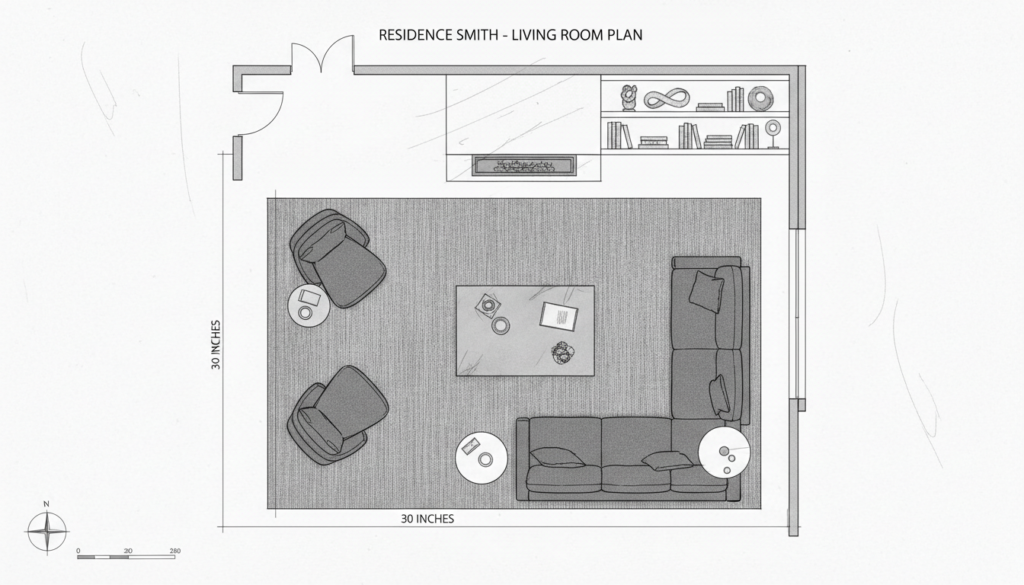
If you want that elusive “designer look” you see in high-end editorials, you need to stop measuring your coffee table and start measuring your entire seating arrangement. The most effective formula we use at the magazine is the Seating Boundary + 30. Take the width and length of your sofa, chairs, and tables as they sit in their final placement. Add 30 inches of rug to every side. This ensures that when a guest pulls a chair back or leans in, their feet remain on the textile. This extra breathing room prevents the furniture from looking like it’s falling off a cliff. For a standard 84-inch sofa, this almost always pushes you out of the “standard” 8×10 territory and into a more sophisticated 9×12 or even a 10×14 footprint from artisanal collections like those found at thebohorugs.com.
“The biggest mistake of the last decade was treating the rug as an accessory. In 2026, we treat the rug as the foundation. If the front legs of your armchair aren’t anchored on that weave, the room’s energy literally leaks out at the edges.”
— Julian Thorne, Senior Textile Historian & Interior Consultant
Formula 2: The “All-In” vs. “Front-Row” Calculation
Placement isn’t just about size; it’s about the visual weight of your furniture. In 2026, the trend is shifting toward “All Legs On,” particularly in open-concept homes where the rug serves as the only “wall” defining the living space.
- The All-Legs-On Formula: Measure your seating group and ensure the rug extends 6–12 inches behind the back legs of the sofa. This creates a “room within a room” effect that is essential for grounding large-scale, minimalist furniture.
- The Front-Row Formula: If your sofa is pushed against a wall, the rug should slip at least 12–18 inches under the front legs. This connects the seating to the floor covering, preventing that “floating island” look that ruins the flow of a modern living room.
Before you commit to a 10×14 investment, use blue painter’s tape to outline the rug’s dimensions on your floor. Leave it there for 24 hours. If you find yourself walking “around” the tape or if the sofa looks like it’s crowding the boundary, you need to go larger. In 2026, we prioritize flow over floor exposure; don’t be afraid to let the rug come within 12 inches of your baseboards.
The 18-Inch “Frame” Formula
While we are advocating for larger rugs, you still need to respect the architecture. The 18-Inch Frame is the gold standard for traditional closed-plan living rooms. This formula dictates that you should see approximately 18 inches of bare floor (be it white oak or polished concrete) between the edge of the rug and the wall. This creates a natural border that acts like a frame on a painting. In smaller urban apartments, you can cheat this down to 8 inches, but never let the rug touch the wall—this creates a “wall-to-wall” carpeting feel that lacks the curated edge of a luxury space.
When selecting your weave at thebohorugs.com, consider the pile height in relation to this formula. A thick, hand-knotted Shag or a textured 2026-style 3D-relief rug needs more “frame” space to avoid looking like it’s overwhelming the room’s proportions.
Placement Protocols: The ‘All-Legs-On’ Mandate
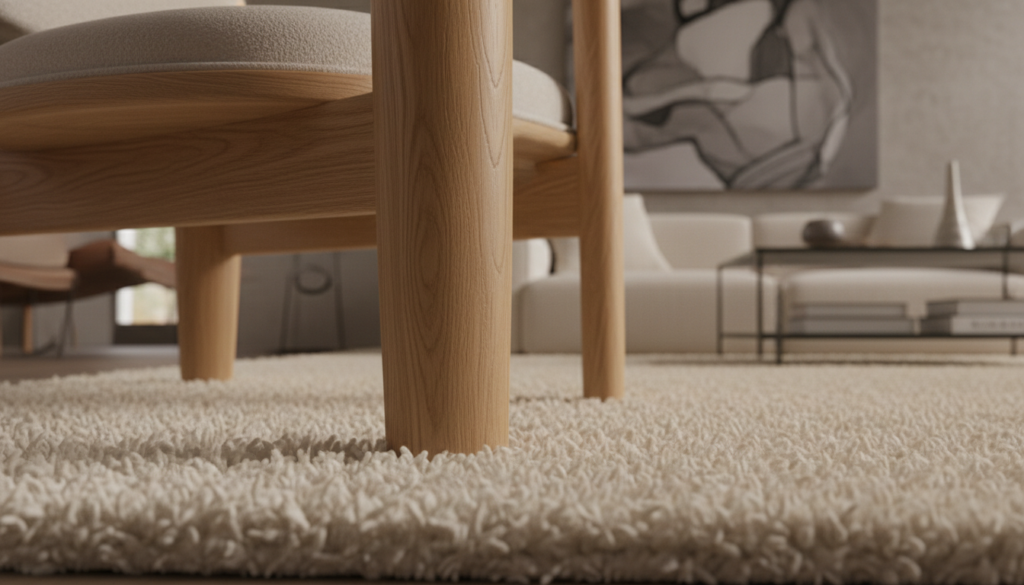
The Architecture of Grounding: Why Your Rug is a Foundation, Not an Accessory
Walking into a room where the furniture orbits a tiny rug like lonely satellites is a visceral design tragedy. We’ve all seen it: the “floating island” effect, where a 5×7 rug sits marooned in the center of a vast sea of hardwood, barely touching the coffee table. As we look toward 2026, the design world is undergoing a seismic shift toward maximalist grounding. This isn’t just about aesthetics; it’s about the psychological comfort of a defined perimeter. When every leg of your sectional, your accent chairs, and your side tables rests firmly on the pile, the room instantly feels resolved.
This “All-Legs-On” mandate serves as an invisible architectural boundary. It tells the eye exactly where the conversation starts and ends. In high-end residential projects, we are seeing a move away from standard poly-blends toward high-twist New Zealand wool and hand-knotted artisanal pieces that demand to be the centerpiece. A larger rug doesn’t just “fit” the furniture; it expands the perceived square footage of the room by pushing the visual boundaries toward the walls.
“The most common mistake I see in modern living rooms is a lack of courage regarding scale,” says Julian Thorne, Senior Textile Historian and Consultant. “In 2026, the luxury standard is the ‘Wall-to-Rug Ratio.’ We aren’t looking for postage stamps; we are looking for a canvas. A rug from a source like thebohorugs.com isn’t just floor covering—it’s a grounding element that anchors the Light Reflectance Value (LRV) of your walls, creating a cohesive ‘color box’ that feels intentional rather than accidental.”
The Geometry of the 30-Inch Border
To execute this look with surgical precision, you need to think in terms of margins. The goal is to have a minimum of 8 to 12 inches of rug extending beyond the back of the sofa. This creates a sense of abundance. If you’re working with a large open-concept space, the rug essentially becomes the “walls” of your living room. By ensuring every piece of furniture—including that heavy marble side table or the vintage Eames lounger—is fully accommodated, you eliminate the visual clutter of broken lines on the floor.
Consider the interplay between your rug and your wall color. If you have deep, moody walls with a low LRV (around 10-15), an oversized rug in a contrasting cream or sand tone creates a stunning “halo” effect. Conversely, for the 2026 trend of Tone-on-Tone Serenity, matching a sage green rug to a wall of the same hue requires the rug to be large enough to act as a seamless extension of the architecture. Smaller rugs break this illusion; larger rugs fulfill it.
- The Anchor Effect: Large rugs prevent furniture from “shifting” visually, making the arrangement feel permanent and high-end.
- Acoustic Luxury: Beyond looks, the “All-Legs-On” rule maximizes sound absorption, a crucial factor in the 2026 trend of “Quiet Luxury” interiors.
- Spatial Logic: It defines walkways. By keeping the furniture on the rug, the “traffic lanes” around the perimeter stay clear and intuitive.
Before committing to an oversized 10×14 or 12×15 piece, map it out. Use blue painter’s tape to outline the rug’s edges on your floor. If the tape doesn’t go at least 6 inches behind your sofa, the rug is too small. In 2026, the most sophisticated silhouettes are those where the rug terminates just 12 to 18 inches from the baseboards, creating a bespoke, near-wall-to-wall custom feel without the commitment of carpet.
Texture and Performance in Large-Scale Formats
When you scale up to these designer-approved sizes, material choice becomes paramount. A massive rug in a cheap material will lose its luster quickly. Look for bio-acetate fibers or premium wool-silk blends that offer a subtle sheen under recessed lighting. At thebohorugs.com, the focus on artisanal weaving ensures that even at 9×12 or 10×14, the tension of the weave remains consistent, preventing the “rippling” effect often seen in mass-produced oversized rugs. This structural integrity is what allows a room to look curated rather than cluttered, providing a smooth, uninterrupted visual plane that complements everything from mid-century walnut to contemporary bouclé sofas.
Case Studies: 8 Visual Examples of Perfect Proportion
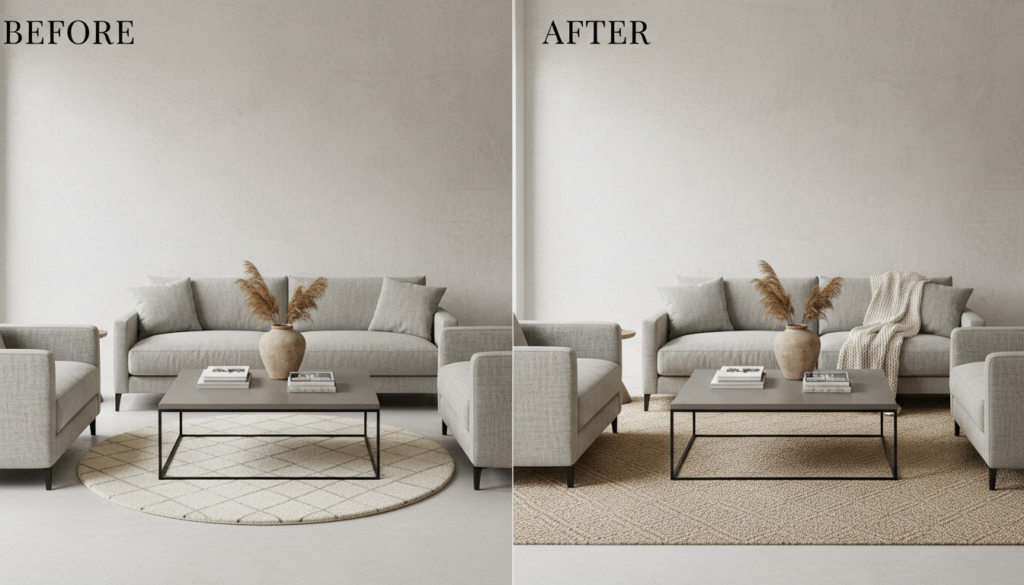
1. The Scandi-Industrial Studio: Expanding a Limited Footprint
In this 600-square-foot apartment, the goal was to make a charcoal-gray sofa and white walls feel like a cohesive suite rather than a collection of furniture. By opting for an 8×10 rug instead of a standard 5×7, the rug extends 12 inches past the sofa on both sides. This “visual spill” tricks the eye into thinking the floor area is larger. We recommended a high-LRV (Light Reflectance Value) cream wool piece from thebohorugs.com to bounce natural light back onto the ceiling, preventing the gray sofa from feeling “heavy” in a small room.
2. The “All-In” Sectional: Harmonizing Warm Neutrals
Medium-sized family rooms often fall victim to the “half-on, half-off” trap. Here, a 9×12 oversized rug anchors a modular sectional. By ensuring all legs of the furniture sit firmly on the textile, the room feels anchored. This setup is particularly effective for 2026’s “Quiet Luxury” aesthetic, where the rug’s texture—think undyed New Zealand wool—provides the primary visual interest against warm beige walls. It creates a defined island of comfort that separates the lounging zone from the dining area.
3. The Open-Plan Great Room: Defining the Walnut Gallery
Large open-plan spaces with walnut furniture and greige walls need a 10×14+ statement size to prevent the furniture from looking like it’s drifting at sea. In this example, the rug acts as a border, leaving exactly 18 inches of exposed hardwood between the rug edge and the wall. This creates a “frame” for the room, making the mid-century silhouettes of the walnut chairs pop against the neutral fibers.
4. The Narrow Row House: The Elongated Rectangle
Narrow living rooms are notoriously difficult to size. A common mistake is using a small square rug that chops the room in half. In this case study, we utilized an elongated 8×12 custom-cut piece. This shape draws the eye toward the focal point—a bold, navy accent wall—while keeping the walkway clear. By choosing a low-pile, high-performance weave, the transition from the hallway to the seating area remains seamless and trip-free.
5. The Curvilinear Nook: Organic Shapes in Small Scales
2026 is the year of the curve. In this cozy reading nook, we bypassed the rug size formulas for sofa and coffee table in favor of an organic, kidney-shaped rug. This breaks up the rigid lines of the surrounding bookshelves and window frames. The key to this “Designer Look” is ensuring the rug is large enough that the armchair and the side table sit entirely within the rug’s silhouette, creating a “room within a room.”
- Sofa Style: Curved Bouclé
- Rug Choice: 8′ Round or Organic Freeform
- Why it works: Softens the “boxiness” of standard apartment architecture.
6. The High-Traffic Hub: Performance Meets Scale
For a family space with kids and pets, we looked at a room featuring a large leather sofa and clay-toned walls. The solution? A 9×12 performance rug made from Bio-Acetate fibers. These 2026-gen fibers mimic the sheen of silk but offer the durability of nylon. By sizing up, we ensured that even when the kids are playing on the floor, they are on the rug, protecting the expensive oak flooring underneath while keeping the room looking polished.
7. The Modern Minimalist: The Precision 10×14
In a minimalist loft with oak furniture and white-washed walls, there is no clutter to hide mistakes. We used a 10×14 rug to create a “monastic” level of calm. When every piece of furniture—the sofa, the accent chairs, the marble coffee table—is contained within the rug’s boundaries, the room achieves a sense of “zen” symmetry. It’s a masterclass in using oversized rug placement rules to create a high-end, gallery-like atmosphere.
8. The Layered Maximalist: The Base + Top Formula
This final example showcases the “layered look” that is dominating 2026 Pinterest boards. We started with a neutral, oversized 12×15 jute rug as a base, covering nearly the entire floor. On top, a smaller, vibrant 8×10 hand-knotted vintage piece was centered under the coffee table. This technique allows you to get the “grounded” designer look of an oversized rug without the massive price tag of a 12×15 premium wool piece. It’s textural, sophisticated, and incredibly forgiving in rooms with awkward layouts.
Selecting the right size isn’t just about the tape measure; it’s about the feeling of the space. When you move from a floating 5×7 to a purposeful, oversized 9×12, the room stops feeling like a collection of objects and starts feeling like a home. For those ready to make the transition, the curated collections at thebohorugs.com offer the specific 2026 dimensions—like the elusive 10×14 and custom runners—needed to execute these designer layouts flawlessly.
The Tape-to-Texture Pipeline: A Designer’s Blueprint
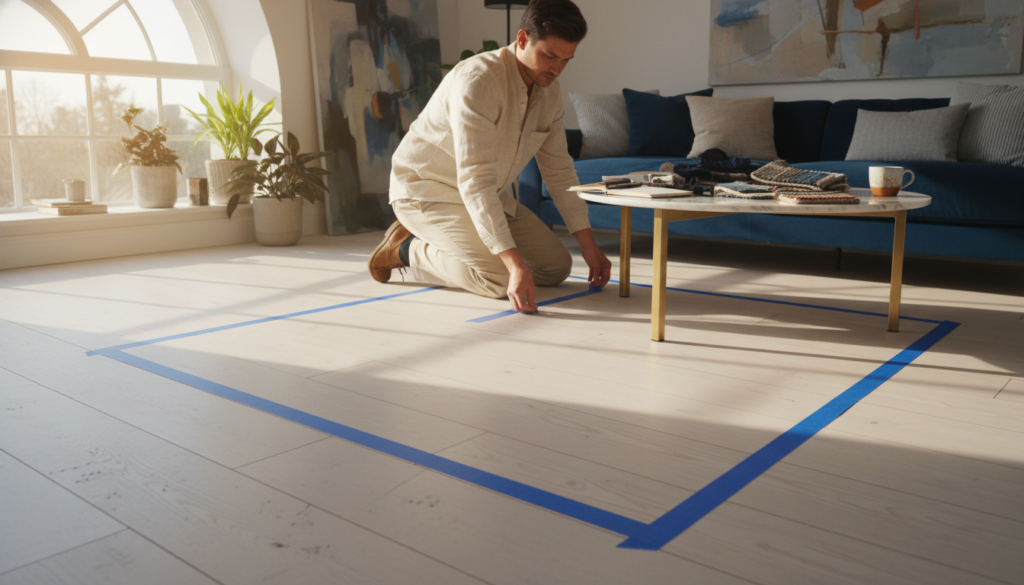
The “All-In” Mandate: Redefining 2026 Proportions
The 2026 aesthetic has moved away from the “front legs only” compromise. Designers are now leaning into the **Acreage Formula.** This approach treats the rug as a secondary floor—a lush, textured island where every piece of furniture in the seating group resides entirely on the textile. To achieve this, your starting point isn’t the sofa; it’s the perimeter of the room. A designer’s secret for 2026 is the **12-to-18-inch Rule.** In a standard living room, you want to see roughly 12 to 18 inches of bare floor between the edge of the rug and the baseboards. This creates a frame of negative space that highlights the floor’s material—be it reclaimed oak or polished concrete—while ensuring the rug feels intentional.
The New Rug Size Formulas for 2026
If you’re staring at a floor plan, forget the old 5×8 standard—that size has been relegated to the entryway or the bedside. For a modern living room, these are the updated blueprints:
- The Small Sanctuary (Apartment Living): For a standard three-seater sofa, a **9×12 rug** is the new minimum. This allows the sofa to sit fully on the rug with at least 8 inches of textile peeking out from the sides, instantly doubling the perceived square footage of the room.
- The Social Hub (Medium Living Room): If you’re pairing a sofa with two accent chairs, a **10×14 rug** is your hero. This size ensures the “walkway” is part of the design, preventing that awkward half-on, half-off stumble when guests move through the space.
- The Great Room (Open Plan): In 2026, we are seeing a surge in **12×15 and 13×18 rugs.** In an open-plan layout, the rug is the only thing defining the “room.” Without a massive rug, your furniture looks like it’s drifting in space.
— Julian Thorne, Principal Textile Historian
The Tape-to-Texture Pipeline: The “Test Drive”
Before you commit to a hand-knotted masterpiece from thebohorugs.com, you must engage in the **Blue Tape Ritual.** This is the bridge between a digital formula and physical reality. Map out your desired rug size on the floor using blue painter’s tape. Leave it there for 24 hours. Walk around it. Open the balcony doors. Vacuum around it. Does the tape feel like a boundary or a foundation? If the tape feels like it’s “in the way” of your natural traffic flow, you may need a custom cut—a service that high-end artisans now offer to ensure the rug fits the unique contours of 2026’s organic architectural shapes.
The Sectional Struggle: Solving the L-Shape Puzzle
Sectionals are the primary culprit of sizing confusion. The 2026 rule of thumb for L-shaped seating is the **6-Inch Extension.** The rug should extend at least 6 to 10 inches beyond both “ends” of the sectional. If the rug ends exactly where the sofa ends, the room looks chopped. By extending the rug, you create a visual “runway” that leads the eye toward the windows or focal points, making the furniture feel integrated rather than just “placed.”
Performance Meets Scale
We can’t talk about 2026 without mentioning the shift toward **High-Utility Luxury.** As oversized rugs become the standard, the “cleanability” factor of a large surface area is paramount. We are seeing a massive move toward oversized rugs crafted from **Bio-Acetate and recycled PET yarns** that mimic the sheen of silk but offer the durability of a performance fabric. This allows you to go big—covering nearly the entire floor—without the anxiety of a red wine spill ruining a 12×15-foot investment.
When you finally transition from the tape on the floor to a premium textile from a curated collection like those at **thebohorugs.com**, the transformation is instantaneous. It’s a sensory upgrade. The room suddenly sounds quieter (the “acoustic dampening” effect of an oversized rug), feels warmer, and looks undeniably designer. You aren’t just buying a rug; you’re defining the boundaries of your home’s most important sanctuary.
Elevate Your Space
Discover the artistry of handmade luxury. Each rug is a masterpiece of tradition and modern design.
Expert Q&A
What is the standard rug size for a 3-seater sofa in 2026?
In 2026, the standard has shifted toward 9×12 ft for a 3-seater sofa. This allows for at least 12-18 inches of rug to extend beyond both sides of the sofa, creating a balanced, grounded aesthetic rather than a cramped look.
Should all furniture legs be on the rug?
Ideally, yes. The ‘All-Legs-On’ rule is the gold standard for 2026. If the room is smaller, the ‘Front-Legs-Only’ rule is acceptable, provided the rug extends at least halfway under the furniture pieces.
How does rug size affect a small living room with light walls?
A larger rug in a small room actually makes the space feel bigger. By covering more floor area and extending near the walls, it eliminates visual breaks, creating a seamless ‘uninterrupted sweep’ that expands the room’s perceived footprint.
Can I layer different rug sizes?
Absolutely. A 2026 trend involves layering a smaller, high-texture rug (like a sheepskin or vintage piece) over a large, flat-weave neutral base. This adds depth and defines specific zones like a reading nook.
What is the 18-inch rule in rug placement?
This classic rule suggests leaving 18 inches of bare floor between the edge of the rug and the walls of the room to maintain a balanced border. In smaller 2026 apartments, this can be reduced to 8-12 inches.
What size rug works best for a sectional sofa?
Sectionals require larger rugs, typically 9×12 or 10×14 ft. The rug must be large enough so that all parts of the sectional sit on the rug, otherwise the room will feel lopsided.
How do I choose a rug size for an open-concept living area?
In open-plan spaces, use the rug to define the ‘island.’ Choose a size that encompasses the entire seating arrangement, effectively creating a ‘room within a room’ without the need for walls.
Does the coffee table size dictate the rug size?
Indirectly. The rug should be significantly larger than the coffee table—usually providing at least 24-30 inches of clearance on all sides—to ensure the table doesn’t look like it’s ‘overwhelming’ the rug.
What are the common rug sizing mistakes to avoid?
The most common mistake is the ‘floating rug,’ where the rug is too small to touch any furniture. Other mistakes include ignoring traffic patterns and failing to account for door clearances.
Is a round rug a good choice for a living room in 2026?
Round rugs are trending for 2026 in smaller, organic-modern spaces. They work best under curved furniture or in square rooms to soften the architectural lines.
Written by TheBohoRugs Interior Design Team
Experts in handmade rugs, boho interiors, and modern home decor.