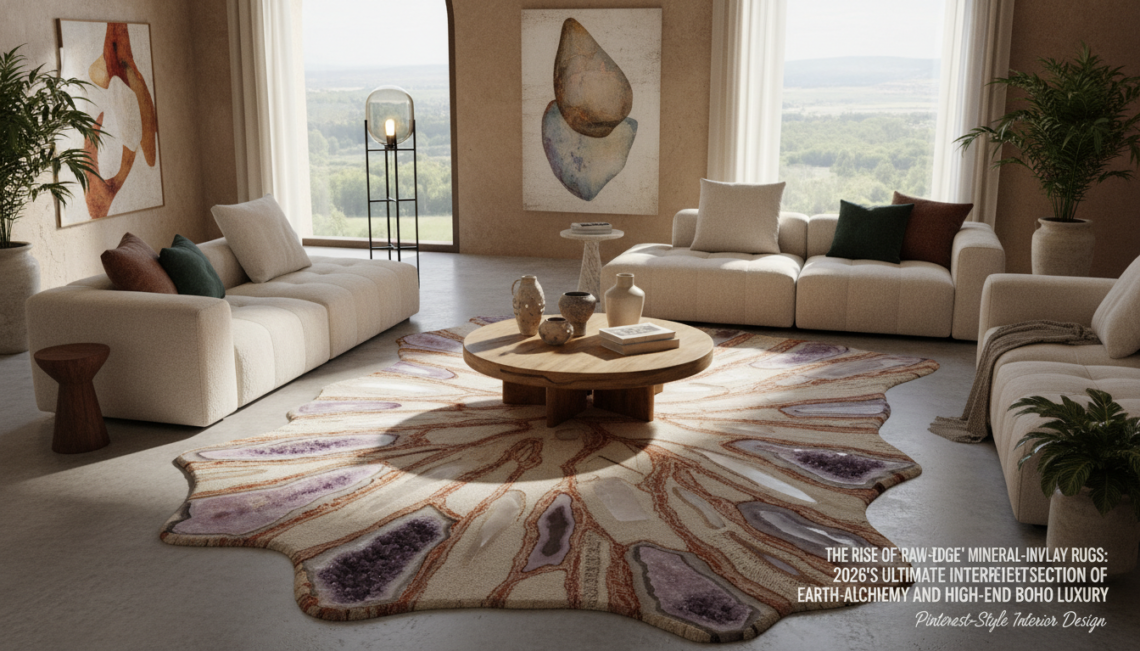
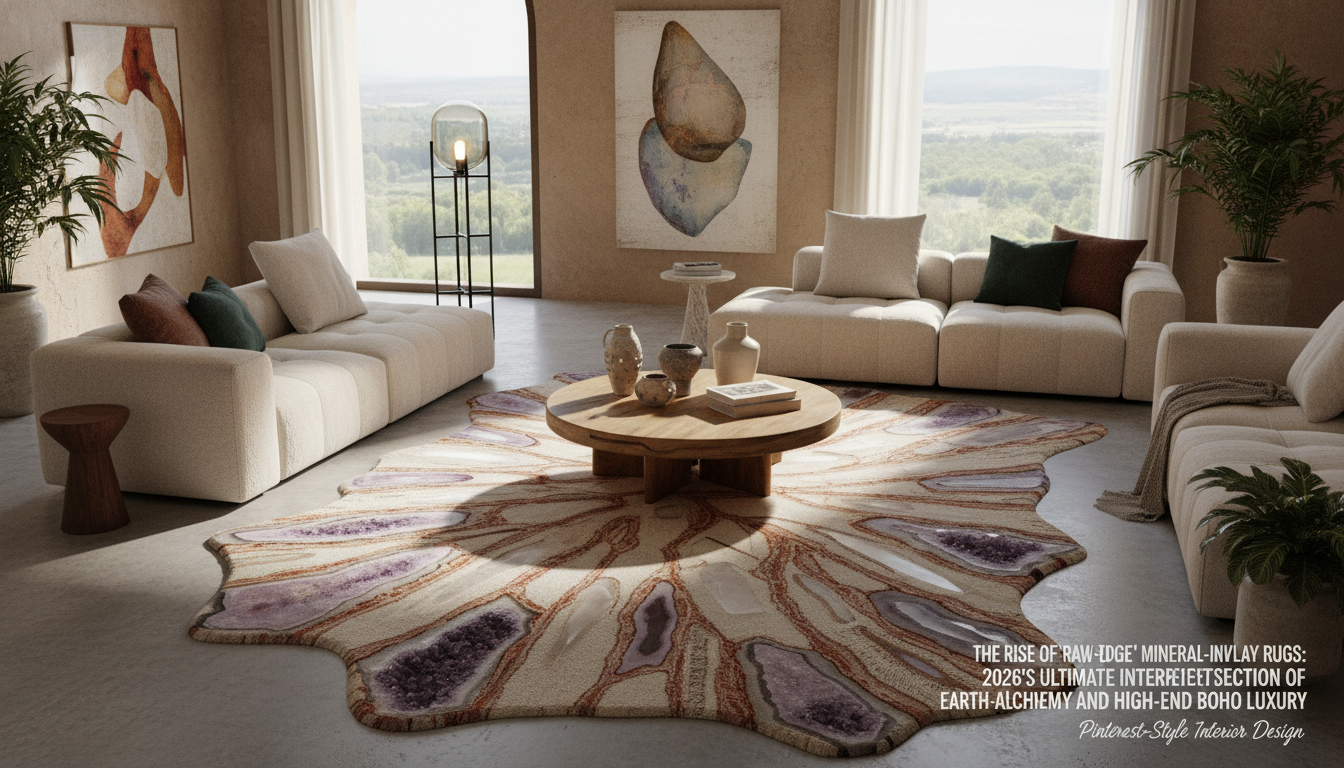
As we move into 2026, the boundary between geological formation and textile design continues to dissolve, giving rise to the most tactile trend in the luxury market: ‘Raw-Edge’ Mineral-Inlay Rugs. Far from the synthetic imitations of previous decades, Mineral-Inlay Rugs 2026 represent a sophisticated marriage of ancient earth-alchemy and modern artisanal craftsmanship. These are no longer mere floor coverings; they are ‘Art for the Floor,’ designed to ground high-end boho spaces with the raw energy of semi-precious stones and unrefined natural fibers. This trend report explores the tectonic shift toward interiors that prioritize sensory depth, geological history, and the unapologetic luxury of nature’s own handiwork.
“Mineral-Inlay Rugs 2026 are defined by the integration of semi-precious stone fragments—such as quartz, amethyst, and pyrite—directly into hand-knotted natural fibers like wool, silk, and jute. Characterized by ‘raw-edge’ silhouettes that mimic natural rock formations, these rugs prioritize organic irregularity over geometric precision, serving as a cornerstone of the ‘Earth-Alchemy’ aesthetic in high-end bohemian interior design.”
The Roadmap
Table of Contents
- The Evolution of Earth-Alchemy in Luxury Textiles
- Defining the ‘Raw-Edge’ Aesthetic: Geometrical Anarchy
- Material Science: From Sourcing to Substrate
- The Artisanal Process: How Minerals are Inlaid
- Styling 2026: Designing Around Floor Art
- The Sustainability of Mineral Extraction in Decor
- Investment Value: Why Mineral-Inlay is the New Fine Art
- Future Outlook: Beyond the 2026 Horizon
The Evolution of Earth-Alchemy in Luxury Textiles
Beyond the Loom: The Geological Rebirth of Textiles
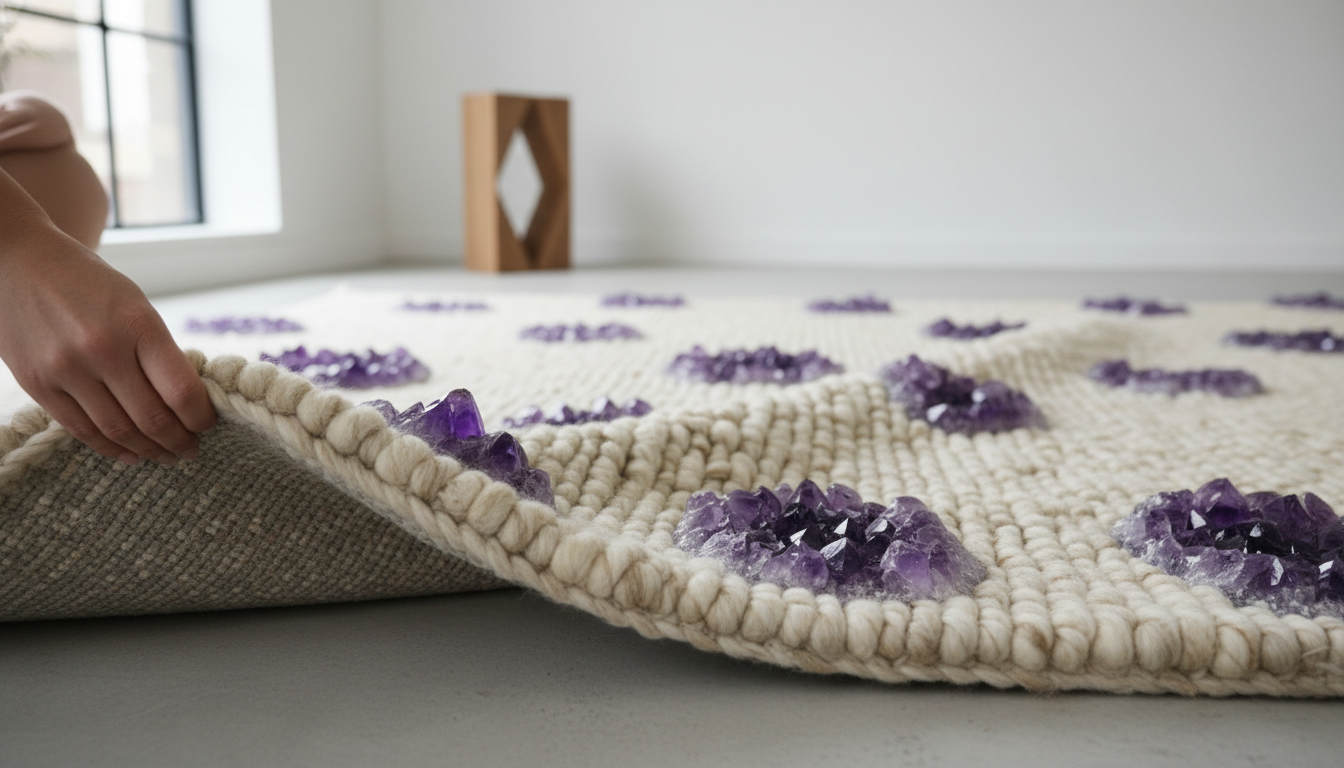
In the trajectory of high-end interior design, 2026 marks a definitive departure from the “disposable organic” trend toward a more profound geological permanence. This shift, often described as Earth-Alchemy, represents a sophisticated fusion of lapidary arts and traditional weaving. No longer are minerals merely inspiration for color palettes; they are becoming physical components of the fabric itself.
The emergence of Mineral-Inlay Rugs 2026 represents a synthesis of ancient masonry and modern hand-tufting. By embedding finely crushed semi-precious stones—such as smoky quartz, obsidian, and raw malachite—into the foundation of silk or high-altitude wool, designers are creating “living” floor coverings that react to light and temperature in ways a traditional dye never could.
For the discerning collector, this evolution represents a move away from the flat, predictable textures of the past decade. Curators at thebohorugs.com have noted that the modern luxury consumer is increasingly seeking pieces that feel “unearthed” rather than manufactured, favoring rugs that function as grounded sculptures for the home.
The Tactile Topography of Raw-Edge Design
The 2026 aesthetic is defined by “intentional imperfection.” The traditional bound edge is being replaced by raw, organic perimeters that mimic the jagged fault lines of a canyon or the soft erosion of riverbeds. This raw-edge philosophy extends into the mineral application, where the stones are not polished to a shine but left in a matte, crystalline state to maximize tactile feedback.
Industry insiders predict that the following three elements will define the elite tier of Mineral-Inlay Rugs 2026:
- Piezoelectric Textiles: The use of crushed clear quartz within the weave to theoretically enhance the energetic “vibration” of a living space.
- Sedimentary Layering: A technique where wool density varies to mimic the stratification of rock, creating a 3D topographic map underfoot.
- Metamorphic Pigmentation: Utilizing pulverized iron ore and copper carbonates instead of synthetic dyes to achieve deep, oxidized hues that patina over time.
Investing in Earth-Alchemy
As we move deeper into the decade, the value of a textile is being measured by its mineral density and the provenance of its materials. This is not “boho-chic” in the sense of the early 2010s; this is a high-luxury iteration of the bohemian spirit—one that values the raw power of the earth over the refinements of the industrial loom.
The rise of Mineral-Inlay Rugs 2026 signals a return to “slow-luxury.” These pieces are labor-intensive, often taking months to cure as the mineral pigments bond with the natural fibers. This slow-burn approach to manufacturing ensures that every rug is a unique geological artifact, making them a cornerstone for the next generation of heirloom-quality interiors.
To navigate this new landscape, designers are turning to specialists like thebohorugs.com, whose collections emphasize the intersection of raw mineral beauty and artisanal integrity. In 2026, the most luxurious floor is the one that feels as though it were carved directly from the earth’s crust.
Defining the ‘Raw-Edge’ Aesthetic: Geometrical Anarchy
The Collapse of Formal Symmetry
In the high-stakes world of avant-garde interiors, the “perfect rectangle” has become a relic of the industrial age. As we look toward the dominance of Mineral-Inlay Rugs 2026, the aesthetic shift is characterized by what designers are calling “Geometrical Anarchy.”
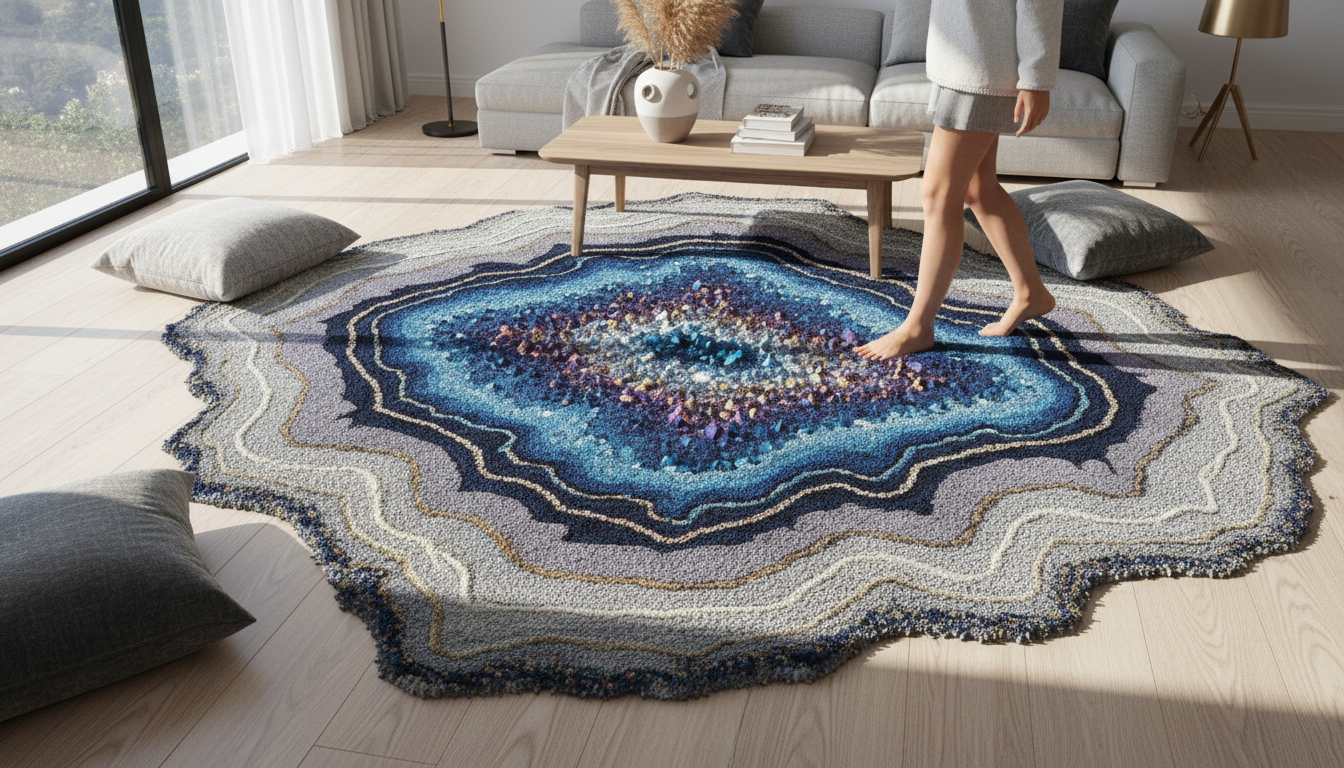
This movement rejects the constraints of traditional looms, favoring silhouettes that mimic tectonic shifts and jagged obsidian fractures. These pieces do not merely sit in a room; they appear to have erupted from beneath the floorboards, creating a dialogue between architectural structure and raw, unrefined nature.
The “raw-edge” isn’t an unfinished detail; it is a calculated design choice. By integrating crushed pyrite and pulverized malachite directly into the silk-and-wool wefts, artisans are achieving a level of Earth-alchemy that transcends simple home decor.
Lithic Textures and the Tectonic Shift
The 2026 aesthetic is defined by a sensory hierarchy. It is no longer enough for a rug to be soft; it must be evocative. The inclusion of mineral elements creates a topographical experience underfoot that mimics the high-desert landscapes of Atacama or the basalt plains of Iceland.
Key design elements defining this new era include:
- Serrated Perimeters: Edges that mirror the natural crystallization of quartz rather than straight-line stitching.
- Crystalline Veining: Thin, erratic lines of metallic thread and crushed stone that break the visual plane of the textile.
- Material Tension: The juxtaposition of ultra-fine Himalayan wool against the cold, hard reality of semi-precious stone inlays.
According to textile curators at thebohorugs.com, the demand for these “living” textures reflects a desire for interiors that feel both ancient and futuristic. This trend towards Mineral-Inlay Rugs 2026 signals a departure from mass-produced minimalism in favor of bespoke, geological storytelling.
The Rise of ‘Found-Object’ Luxury
We are moving away from rugs that look like they were made in a factory and toward those that look like they were “discovered.” This pivot toward Geometrical Anarchy is driven by a global elite who value the “imperfect” marks of artisan craftsmanship over clinical precision.
By 2026, the high-end boho market will prioritize pieces where the mineral dictates the shape of the rug. If a vein of amethyst runs wide, the rug follows. This organic growth creates a one-of-a-kind footprint that makes traditional luxury feel suddenly stagnant.
As collectors look to ground their spaces with more “weight,” the integration of heavy minerals into soft textiles provides a literal and metaphorical anchor. These rugs act as the foundational “stone” of the room, around which all other furniture must orbit.
Material Science: From Sourcing to Substrate
The Geology of the Loom: Ethically Sourced Gemstones
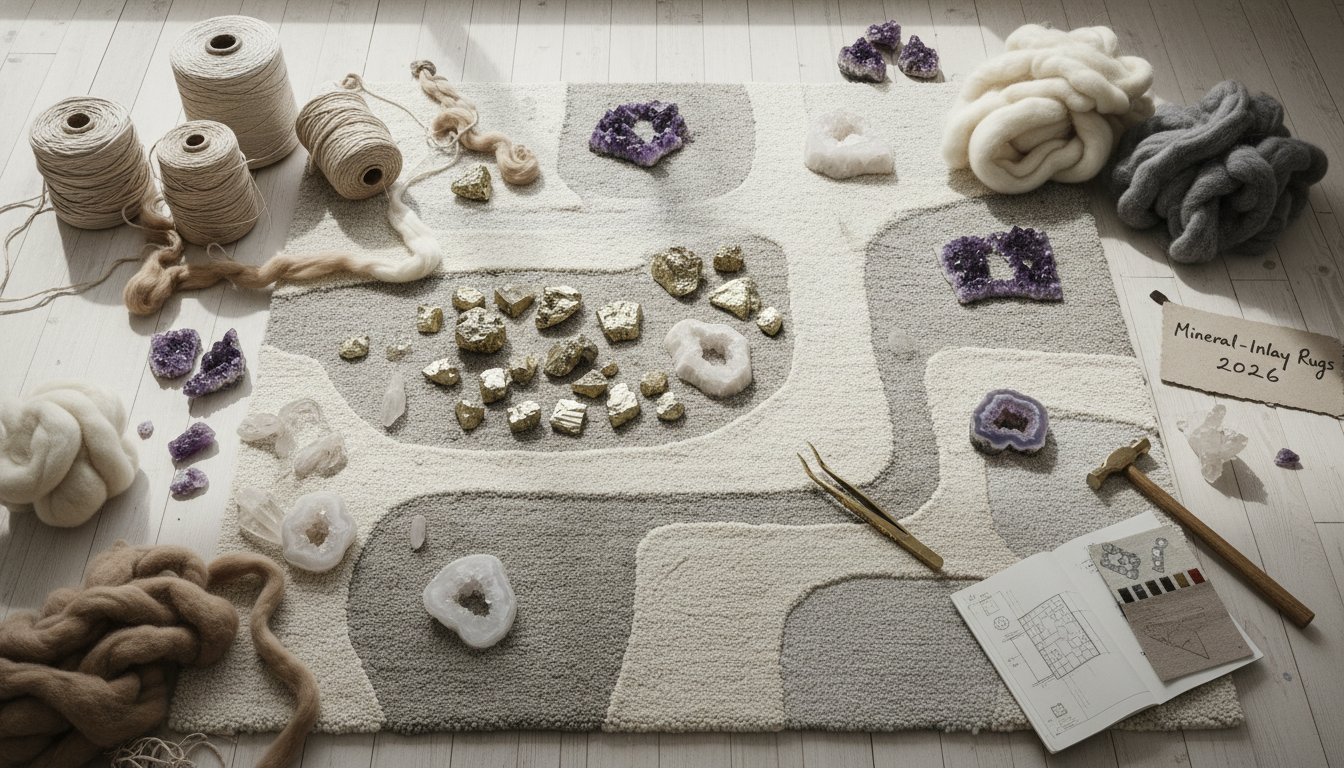
The transition toward Mineral-Inlay Rugs 2026 marks a departure from purely botanical dyes into the realm of geological permanence. Designers are now sourcing raw, semi-precious stones—such as crushed obsidian, lapis lazuli, and tiger’s eye—directly from artisanal mines that prioritize ecological restoration.
Unlike traditional glitter or synthetic shimmers, these minerals are ground into varying calibers, from fine “stardust” powders to “raw-edge” chunky chips. This creates a multi-dimensional surface that interacts with natural light in ways a standard textile cannot, effectively turning the floor into a living geode.
- Malachite & Azurite: Utilized for deep, saturated greens and blues that offer natural antimicrobial properties.
- Pyrite Inlays: Adding metallic “fool’s gold” veins to create a high-contrast, brutalist aesthetic.
- Rose Quartz Suspensions: Finely milled into the fiber wash for a soft, ethereal luminescence.
Engineering the Substrate: The 2026 Bio-Binder Revolution
Integrating stone into fabric requires more than simple weaving; it demands a feat of material engineering. By 2026, the industry is moving away from toxic glues in favor of bio-based resin binders derived from seaweed and fungal mycelium. This ensures the stones remain “locked” within the pile without compromising the rug’s flexibility.
The foundation of these pieces often utilizes high-altitude Himalayan wool or “Cactus Silk,” known for their incredible tensile strength. For those seeking the pinnacle of this craftsmanship, curators like thebohorugs.com highlight how these artisanal substrates provide the necessary “grip” to support the weight of mineral inclusions while maintaining a soft, underfoot feel.
Advanced Tension-Locking and Thermal Regulation
A key innovation in Mineral-Inlay Rugs 2026 is the use of tension-locking weaves. This technique involves varying the density of the warp and weft to “cradle” larger mineral shards. This prevents shedding and ensures the rug remains a durable heirloom rather than a delicate showpiece.
Beyond aesthetics, the material science of 2026 focuses on the thermal properties of the minerals themselves. Stones like jade and marble possess high thermal mass, allowing these rugs to provide a passive cooling effect in summer months—a critical feature for the evolving high-end boho interior.
The Rise of “Active” Minerals in Home Alchemy
Looking forward, we predict a shift toward “active” mineralogy. This involves the strategic placement of minerals based on their piezoelectric properties. When stepped on, certain quartz-heavy Mineral-Inlay Rugs 2026 generate minute, undetectable energetic shifts, leaning into the “Earth-Alchemy” trend that defines the new decade.
- Piezoelectric Quartz: Integrated into high-traffic zones to harness kinetic energy.
- Shungite Borders: Used for their purported ability to shield against electromagnetic frequencies (EMF) in smart homes.
- Layered Selenite: Inlaid into the perimeter to create a “cleansing” threshold for high-end residential entryways.
The Artisanal Process: How Minerals are Inlaid
The Convergence of Geological Integrity and Textile Mastery
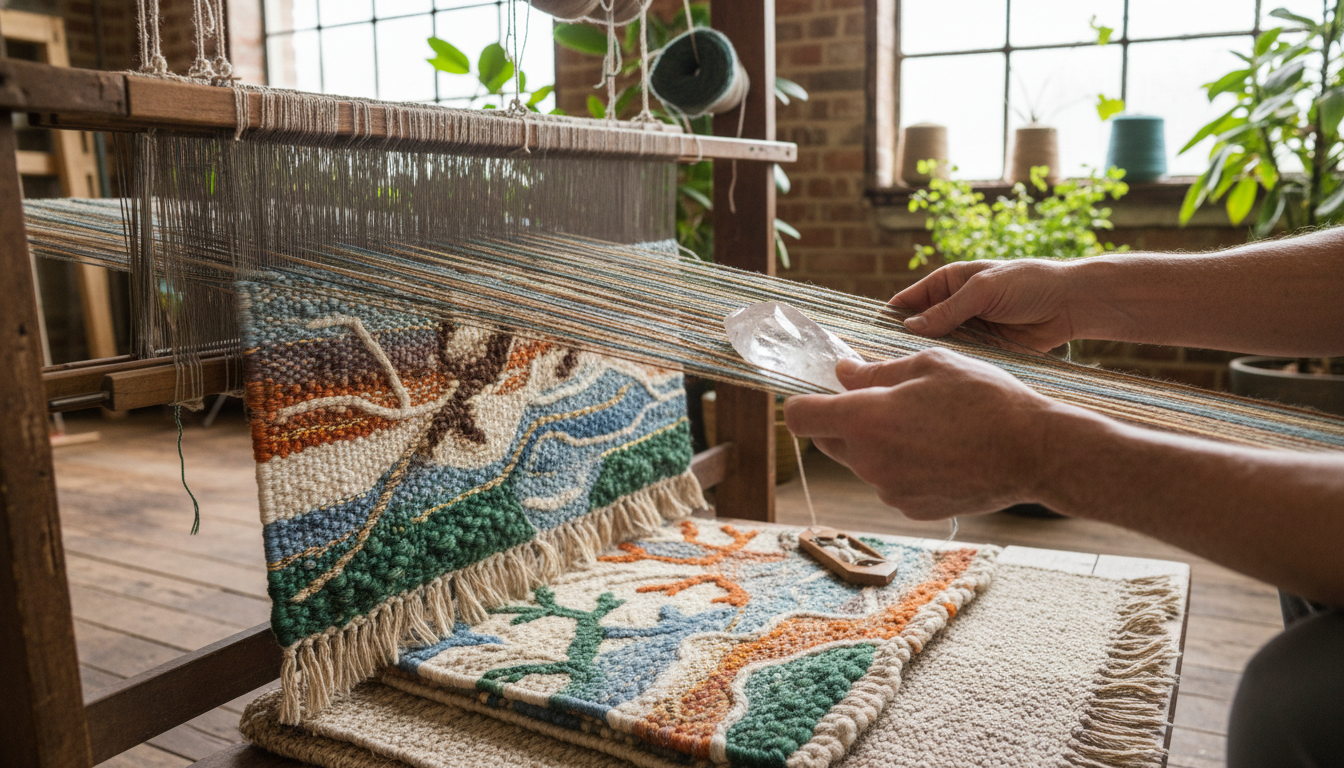
The evolution of interior design in 2026 has moved beyond the purely visual, gravitating toward a visceral, tactile connection with the earth. At the heart of this movement is a sophisticated manufacturing alchemy where geological specimens are no longer just ornaments on a mantle, but are physically woven into the architecture of the floor.
The creation of Mineral-Inlay Rugs 2026 requires a specialized discipline that bridges the gap between traditional rug-making and gemstone lapidary. Unlike the mass-produced patterns of the previous decade, these pieces utilize raw, ethically sourced minerals like crushed pyrite, translucent quartz, and deep malachite to create “veins” that mimic the natural cooling of volcanic rock.
For collectors seeking this level of tactile sophistication, thebohorugs.com serves as a primary source for understanding how these artisanal textures elevate a space from a standard “boho” aesthetic to a refined, high-end sanctuary.
The Multi-Stage Infusion Technique
The process of embedding minerals into a flexible textile base is a meticulous endeavor that rejects the speed of industrial machinery. Artisans have refined a three-tier approach to ensure the durability of the stones without sacrificing the softness of the rug’s high-micron wool or silk base.
- Micro-Sieving and Grading: Minerals are hand-crushed and sorted into specific grain sizes. In 2026, the trend favors “Raw-Edge” chunks—larger, irregular fragments that maintain their natural crystalline structure.
- Bio-Polymer Setting: To secure the stones, a proprietary, plant-based resin is used. This clear, flexible binding agent holds the minerals in place within the fibers, allowing the rug to be rolled or moved without losing its geological character.
- Fiber Entrapment: Rather than simply gluing stones to the surface, the minerals are “nested” into recessed channels hand-carved into the pile, creating a flush surface that feels like walking across a polished riverbed.
2026 Trends: From Crystalline Borders to Veined Centerpieces
As we look toward the signature interiors of the coming year, the application of Mineral-Inlay Rugs 2026 is becoming more daring. We are seeing a shift away from symmetrical borders toward “Tectonic Fractures”—designs where the mineral inlay appears to burst through the wool in unpredictable, jagged lines.
Expert designers are currently prioritizing three specific mineral palettes for the 2026 season:
- Obsidian and Charcoal Wool: A study in monochromatic depth, using the reflective properties of volcanic glass to catch low-level ambient lighting.
- Lapis Lazuli and Raw Silk: A nod to ancient Mediterranean luxury, where the deep blue of the stone contrasts with the cream-colored sheen of premium silk.
- Rose Quartz and Sand-Washed Jute: The ultimate expression of “Earth-Alchemy,” blending the warmth of the crystal with the rugged, organic texture of sustainable plant fibers.
This artisanal precision ensures that every piece is a unique geological record. By integrating these permanent elements of the earth into the home, Mineral-Inlay Rugs 2026 offer more than just comfort; they provide a grounding, prehistoric luxury that modern synthetic alternatives simply cannot replicate.
Styling 2026: Designing Around Floor Art
The New Hierarchy: Floor-First Curation
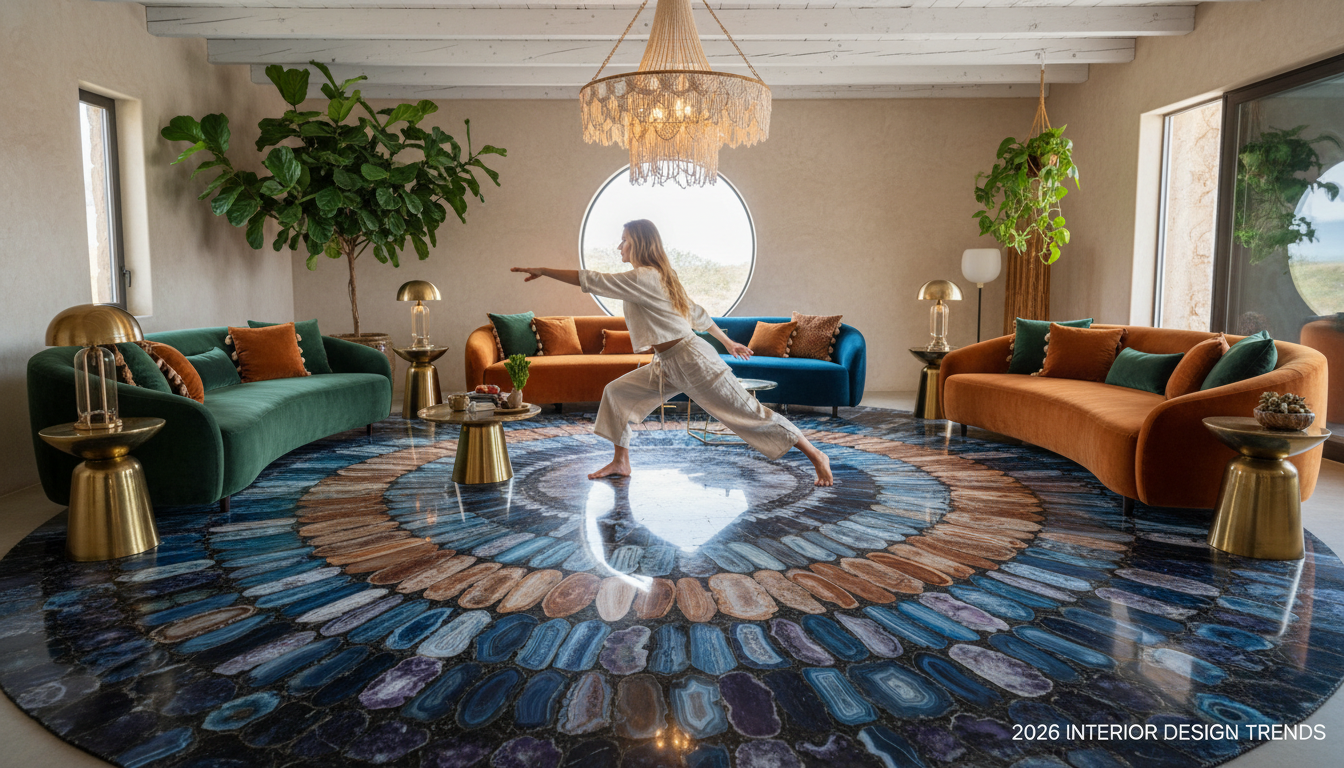
In the evolving landscape of 2026 interior design, the rug is no longer a silent partner to the sofa. We are witnessing a pivot toward “Floor-First” curation, where Mineral-Inlay Rugs 2026 serve as the structural and aesthetic foundation of a room. This shift moves away from mass-produced minimalism toward “Earth-Alchemy”—a design philosophy that treats geological textures as high-art statements.
Designing around these pieces requires a departure from traditional layering. Instead of obscuring the intricate mineral patterns, designers are opting for “island arrangements.” This involves using floating furniture with slender, tapered legs—think mid-century silhouettes or ethereal glass-topped tables—to ensure the raw-edge borders and crystalline inclusions remain visible from every angle.
For collectors seeking authentic craftsmanship, sourcing from specialized curators like thebohorugs.com ensures that the rug possesses the requisite tactile depth. These pieces aren’t just floor coverings; they are topographical maps of luxury that dictate the room’s entire energy flow.
Material Alchemy: Pairing the Raw with the Refined
The hallmark of 2026’s high-end boho aesthetic is the deliberate friction between the rugged and the polished. To master this look, one must balance the organic grit of mineral-flecked wool with industrial or ultra-refined finishes. Consider the following paring strategies to elevate your space:
- Geological Brutalism: Pair a quartz-inlay rug with a raw-cut travertine coffee table. The shared mineral DNA creates a cohesive, grounded atmosphere.
- Reflective Counterpoints: Use smoked glass or polished chrome accents to catch the light reflecting off the metallic mineral fibers woven into the rug’s pile.
- Textural Polarity: Contrast the “crunch” of a raw-edge mineral rug with the liquid smoothness of a mohair velvet armchair or a silk wall covering.
Illuminating the Inlay: A 2026 Lighting Strategy
To truly activate the visual potential of Mineral-Inlay Rugs 2026, lighting must be treated as a kinetic element. Static, overhead lighting is being replaced by “grazing” techniques. Low-level LED floor washers or adjustable picture lights positioned near the floorboards allow light to skim the surface of the rug.
This side-lighting technique emphasizes the three-dimensional quality of the mineral shards and the variable heights of the hand-knotted wool. At night, these rugs transform, with the embedded minerals glimmering like subterranean veins of ore, providing a sense of “quiet opulence” that defines the modern luxury home.
Chromatic Geology: The 2026 Palette Transition
The color stories of 2026 are moving beyond the safe neutrals of previous seasons. We are seeing a surge in “Oxidized Tones”—deep hematite greys, malachite greens, and burnt ochre. When styling around these pigments, the goal is monochromatic layering rather than high-contrast matching.
1. Select a Hero Mineral: Identify the dominant stone in the rug (e.g., Lapis or Citrine) and pull that pigment into your soft furnishings.
2. Layering Tones: Use varying shades of the same earthy hue to create a “sedimentary” look throughout the room.
3. Negative Space: Leave ample floor space around the rug’s raw edges to let the irregular geometry breathe against dark-stained hardwood or micro-cement floors.
Ultimately, the rise of Mineral-Inlay Rugs 2026 marks a return to the primitive and the permanent. By centering your design on these artisanal masterpieces, you are not just decorating a room; you are tethering your living space to the timeless, visceral beauty of the natural world.
The Sustainability of Mineral Extraction in Decor
From Extraction to Artistry: The Ethics of Earth-Alchemy
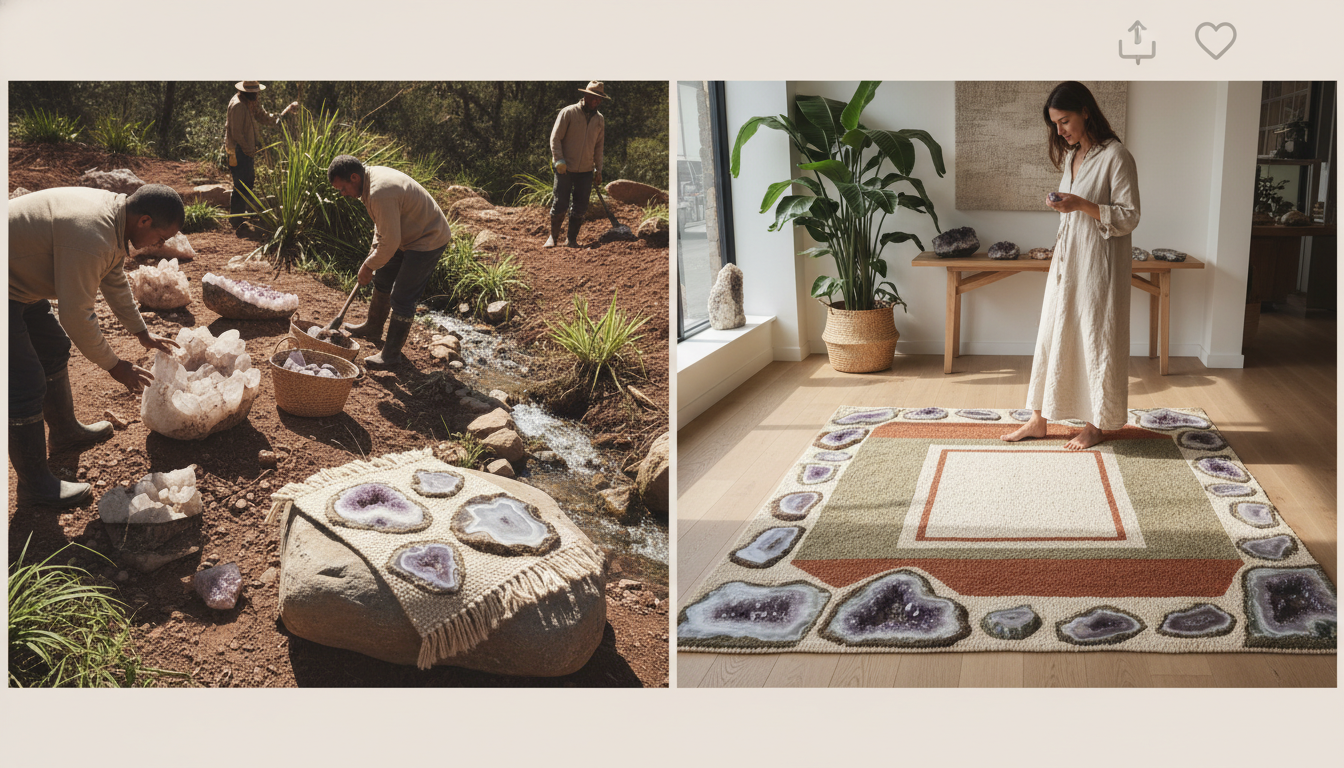
As we approach the mid-decade shift, the luxury market is distancing itself from the opaque supply chains of the past. The emergence of Mineral-Inlay Rugs 2026 marks a pivot toward “Geological Traceability,” where the value of a piece is measured by the transparency of its subterranean origins.
For the modern collector, sustainability is no longer an afterthought—it is the primary luxury. Design houses are now focusing on “Tailing Reclamation,” a process where high-grade mineral fragments discarded by the jewelry industry are salvaged and refined for textile integration.
This circular approach ensures that the pyrite, quartz, and obsidian found in these rugs do not contribute to new mining footprints. Instead, they represent a sophisticated form of upcycling that elevates Earth’s rawest materials into functional high-art.
The 2026 Prediction: Digital Mineral Passports
The coming year will see the debut of “Digital Mineral Passports” for high-end flooring. By scanning a discrete NFC tag embedded in the rug’s underside, owners can view the ethical lineage of every stone and fiber.
Expect these passports to highlight three key metrics for Mineral-Inlay Rugs 2026:
- Artisanal Extraction: Sourcing from small-scale, family-owned mines that utilize hand-tool methods rather than heavy machinery.
- Hydraulic Neutrality: Utilizing closed-loop water systems during the mineral crushing and polishing stages to prevent local groundwater contamination.
- Carbon-Negative Weaving: Pairing minerals with regenerative organic wool or wild-harvested silk to offset the energy used in stone processing.
Curated Rawness and the Artisanal Standard
The “High-End Boho” aesthetic of 2026 rejects the polished, mass-produced look of previous years. The focus has shifted toward “Raw-Edge” luxury, where the natural imperfections of the minerals are celebrated as unique signatures of the Earth.
This movement requires a level of craftsmanship that cannot be replicated by automated looms. Curators at thebohorugs.com emphasize that the longevity of these pieces is a sustainability pillar in itself; a rug built with genuine mineral density is designed to endure for generations, resisting the “fast-furniture” cycle.
By investing in Mineral-Inlay Rugs 2026, connoisseurs are choosing a piece that bridges the gap between ancient geology and futuristic ethics. These are not merely home accessories; they are tactile investments in a future where luxury and planetary stewardship are inextricably linked.
Investment Value: Why Mineral-Inlay is the New Fine Art
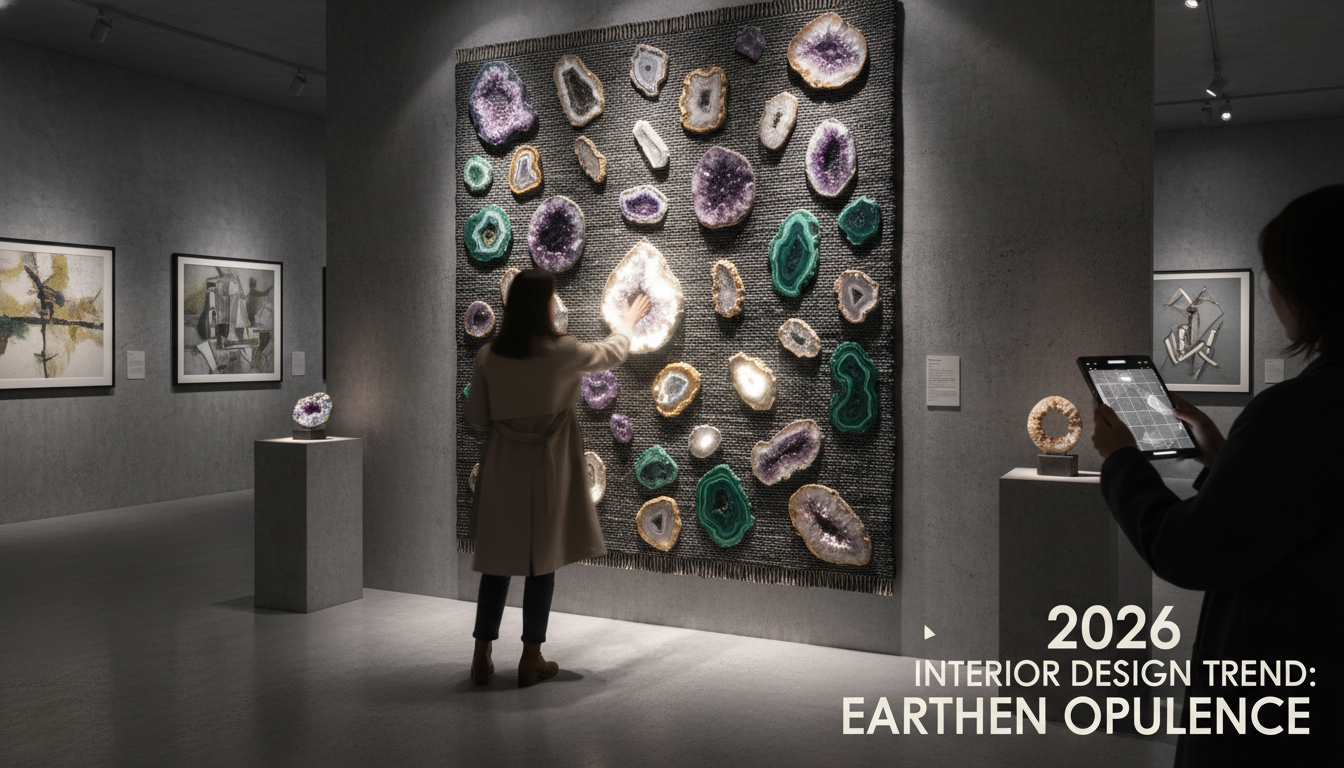
The Shift from Decorative Surface to Curated Asset
In the evolving landscape of interior design, the boundary between furniture and fine art is blurring. We are moving past the era of mass-produced minimalism into a period defined by Earth-Alchemy—a design movement where raw materials are treated with the reverence once reserved for precious metals.
As we look toward the market for Mineral-Inlay Rugs 2026, these pieces are no longer being categorized simply as floor coverings. They are being acquired by collectors as “horizontal sculptures,” valued for their geological rarity and the specialized labor required to fuse crushed minerals with high-altitude wool.
The investment value lies in the scarcity of the craft. Unlike traditional weaving, the integration of raw-edge stone requires a master’s understanding of both petrology and textile tension, making each piece a unique geological record.
The “Terroir” of Textiles: Provenance and Value
Just as fine wine is valued by its soil, the high-end market is beginning to demand “terroir” in home decor. The 2026 collector isn’t just looking for a pattern; they are looking for the specific energetic and aesthetic signature of the minerals embedded within the fibers.
Several factors contribute to the appreciating value of these artisanal works:
- Material Scarcity: The use of ethically sourced Lapis Lazuli, Malachite, and Tiger’s Eye ensures that production cannot be scaled, maintaining high secondary market demand.
- Labor Intensity: A single raw-edge piece can take up to six months to cure and weave, limiting annual global supply.
- Biophilic Resonance: As luxury spaces pivot toward “wellness-centric” architecture, the tactile presence of real minerals provides a grounding element that synthetic materials cannot replicate.
Why 2026 is the Year of the Alchemical Floor
The rise of Mineral-Inlay Rugs 2026 signals a rejection of the “fast-interior” cycle. Interior architects are increasingly advising clients to allocate budgets toward “foundation pieces” that gain character with age rather than succumbing to wear.
For those seeking to anchor a room with this level of organic sophistication, platforms like thebohorugs.com have become essential resources. Their focus on the intersection of heritage craftsmanship and raw, mineral-rich aesthetics provides the pedigree that modern art collectors demand.
We predict that by the end of the decade, these rugs will appear in auction houses alongside contemporary paintings. The “raw-edge” movement isn’t just a trend; it is the solidification of the home as a private gallery of the natural world.
Strategic Acquisition: What to Look For
- Stone Integration: Ensure the minerals are hand-inlaid rather than topically applied to guarantee longevity.
- Wool Quality: Look for hand-spun, lanolin-rich wools that provide a natural luster to contrast the matte finish of the raw stones.
- Artisan Signature: Investment-grade pieces often carry the mark of a specific weaving house, ensuring provenance for future resale.
Future Outlook: Beyond the 2026 Horizon
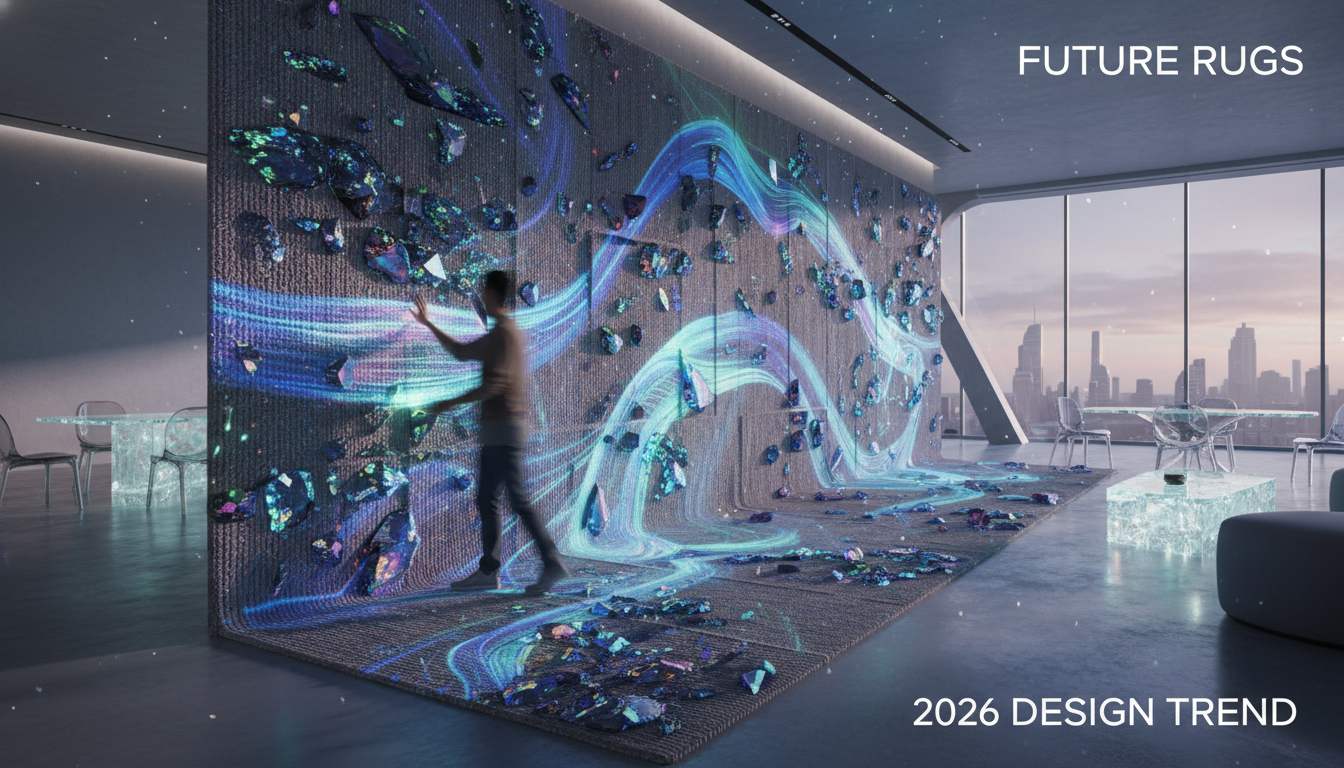
The Geological Shift in Artisanal Textiles
As we approach the latter half of the decade, the interior design landscape is shedding its preference for the clinically perfect. We are entering an era of visceral materialism, where the home serves as a curated sanctuary of Earth’s rawest elements. The emergence of Mineral-Inlay Rugs 2026 marks a definitive pivot away from disposable decor toward “geological artifacts” that command attention through weight, texture, and ancient resonance.
The “raw-edge” movement represents the next evolution of high-end boho luxury. By 2026, the industry anticipates a departure from standard rectangular silhouettes. Instead, we will see asymmetric, hand-clipped borders that mirror the tectonic irregularities of the natural world, seamlessly integrating crushed pyrite, obsidian, and amethyst into the very warp and weft of the textile.
Predictive Aesthetics: The 2026 Design Forecast
Designers are moving beyond the surface-level visual, focusing instead on the haptic and energetic properties of floor coverings. The future of high-end interiors lies in the balance between soft organic fibers and the cold, unyielding precision of stone. Experts suggest three key developments for Mineral-Inlay Rugs 2026 and beyond:
- Crystalline Conductivity: The integration of high-frequency quartz into wool lattices to promote “grounding” within smart-home environments.
- Topographical Weaving: Utilizing varying pile heights to mimic the jagged strata of canyon walls, creating a 3D landscape underfoot.
- Sedimentary Dyeing: Moving away from synthetics toward pigment sourced from the same minerals used in the inlays, ensuring a monochromatic, “of-the-earth” aesthetic.
Investing in Terroir-Driven Design
Just as the wine industry prizes “terroir,” the 2026 collector will demand specific geological provenance. A rug isn’t merely a rug; it is a piece of a specific mountain range or riverbed. This demand for authenticity is driving a resurgence in small-batch, artisanal production over mass-market mimicry.
The movement toward these specialized pieces is already being felt in the luxury market. Curators at thebohorugs.com have noted a significant uptick in clients seeking “living finishes”—textiles that age gracefully as the mineral components oxidize and the natural fibers patina over time. This creates a legacy piece that evolves with the architecture it inhabits.
The Sustainability of Earth-Alchemy
Looking past the 2026 horizon, the marriage of mineral and fiber offers a new blueprint for sustainable luxury. By utilizing “tailing” fragments—the beautiful remnants left behind by the jewelry and architectural stone industries—designers are practicing a form of high-fashion upcycling.
- Zero-Synthetic Mandates: A shift toward 100% biodegradable silk, hemp, and jute to support the weight of the stone inlays.
- Ethical Mining Partnerships: Direct-to-weaver mineral sourcing that ensures fair wages for both the miners and the artisans.
- Longevity as Luxury: The understanding that a Mineral-Inlay Rug 2026 is designed to last generations, countering the “fast-furniture” cycle.
Ultimately, the rise of these raw-edge masterpieces signals a collective desire to return to something permanent. In an increasingly digital world, the cool touch of an inlaid stone underfoot provides a sensory anchor, grounding the modern inhabitant in the timeless luxury of the Earth itself.
Elevate Your Space
Discover the artistry of handmade luxury. Each rug is a masterpiece of tradition and modern design.
Expert Q&A
What exactly are Mineral-Inlay Rugs 2026?
They are bespoke textiles that incorporate genuine semi-precious stones and minerals into the weave to create a three-dimensional, Earth-inspired aesthetic.
Are these rugs comfortable to walk on?
Yes, artisans strategically place the mineral inlays in low-traffic zones of the rug or use polished, flat-set stones to ensure comfort underfoot.
Which minerals are most popular in 2026 designs?
Quartz, pyrite, labradorite, and amethyst are the most sought-after minerals for their aesthetic depth and perceived energetic properties.
How do you clean a mineral-inlay rug?
Professional specialized cleaning is recommended; for home care, gentle suction without a beater bar and damp-cloth spot cleaning for the stones is best.
What is the ‘Raw-Edge’ trend?
It refers to rugs with non-linear, organic borders that mimic the natural state of geological formations rather than traditional rectangles or circles.
Is the ‘Earth-Alchemy’ style suitable for minimalist homes?
Absolutely. It provides a tactile focal point that adds warmth and complexity to minimalist ‘quiet luxury’ environments.
Do these rugs use synthetic glues to hold the stones?
High-end 2026 versions use mechanical weaving techniques and natural resins to secure the stones, avoiding harsh synthetic adhesives.
How heavy are these rugs compared to traditional ones?
They are significantly heavier due to the stone content, often requiring non-slip padding and professional installation.
Are Mineral-Inlay Rugs 2026 considered sustainable?
When sourced from ethical mines and paired with organic fibers, they are one of the most eco-conscious luxury decor options available.
Can I use these rugs in high-traffic areas?
It is best to place them in curated spaces like primary suites or formal lounges to preserve the integrity of the mineral fragments.
What kind of lighting best highlights these rugs?
Directional LED lighting or natural raking sunlight best captures the crystalline shimmer of the mineral inlays.
Do the stones fall out over time?
With master-level craftsmanship, the stones are integrated into the structural warp and weft, making them very secure.
What color palettes define Mineral-Inlay Rugs 2026?
Expect monochromatic ‘soil’ tones, deep ochres, oxidized coppers, and ethereal grays that complement the natural stone colors.
Are these rugs pet-friendly?
They are generally safe, though pets with long claws should be monitored to prevent snagging near the stone settings.
How do these rugs fit into the ‘Boho Luxury’ aesthetic?
They elevate boho style from ‘shabby chic’ to ‘curated organic,’ replacing mass-produced patterns with unique geological textures.
Can I customize the minerals in my rug?
Many high-end manufacturers offer bespoke services where clients can choose stones based on birthstones or specific aesthetic preferences.
What is the typical price range for these rugs?
As investment pieces, they typically range from $150 to $500 per square foot, depending on the rarity of the minerals used.
How do I verify the authenticity of the minerals?
Reputable sellers provide a geological certificate of authenticity for the stones used in the rug’s construction.
Are there vegan options for mineral-inlay rugs?
Yes, by substituting wool and silk with high-quality Tencel, bamboo silk, or organic cotton substrates.
Why is the term ‘Earth-Alchemy’ used?
It refers to the transformative process of turning raw, ‘lowly’ minerals and fibers into high-value, spiritually grounding art pieces.
Do these rugs have health benefits?
Proponents of crystal healing suggest the minerals can help ground energy in a room, though this is an aesthetic and lifestyle choice.
What size do raw-edge rugs usually come in?
While custom sizes exist, they are most effective as ‘island’ rugs (approx 5×8 to 8×10) where the raw edges are fully visible.
Are the minerals polished or raw?
2026 trends favor a mix, often featuring ‘tumbled’ stones for comfort and ‘druzy’ raw sections for visual impact.
Can these rugs be hung on the wall?
Yes, their status as ‘Art for the Floor’ makes them excellent candidates for high-end wall tapestries.
What fibers work best with mineral inlays?
Coarse, high-micron wool provides the necessary structural support to hold the weight of the minerals.
Is the mineral-inlay trend a fad?
The shift toward ‘biophilic luxury’ suggests that geological elements in home decor have long-term staying power beyond 2026.
How does moisture affect the stones?
Non-porous stones like quartz are unaffected, but the rug should be kept in a climate-controlled environment to protect the natural fibers.
Do mineral-inlay rugs come in bright colors?
The 2026 trend is moving away from neon toward saturated, natural pigments derived from plants and minerals.
Can I put furniture on top of the minerals?
It is advised to place furniture legs on the fiber-only sections of the rug to avoid cracking the inlaid stones.
Where can I buy authentic Mineral-Inlay Rugs 2026?
Look for specialized luxury boutiques like TheBohoRugs that focus on artisanal, small-batch textile production.
Written by TheBohoRugs Interior Design Team
Experts in handmade rugs, boho interiors, and modern home decor.
