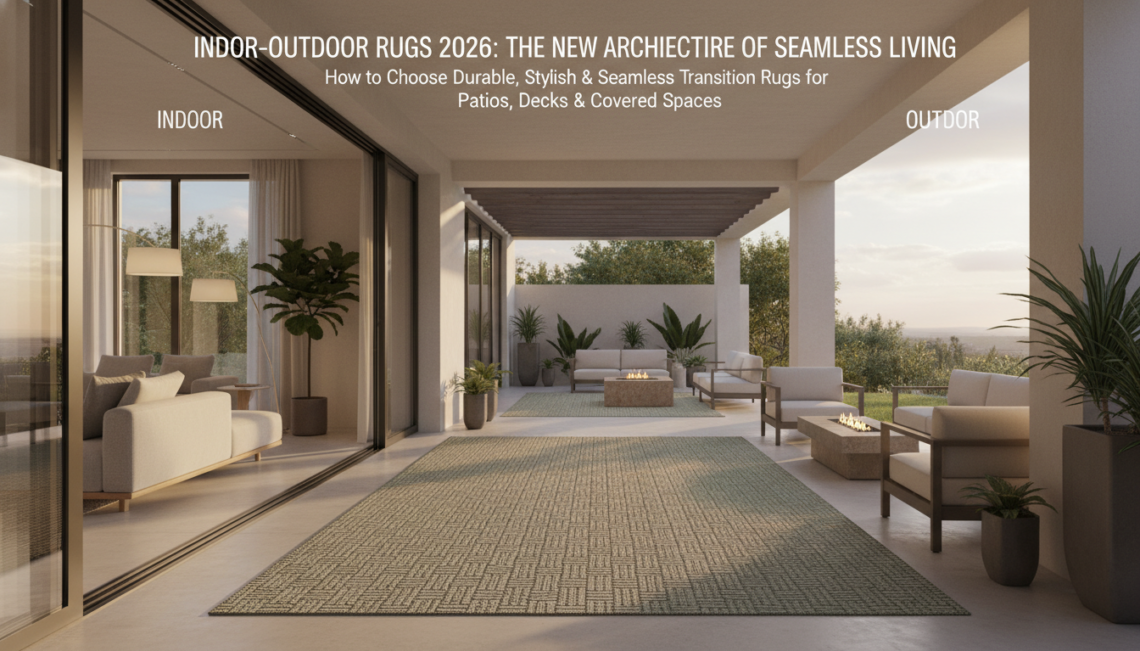
Indoor-Outdoor Rugs 2026: are no longer merely functional floor coverings; they have become the essential architectural bridge that dissolves the boundary between your indoor sanctuary and the open sky. In an era where the home is viewed as a holistic ecosystem, the ‘performance rug’ has undergone a high-fashion metamorphosis, replacing the scratchy, plasticky textures of the past with sophisticated weaves that mimic Belgian linen and raw silk. This shift isn’t just about aesthetics—it is a material science revolution that allows us to extend the luxury of our living rooms into the elements without compromising on durability or UV resistance. By mastering the art of the ‘one-space’ aesthetic, you can create a home that feels twice as large and infinitely more inviting.
“To select the best indoor-outdoor rugs in 2026, focus on high-performance materials like UV-stabilized polypropylene or recycled PET fibers which offer an ‘interior’ hand-feel with weather-proof durability. Ensure a seamless transition by selecting a rug size that anchors all furniture legs—typically 9×12 or larger for patios—and matching the color undertones to your interior flooring. Look for rugs with integrated drainage capabilities and low-profile piles (under 0.25 inches) to ensure door clearance and rapid drying after rain.”
The Roadmap
Table of Contents
- The 2026 Performance Renaissance
- 7 Essential Rules for Seamless Interior-Exterior Transitions
- Material Science: Why Recycled PET and Polypropylene Win
- 8 Curated Examples of High-End Outdoor Styling
- The ‘Oversized’ Philosophy: Anchoring Outdoor Zones
- Common Pitfalls: Avoiding the Fading and Drainage Trap
- Maintenance Protocols for Year-Round Elegance
The 2026 Performance Renaissance: Redefining the Threshold
The New Materiality: Beyond Basic Polypropylene
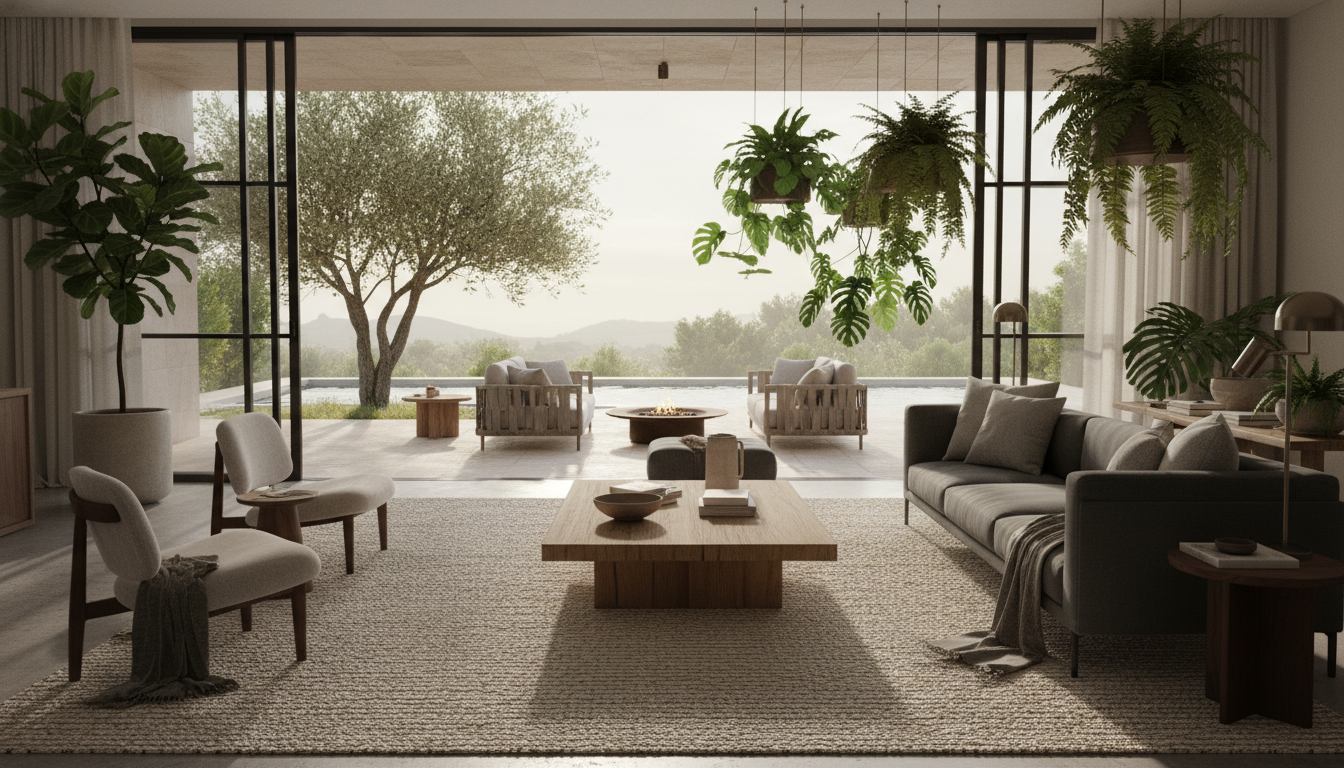
Modern 2026 collections have moved toward sophisticated **Bio-Acetate blends** and **extruded recycled PET** that mimic the luster of silk or the matte organic texture of Belgian linen. These aren’t just weather-resistant; they are designed to be “living-room-grade” in terms of tactile comfort. Textile engineers have perfected a method of high-twist heat-setting that prevents the flattening common in older outdoor rugs. If you are browsing the curated selections at thebohorugs.com, you’ll notice that the distinction between an indoor pile and an outdoor weave is becoming nearly indistinguishable to the naked eye. This allows for a literal “mirrored layout,” where the exact same aesthetic can be maintained from the kitchen island all the way to the poolside fire pit.When selecting your 2026 indoor-outdoor rug, pay attention to the Light Reflectance Value (LRV) of the fibers. For uncovered decks, aim for mid-range tones (LRV 30-50). Deep charcoals absorb too much thermal energy and become hot to the touch, while ultra-whites can cause blinding glare in high-noon sun. A soft Sage Green or a Taupe-Sand blend offers the perfect balance of heat dissipation and visual calm.
The 2026 Color Palette: Grounded and Atmospheric
The neon-bright “tropical” patterns of the past have been replaced by a much more atmospheric approach. The **best outdoor rugs for patio deck 2026** designs are focusing on “biophilic neutrals.” Think of the colors found in a sun-bleached Mediterranean landscape:- Earthy Terracotta and Burnt Sienna: These tones bridge the gap between natural wood decks and interior clay-tiled accents.
- Cloud Grays and Mineral Blues: Designed to reflect the sky, these colors help a small balcony feel more expansive and connected to the horizon.
- The “Undyed” Look: Utilizing the natural color of recycled materials to create a raw, wabi-sabi aesthetic that masks everyday dust and outdoor debris.
Mastering Seamless Indoor-Outdoor Rug Styling
The secret to **seamless indoor outdoor rug styling** lies in the “Visual Echo” technique. Instead of matching rugs exactly—which can sometimes feel forced or clinical—designers are opting for shared undertones. If your indoor rug features a delicate navy pinstripe, your outdoor rug might be a solid navy with a heavy, braided texture. This creates a psychological link between the two spaces without being repetitive. When it comes to scale, the 2026 rule is to “go big or stay inside.” A common mistake is choosing a rug that is too small for the outdoor furniture set, making the space feel fragmented. For a truly luxurious feel, the rug should extend at least 18 to 24 inches beyond the back legs of your outdoor chairs. This anchors the furniture and defines the “room” against the backdrop of the open air.The Checklist: Performance Meets Aesthetics
To ensure your selection stands the test of time and trends, look for these specific 2026 markers:- Solution-Dyed Acrylics: Ensure the color goes all the way through the fiber, rather than just being printed on top, to prevent UV fading in high-sun areas.
- Open-Cell Backing: Essential for drainage. This allows water to pass through the rug and evaporate from the floor underneath, preventing the dreaded “mildew trap.”
- Low-Profile Transitions: For rugs placed near sliding glass doors, a pile height of 0.25 inches or less ensures the door clears the rug easily without catching.
- Sustainable Pedigree: The most sought-after rugs this year are those utilizing ocean-bound plastics, transformed into soft-touch yarns that support environmental restoration.
Rule 1: Prioritize Advanced Performance Fibers
The New Era of High-Tactile Synthetics
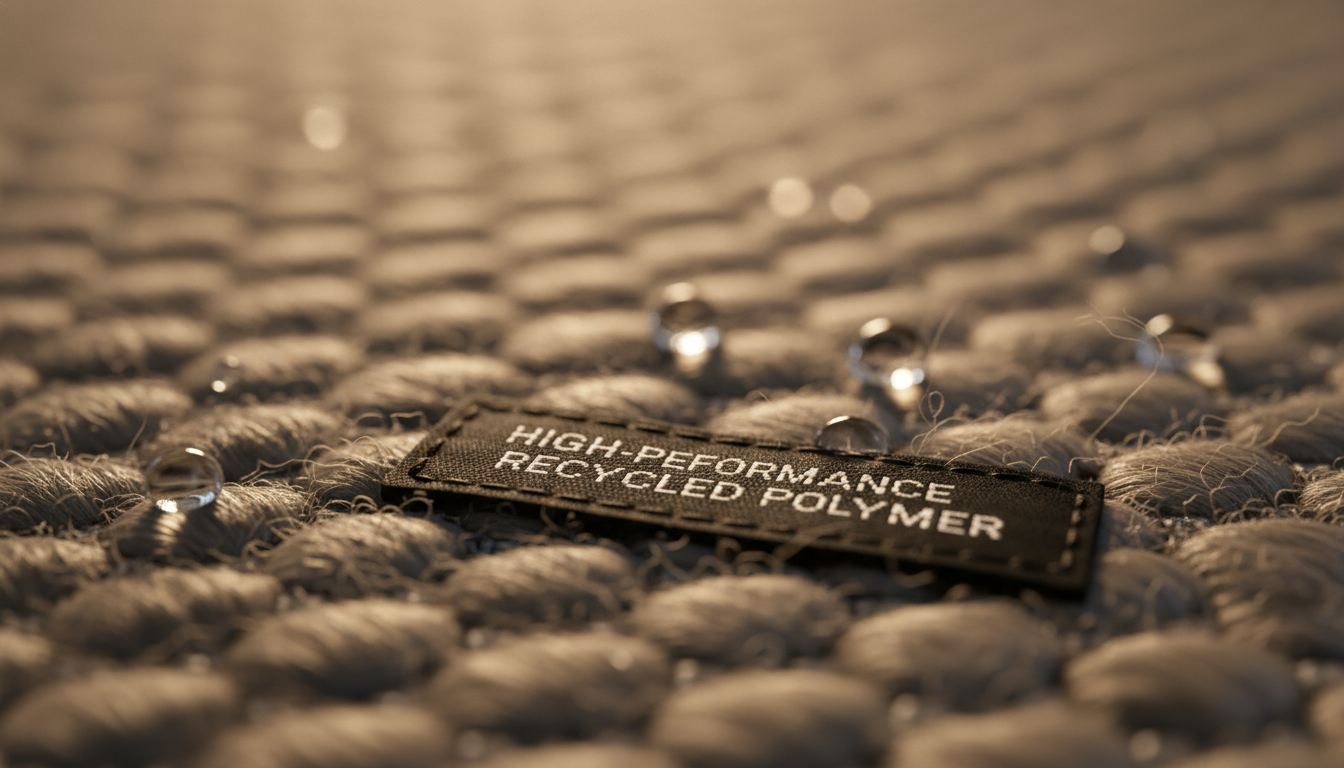
Gone are the days when an outdoor rug felt like a glorified plastic picnic mat. As we move into 2026, the threshold between your living room and your terrace has effectively vanished, and that’s largely due to a revolution in performance fiber technology. When you’re curated a space that flows from a custom velvet sofa to a weather-resistant teak lounge, the rug beneath your feet must bridge that sensory gap. It should feel like wool, drape like linen, yet withstand a torrential downpour and a spilled glass of Cabernet without flinching.
The core of this evolution lies in Heat-Set Crystalline Polypropylene. Unlike the flat, shiny fibers of the past, today’s high-end yarns undergo a thermal transformation that mimics the matte finish and “bounce” of natural organic fibers. When browsing the curated selections at thebohorugs.com, you’ll notice these fibers are often blended to create depth and pile heights that were previously impossible in weather-exposed environments.
The Rise of Post-Consumer PET and Bio-Acetate
Sustainability is no longer a niche preference; it’s a 2026 design standard. We are seeing a massive shift toward recycled PET (Polyethylene Terephthalate), which transforms ocean-bound plastics into silky, durable yarns. These fibers are inherently hydrophobic—they don’t absorb water—which is the secret to preventing that musty “damp dog” smell that plagued older outdoor textiles.
Even more cutting-edge is the introduction of Bio-Acetate hybrids. These fibers offer a Light Reflectance Value (LRV) that mimics natural silk, providing a subtle shimmer that catches the golden hour light on a veranda. Because these materials are solution-dyed, the color is locked into the fiber’s DNA. You can leave a deep Slate Blue or a rich Terracotta rug in 12 hours of direct summer sun, and the hue will remain as vibrant as the day it was unrolled.
When sourcing for a luxury project, I always advise clients to perform the “barefoot friction test.” Run your foot across the rug; if it generates heat or feels “scratchy,” it’s a low-grade plastic. A true 2026 performance rug should feel cool to the touch and offer a soft, fibrous resistance similar to a flat-weave dhurrie.
Expert Perspectives on Textile Longevity
To understand why fiber choice dictates the success of a seamless transition, I spoke with Marcus Thorne, a Lead Textile Engineer specializing in performance fabrics. “In 2026, we aren’t just looking at whether a rug survives the rain,” Thorne explains. “We are looking at molecular stability. By utilizing UV-stabilized polymers at the extrusion level, we’re creating rugs that handle the high-alkalinity of poolside environments and the acidic nature of fallen leaves without the fibers becoming brittle or ‘fuzzing’ over time.”
This technical durability allows for much more sophisticated weaving techniques. You’ll find hand-hooked textures and high-low piles that create architectural interest underfoot. Choosing a rug with these advanced fibers ensures that the “visual weight” of your outdoor area matches the sophistication of your interior design. It’s about creating a singular, cohesive footprint that doesn’t end at the sliding glass door.
- Solution-Dyed Acrylics: The gold standard for soft-touch luxury and maximum fade resistance in full-sun areas.
- Recycled PET: Best for eco-conscious homeowners who want a wool-like texture that is incredibly easy to hose clean.
- UV-Stabilized Polypropylene: Ideal for high-traffic zones where durability and stain-resistance are the primary concerns.
By prioritizing these advanced materials, you aren’t just buying a rug; you’re investing in a textile that anchors your outdoor “great room” with the same prestige as your indoor sanctuary. For those looking to master this look, exploring the performance collections at thebohorugs.com provides a blueprint for how these technical fibers can be woven into stunning, artisanal patterns that defy the elements.
Rule 2: Size for Architectural Anchoring
Defining the “Outdoor Room” Through Scale
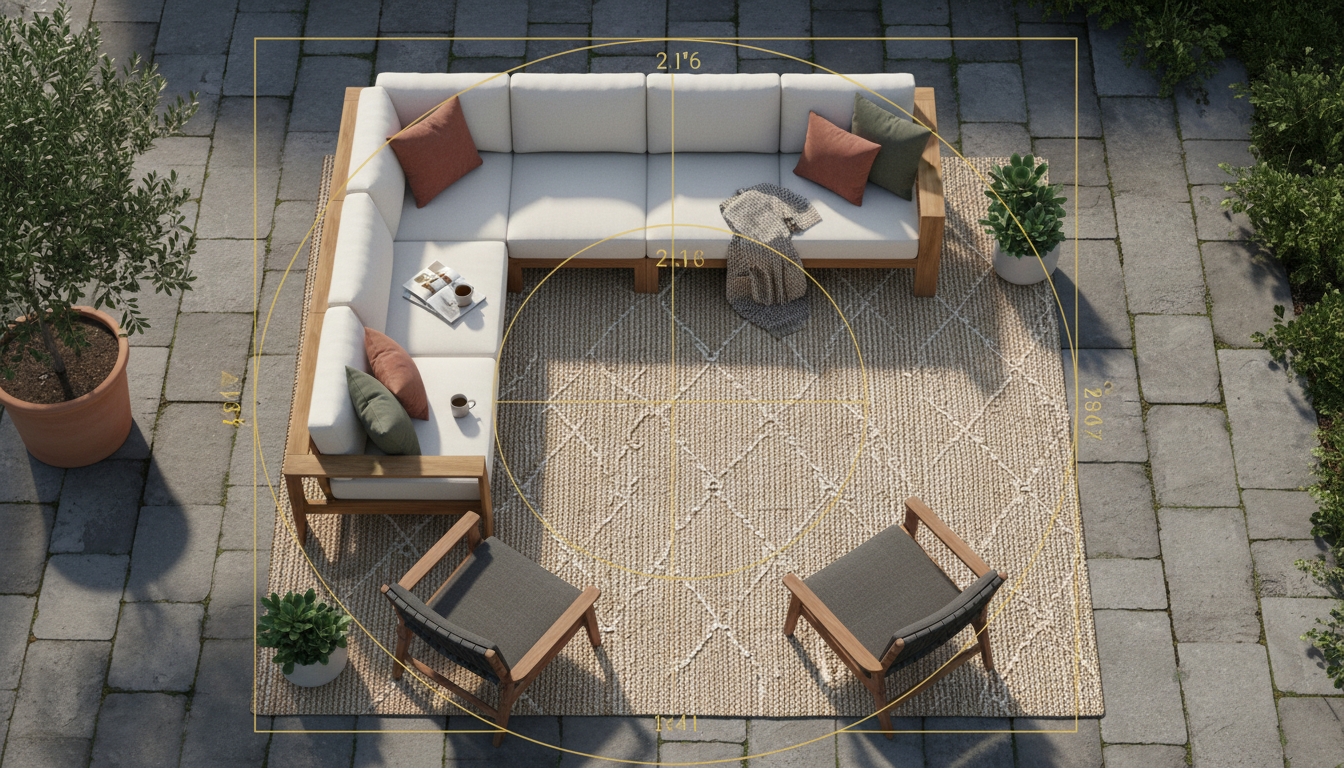
The most common transgression in patio design isn’t a lack of style, but a lack of scale. For 2026, the “postage stamp” rug—a small rectangle floating aimlessly under a coffee table—is officially obsolete. As we blur the lines between our interior sanctuaries and our exterior escapes, the rug must act as a foundational anchor rather than a mere accessory. If the rug is too small, your furniture appears to be drifting at sea; when the rug is sized correctly, it creates an “invisible wall” that defines the lounging or dining area as a distinct, purposeful room. In the luxury design sphere, we are seeing a pivot toward **Architectural Anchoring**. This involves selecting dimensions that allow every piece of furniture to sit entirely on the rug, or at the very least, ensures the front legs of every chair and sofa rest comfortably on the fibers with a minimum of 8 to 12 inches of “breathing room” on the sides. This extra margin is what separates a cramped deck from a sprawling, high-end terrace. When you step from your living room onto the patio, the transition should feel continuous. Using oversized, high-performance weaves from curated collections like those found at thebohorugs.com allows you to maintain that expansive, wall-to-wall luxury feel even when exposed to the elements.“We are moving away from the idea that outdoor rugs are ‘extra’ pieces. In 2026, we treat the patio floor with the same spatial respect as a primary suite. By extending the rug boundaries beyond the furniture perimeter, we manipulate the eye to perceive a larger square footage and a more grounded architectural flow.”
— Elena Vance, Senior Spatial Designer and Textile Historian
The Proportions of Seamless Flow
To achieve that sought-after 2026 aesthetic, consider the Light Reflectance Value (LRV) of your decking material versus your rug. If your patio consists of dark slate or deep mahogany wood, a larger, light-toned rug in a bone or soft sage hue creates a “floating floor” effect that lifts the entire space. For 2026, the trend is to go 20% larger than you think you need. This generous scaling ensures that when guests pull back a dining chair, the legs remain on the rug, preventing the “tripping hazard” common with undersized outdoor textiles.- The Dining Rule: Your rug should extend at least 30 inches beyond the table edge on all sides to accommodate chair movement.
- The Sectional Rule: For large outdoor L-shapes, the rug should extend past the ends of the sofa to “frame” the seating group, rather than being tucked awkwardly underneath.
- The Transition Rule: If your patio is visible through floor-to-ceiling glass, align the rug’s orientation with your indoor flooring planks to create a visual “runway” that pulls the eye outward.
In 2026, top-tier designers are utilizing high-density PET yarns (recycled from ocean plastics but soft as wool) to create custom-looking “flush” layouts. If your patio has a specific architectural cutout or a curved stone fire pit, don’t be afraid to use two overlapping rugs of the same texture to create a custom shape. This mimics the bespoke carpet installations found in luxury hotels and ensures your outdoor “anchoring” feels intentional and permanent.
8 Real Examples: Curated Transitions for the Modern Home
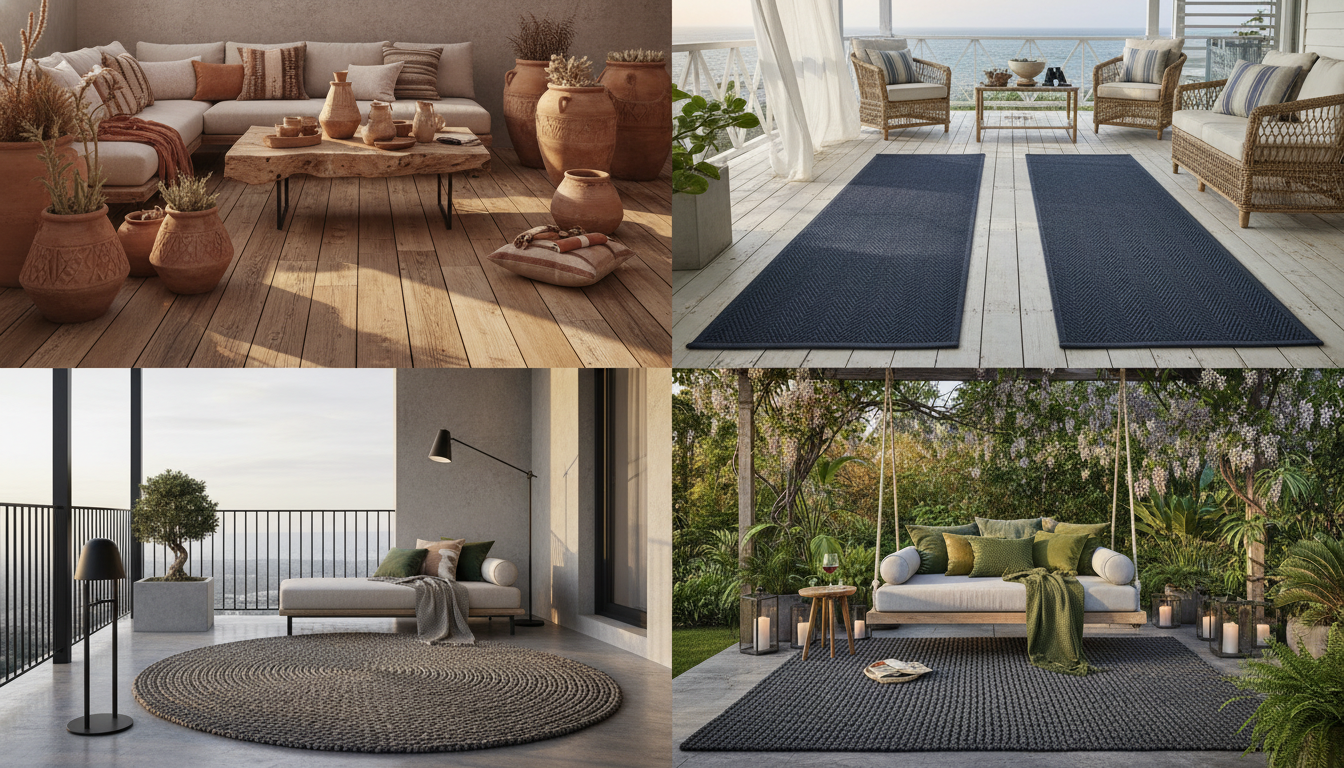
1. The Monochromatic Solarium: Texture Over Color
In this high-end transition, a neutral-toned living room flows into a covered patio. The key here isn’t matching the color exactly, but matching the textural weight. We’re seeing a massive trend toward oversized, “chunky” weaves made from 100% UV-stabilized PET—fibers extruded from recycled water bottles that mimic the feel of organic wool. By choosing a rug with a high Light Reflectance Value (LRV), such as a soft bone or oatmeal, the outdoor space feels like a natural extension of the interior’s brightness rather than a separate, darker “outside” area.
2. The High-Desert Terrace: Earthbound Pigments
For homes with expansive decks and earthy wall accents—think terracotta, ochre, or burnt sienna—a large-scale performance rug in a deep rust or clay tone anchors the space. This isn’t about a “pop” of color; it’s about grounding the furniture. These rugs often utilize solution-dyed acrylics, ensuring the deep pigments won’t fade even under 12 hours of direct sun. When paired with teak furniture, the rug acts as a visual anchor that prevents the furniture from “floating” on a vast deck.
3. The Urban Lanai: Visual Expansion in Small Spaces
Small balconies often feel cramped when broken up by dark floors. A light-neutral, low-profile rug can make a five-by-ten balcony feel twice its size. In 2026, we are seeing a shift toward Bio-Acetate fibers in these smaller formats—materials that provide a subtle sheen similar to viscose but are entirely hose-cleanable. A soft grey or champagne rug with a subtle linear pattern can “draw” the eye outward, creating the illusion of a longer floor plan.
4. The Mediterranean Poolside: Sophisticated Contrast
Poolside lounges are notorious for being utilitarian, but the 2026 aesthetic brings “resort chic” home. We suggest a subtle, geometric pattern—think micro-herringbone or a soft Greek key—in a navy and cream palette. This provides a crisp contrast to the blue of the water and the often-vibrant indoor accents. Look for rugs with open-weave backings; these allow water to drain through the rug to the patio floor, preventing the mildew issues that plagued older outdoor rug generations.
5. The Culinary Flow: The Performance Runner
The transition between an indoor kitchen and a screened-in porch is a high-traffic zone prone to spills. A washable, performance-grade runner is the solution here. By using a runner that echoes the backsplash tiles or the kitchen island stone, you lead the guest’s eye from the stove straight to the porch seating. Modern “flat-braid” constructions at thebohorugs.com offer the artisanal look of a hand-knotted piece while being durable enough to handle dropped appetizers and muddy paws.
6. The Sunken Lounge: Oversized Anchoring
Large backyard seating areas with sectionals require massive rugs—often 10×14 or larger—to feel intentional. A warm neutral rug with a “sisal-look” (made from durable polypropylene) provides the organic vibe of a beach house without the prickly texture of real seagrass. This 2026 trend focuses on “The Big Anchor,” where all furniture legs sit comfortably on the rug, defining the lounge as a distinct room within the landscape.
7. The Sky-High Sanctuary: Low-Pile Precision
For apartment dwellers, wind and debris are the main enemies. A compact, low-pile rug is essential here to prevent the “kite effect” during storms. Choose a rug with a non-slip, integrated rubber backing that is breathable but heavy enough to stay put. Styling-wise, a soft sage green or “Eucalyptus” (a trending 2026 shade) mimics the presence of a garden, even if you’re twenty stories up, creating a calming, biophilic connection to the indoors.
8. The Alfresco Dining Link: Coordinated Earth Tones
The ultimate test of indoor-outdoor flow is the dining area. For a seamless transition, use a rug that shares a shared design DNA with your indoor dining room. If your indoor space features a vintage Persian, look for a “distressed” performance rug that mimics that aged look in a weather-resistant material. This creates a “long-view” through the house that feels curated and expensive, linking the spaces through a shared heritage of pattern rather than just a flat color match.
Whether you are designing a sprawling suburban patio or a compact city balcony, these examples demonstrate that the floor is your most powerful tool for cohesion. By prioritizing performance materials that don’t compromise on the tactile experience, you turn a simple outdoor area into a true living room. Explore the latest in durable, designer-grade transitions at thebohorugs.com to find the piece that bridges your world.
Coordinating Palettes with Interior Wall Colors
Transcending the Threshold: The Alchemy of Color and Walls
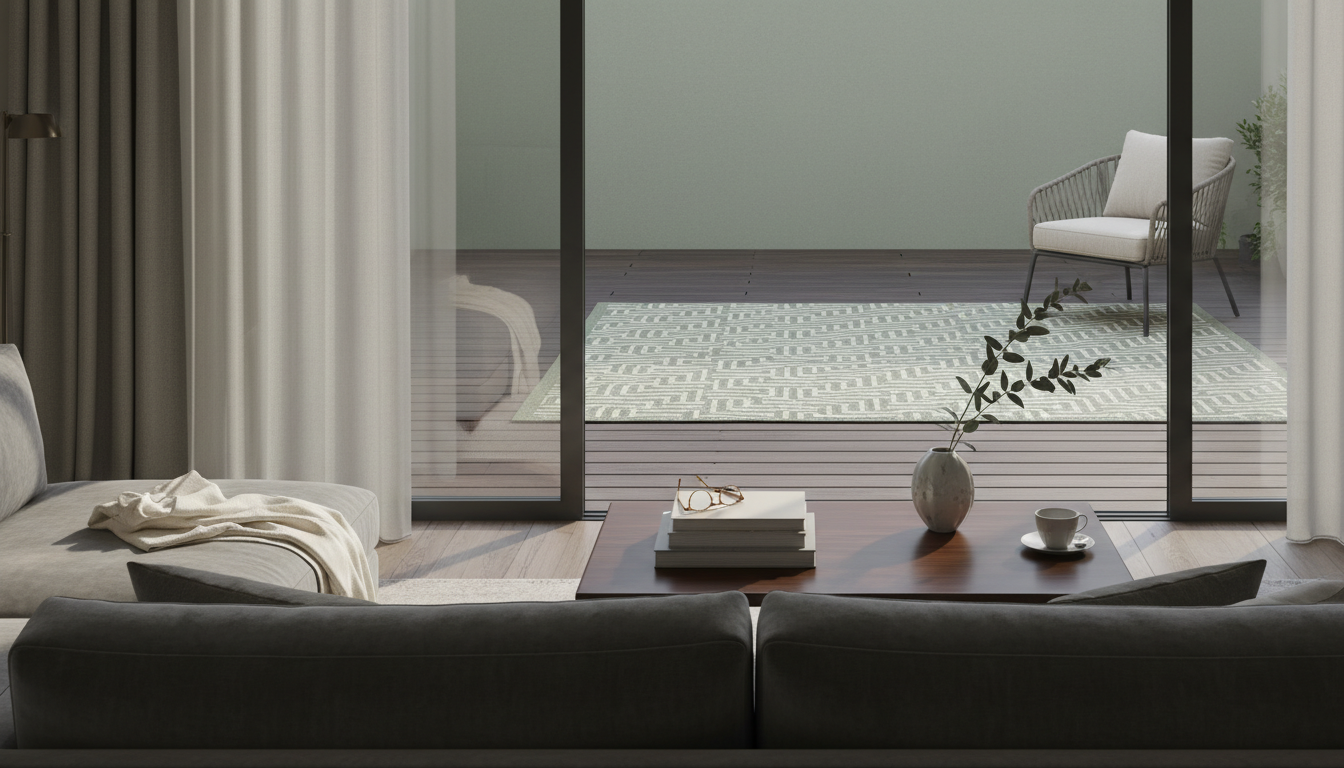
When we design for 2026, we are no longer looking at the patio as a separate “zone.” Instead, we treat the transition from the interior to the exterior as a cinematic long take—one continuous visual sweep where the eye shouldn’t snag on a jarring color shift at the doorframe. The rug serves as the connective tissue in this narrative. To achieve a high-end, seamless flow, your choice of indoor outdoor rugs 2026 must reference the Light Reflectance Value (LRV) and undertones of your interior walls.
Imagine a living room finished in a moody, low-LRV hue like Obsidian Slate or a deep Terracotta Clay. If you step onto a patio featuring a stark, bleached-white rug, the transition feels clinical and fractured. To bridge this gap, designers are leaning into “Visual Persistence”—the technique of carrying a sliver of the interior wall’s pigment into the outdoor rug’s weave. If your walls have a warm, yellow base, your outdoor rug should mirror that warmth, perhaps through a sand-toned sisal-effect performance fiber that catches the afternoon sun without appearing reflective or “plastic.”
“In 2026, we’ve moved past simple color matching. We’re now looking at how atmospheric light interacts with performance fibers. A rug outside should feel like a shadow or a reflection of the room you just left. It’s about creating a psychological sense of safety and enclosure, even when you’re under the open sky.”
— Julian Thorne, Lead Textile Analyst at the International Design Collective.
Mastering Tone-on-Tone Transitions
The most sophisticated homes this season are utilizing monochromatic layering to expand the perceived square footage of the home. If your interior features the popular 2026 “Bio-Sage”—a muted, earthy green—look for performance rugs at thebohorugs.com that utilize solution-dyed yarns in moss or olive. Because these fibers are dyed all the way through, they maintain a depth of color that mimics natural wool, preventing that “flat” look common in older outdoor textiles.
- For Cool-Toned Walls (Blues, Grays, Crisp Whites): Opt for rugs with a “Chambray” weave or silver-threaded polypropylene. This maintains the crispness of the interior while standing up to high-UV exposure without yellowing.
- For Warm-Toned Walls (Ochres, Beiges, Warm Wood Paneling): Seek out rugs with toasted almond or copper accents. The goal is to make the rug feel like an extension of the floorboards or the wall itself.
- For Bold, Maximalist Interiors: Use the outdoor rug as a “visual anchor” by choosing a neutral base that features a border in the exact shade of your interior accent wall. This creates a “frame” for your outdoor furniture that mirrors the architecture of the room inside.
When selecting your palette, remember that outdoor rugs often look darker when damp from morning dew or humidity. In 2026, high-performance recycled PET fibers are engineered to minimize this shift, but a good rule of thumb is to choose a rug one half-shade lighter than your interior wall color. This compensates for the intense overhead light found in outdoor spaces, ensuring the rug doesn’t look “washed out” or overly heavy compared to your indoor decor.
By treating the rug as a horizontal reflection of your vertical surfaces, you eliminate the “threshold shock” that often occurs in poorly planned renovations. This approach ensures your indoor outdoor rugs 2026 don’t just sit on the deck—they belong there, anchored by the very DNA of your home’s interior palette.
The Pitfall of Poor Drainage and UV Exposure
The Invisible Enemies: Why Sunlight and Standing Water Break the Seamless Illusion
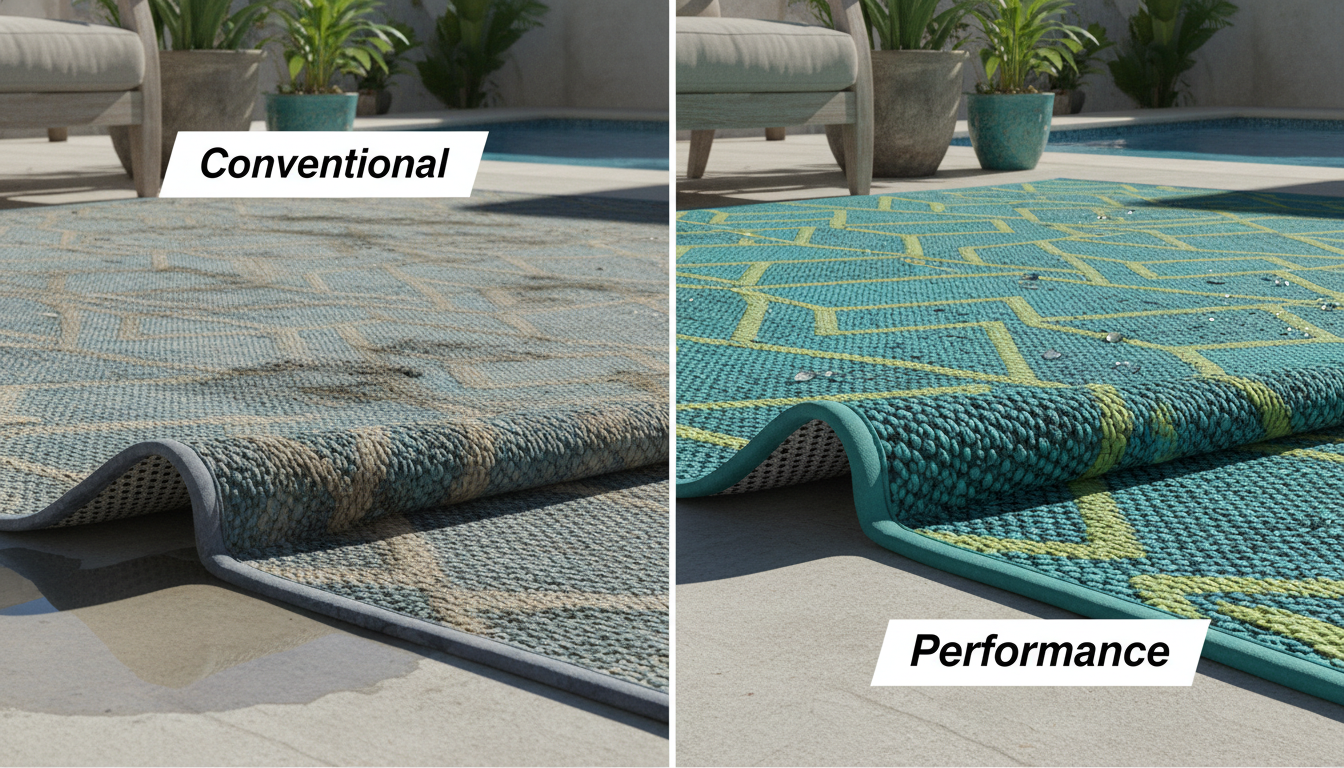
The dream of a 2026 patio is one of effortless continuity—a space where the transition from your Belgian linen sofa to your outdoor teak lounge is visually indistinguishable. However, that high-end aesthetic quickly collapses the moment a rug begins to “ghost.” This phenomenon, where UV rays strip the vibrancy from fibers, doesn’t just dull the color; it alters the **Light Reflectance Value (LRV)** of the rug, making the outdoor portion look drastically different from its indoor counterpart. When you’re curating a space that flows through glass folding doors, the outdoor rug must hold its own against 1,000+ hours of direct sunlight. In 2026, we are seeing a shift toward solution-dyed acrylics and high-UV polyolefins. Unlike traditional rugs where the color is applied to the surface, these performance fibers are saturated with pigment at the molten stage. This ensures that even in high-altitude environments or south-facing decks, the deep terracottas and muted saged greens found at thebohorugs.com remain identical to the day they were unrolled.The Science of Breathability and Drainage
Nothing ruins the luxury experience faster than the “squish” of a waterlogged rug three days after a rainstorm. Beyond the immediate discomfort, poor drainage is a silent killer of both the rug and your flooring. Standard rugs with solid latex backings trap moisture against your deck or stone pavers, leading to:- Microbial Growth: Mildew and mold thrive in the dark, damp microclimate between the rug backing and the ground.
- Surface Staining: Trapped water can leach tannins from wood decks or cause efflorescence on natural stone.
- Fiber Rot: Even synthetic fibers can degrade if they are constantly submerged in stagnant water.
The 2026 Durability Standard
“We are moving away from the ‘disposable’ mindset of outdoor decor,” says Elena Rossi, Lead Textile Consultant for a Milanese design firm. “In 2026, the luxury consumer demands a rug that handles a hose-down as easily as a spill of Cabernet. We look for ‘High-Twist’ yarn constructions that prevent flattening and ensure the rug’s profile remains crisp even after a season of heavy foot traffic and summer storms.”
Before committing to a large-scale anchoring rug for your patio, check the backing construction. If you can’t see light through the weave when held up to the sun, the drainage will likely be insufficient for uncovered spaces. For the ultimate seamless look, artisans at thebohorugs.com recommend choosing a flat-weave performance rug with a “perforated” grip pad. This setup elevates the rug by just 2mm, allowing airflow to reach the backing and cutting drying time by nearly 60%.
Elevate Your Space
Discover the artistry of handmade luxury. Each rug is a masterpiece of tradition and modern design.
Expert Q&A
What defines a rug as ‘indoor-outdoor’ in 2026?
In 2026, the category is defined by the fusion of aesthetic sophistication and extreme durability. These rugs use UV-stabilized synthetic fibers like PET (recycled plastic bottles) or polypropylene that are extruded with color pigments, ensuring they cannot fade or bleed, while maintaining a soft, textile-like feel.
Can I use an indoor-outdoor rug in my high-traffic living room?
Absolutely. Their stain resistance and ease of cleaning—literally being able to hose them down—makes them the premier choice for homes with pets, children, or high-traffic mudrooms, all without looking like a utility mat.
How do I prevent mold from growing under an outdoor rug?
Ensure the rug has a ‘permeable’ backing designed for drainage. It is also recommended to use an outdoor-rated rug pad that allows air to circulate between the rug and the deck surface.
What size rug do I need for a standard 6-person outdoor dining table?
You should aim for a rug that is at least 8×10 or 9×12. The rule of thumb is that the rug should extend 24 to 36 inches beyond the table edges so chairs remain on the rug even when pushed out.
Do these rugs get hot in direct sunlight?
Modern performance rugs in lighter earth tones or neutrals stay significantly cooler than dark wood or stone surfaces. Choose lighter shades for uncovered decks to ensure comfort for bare feet.
How do I clean a performance rug after a heavy storm?
Simply sweep away debris and hose it down with clear water. For stubborn stains, a mild detergent and a soft brush will suffice. Most 2026 models are designed to air-dry within hours.
Should I choose a pattern or a solid color for my patio?
For a seamless transition, match the pattern complexity of your indoor rug. If your indoor space is busy, choose a textured solid for the outdoor area to provide a visual ‘breath’ while maintaining the color story.
Are recycled PET rugs as durable as virgin polypropylene?
Yes, PET (polyethylene terephthalate) is incredibly resilient and naturally stain-resistant. It often has a softer, silkier feel than polypropylene, making it a favorite for 2026 luxury collections.
How do I ensure the rug doesn’t trip people at the doorway?
Choose a ‘low-profile’ or ‘flat-weave’ construction. These typically sit under 0.25 inches high, providing ample clearance for most exterior doors and sliding glass tracks.
Is it worth buying a rug for a completely uncovered space?
Yes, a rug protects your deck or stone from UV damage and heat, while also defining the seating area. Just ensure it is specifically rated for ‘uncovered’ or ‘all-weather’ use.
Written by TheBohoRugs Interior Design Team
Experts in handmade rugs, boho interiors, and modern home decor.

