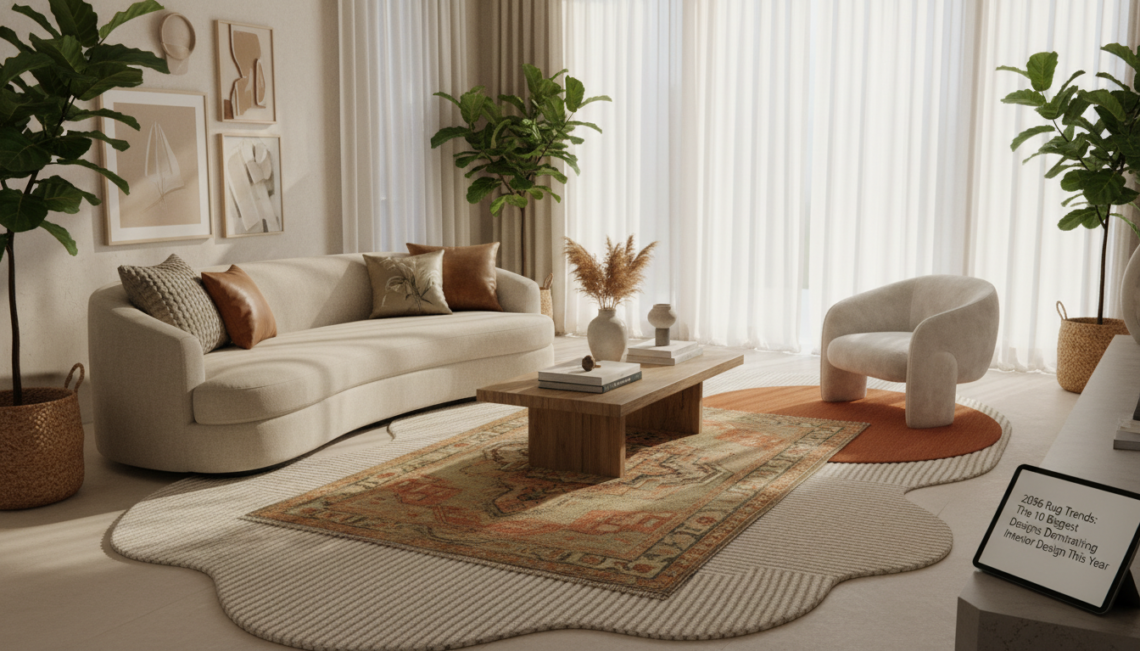
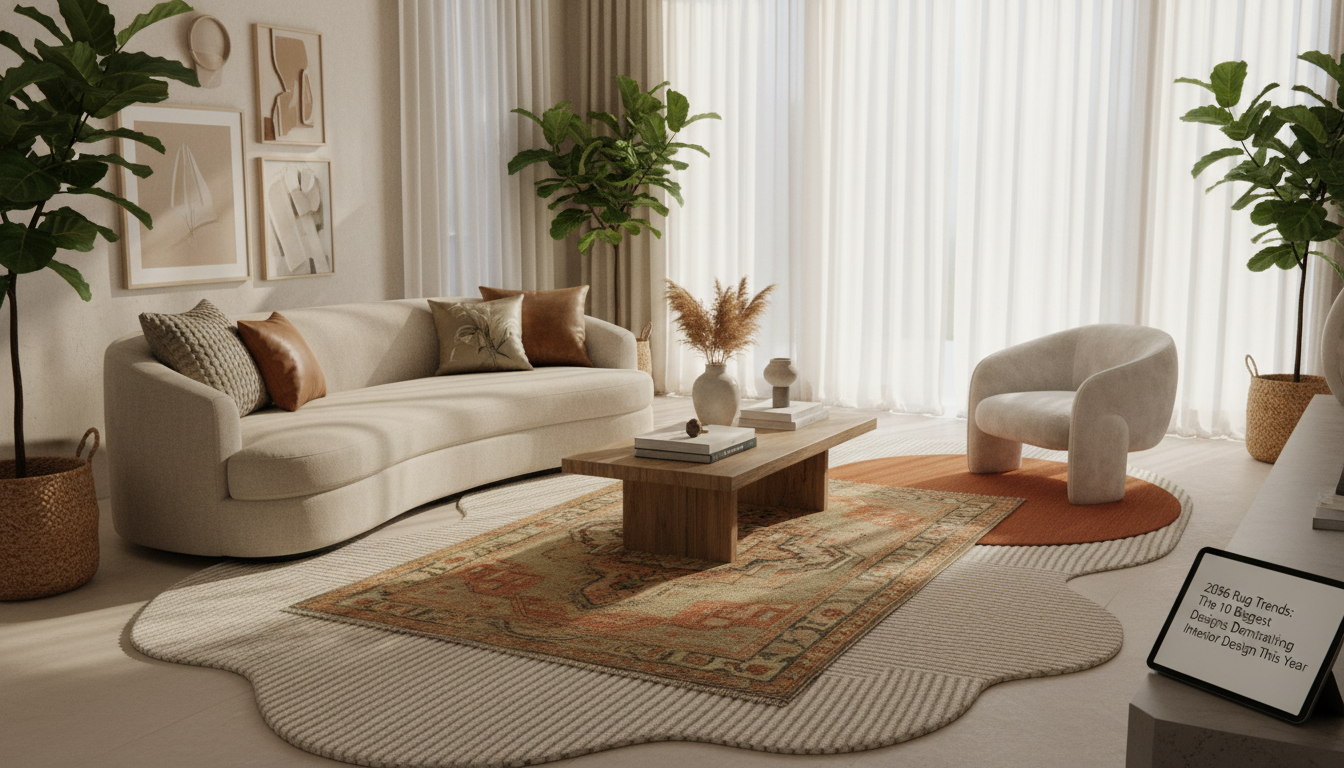
The era of the ‘safe’ grey rectangle is officially over. As we move into 2026, the floor has graduated from a silent background player to the absolute protagonist of the home. Designers are shifting away from flat, industrial aesthetics in favor of high-tactility, storied textiles that demand to be touched. If 2025 was about quiet luxury, 2026 is about ‘Expressive Grounding’—the practice of using rugs to anchor personality and warmth in a post-minimalist world. From the rise of ‘biophilic weaving’ to the unexpected dominance of irregular silhouettes, the following trends represent a fundamental shift in how we inhabit our spaces. We consulted with top industry voices to define the pieces that will define your home this decade.
“The top 2026 rug trends are defined by a move toward maximalist textures and organic authenticity. Key highlights include ‘Lots of Layers’ (stacking varied textures), the ‘Wrong Rug Theory’ (placing natural fibers in formal settings), and ‘Artful Abstracts’ that function as floor-bound masterpieces. Sustainable, high-performance fibers like recycled wool and sophisticated jute variants continue to dominate, while earthy, pigmented tones like terracotta and moss replace cool neutrals.”
The Roadmap
Table of Contents
- The Shift Toward Expressive Grounding
- Trend 1: The Art of Intentional Layering
- Trend 2: Elevating Natural Textures (The Jute Evolution)
- Trend 3: Antique Revival and the New Vintage
- Trend 4: Floor Art and Abstract Narratives
- Trend 5: Earthy Pigments and Bold Chromatics
- Trend 6: Performance Fibers for High-Traffic Luxury
- Trend 7: The ‘Wrong Rug’ Theory in Practice
- Trend 8: 3D Textures and Sculpted Piles
- Trend 9: Organic Shapes and Curved Silhouettes
- Trend 10: The Investment Piece: Hand-Knotted Heritage
- A Designer’s Guide to Selection and Maintenance
- 2026 Rug Trends FAQ
Trend 1: The Art of Intentional Layering
The Sophisticated Shift Toward Tactile Depth
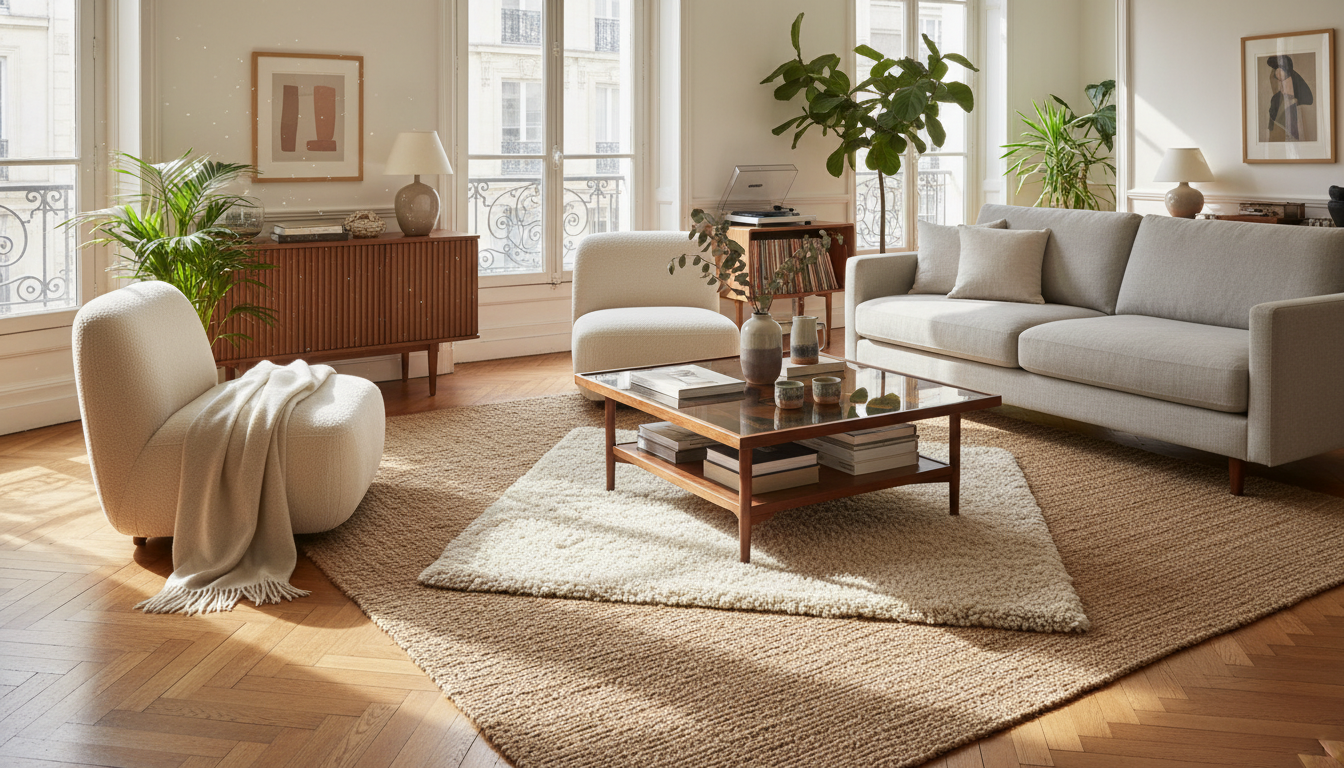
Walk into any AD100-designed home this year, and you’ll notice the floor is no longer treated as a flat, singular plane. We are moving away from the “one-and-done” approach to floor coverings. In 2026, designers are using rugs to build architectural interest from the ground up. This isn’t just about covering space; it’s about creating a curated, multi-dimensional foundation that absorbs sound and invites bare feet. The trend has evolved from the casual bohemian layers of the past decade into something far more structured and intentional. We’re seeing a focus on the interplay between **rugged, high-texture base layers**—think chunky, hand-loomed abaca or heavy-weight sisal—and refined, artisanal top pieces like **low-pile Oushaks** or silk-infused abstracts.Mastering the Material Contrast
The secret to making this look feel expensive rather than cluttered lies in the tension between fibers. To achieve the 2026 look, aim for a significant variance in pile height. A flat-weave jute base provides a neutral, organic stage, allowing a plush, hand-knotted wool rug to sit prominently on top. This creates a “frame” effect that anchors furniture groupings, particularly in expansive open-concept living areas where a single rug often feels lost. When selecting your pieces, consider the light-reflecting properties of the fibers. A matte, vegetable-dyed wool layered over a slightly lustrous mercerized cotton base creates a subtle shimmer that changes as you move through the room. At thebohorugs.com, we’ve observed a sharp rise in collectors pairing oversized, neutral foundations with smaller, vintage-inspired accents to define specific “zones” within a master suite or great room.“The 2026 layering aesthetic is less about ‘more is more’ and more about ‘depth is luxury.’ By placing a high-density Ghiordes-knotted rug over a wider expanse of natural fiber, you aren’t just decorating; you’re creating an acoustic landscape that softens the hard edges of modern architecture.”
— Elena Vance, Senior Textile Historian & Design Consultant
Strategic Styling for the Modern Home
To execute this trend without shrinking your room visually, follow these designer-approved principles:- The 12-Inch Rule: Ensure your base rug is at least 12 to 18 inches larger than the top rug on all sides. This creates a balanced border that looks intentional rather than accidental.
- Tonal Harmony: Keep the color stories related. Pair a charcoal-dyed jute base with a silver and slate wool top-layer for a moody, contemporary feel.
- Shape Play: Don’t feel restricted to rectangles. A large, rectangular natural-fiber rug serves as a perfect canvas for a smaller, organic-shaped or oval sheepskin rug to add softness to a reading nook.
- Weight Management: Always place the heavier, more durable material on the bottom. This prevents the top rug from bunching and ensures the “anchor” stays firmly in place under heavy furniture legs.
In homes with high ceilings or hard flooring like polished concrete and white oak, layering serves a functional purpose beyond beauty. For 2026, look for “High-GSM” (grams per square meter) wool rugs to use as your top layer. These dense fibers act as a natural sound baffle, significantly reducing echo in minimalist spaces. For the ultimate luxury feel, ensure your base rug has a non-slip, felt-and-rubber pad underneath—it adds a “hotel-footfeel” thickness that is immediately noticeable.
Trend 2: Elevating Natural Textures (The Jute Evolution)
The Sophisticated Renaissance of Natural Fibers
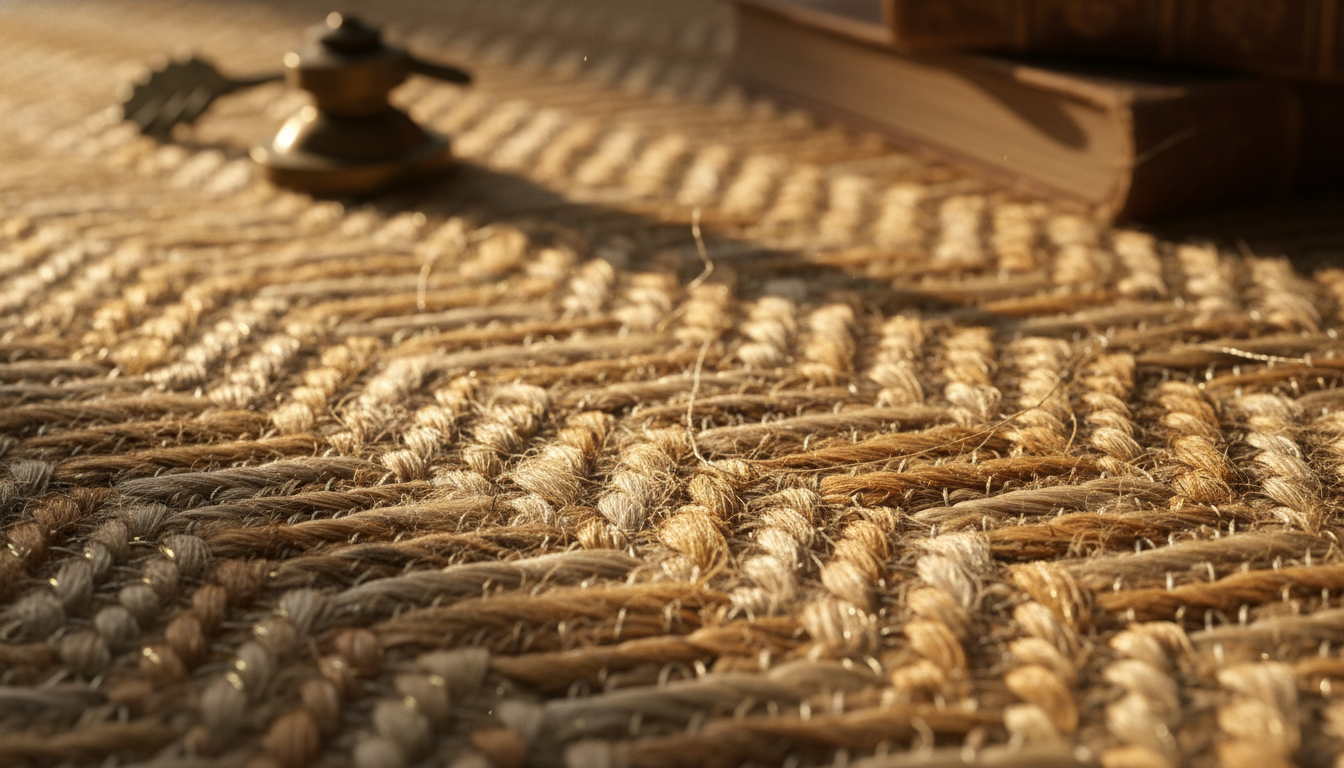
For years, jute and sisal were the reliable workhorses of the design world—durable, affordable, but often relegated to the background as “scratchy” foundations. In 2026, we are witnessing a dramatic evolution. The “crunchy” reputation of the 2010s has been replaced by a buttery, architectural softness that designers are calling “Couture Earthiness.” This isn’t your standard diamond-weave rug from a big-box store; this is a tactile symphony of high-twist Abaca, hand-carded wool blends, and sophisticated New Zealand flax.
The 2026 shift toward Bio-Acetate fibers infused with traditional jute has revolutionized the underfoot experience. We are seeing rugs that maintain the organic, grounding aesthetic of natural materials but possess a Light Reflectance Value (LRV) usually reserved for silk. This allows natural rugs to work in dimly lit libraries or moody dining rooms without absorbing all the light, instead offering a subtle, matte shimmer that feels incredibly expensive.
Designing with the “New Neutrals”
The color palette for these natural pieces has moved beyond “straw” and “tan.” Leading designers are now specifying “heathered naturalism,” where jute is interspun with charcoal-dyed wool or Sage Green silk threads. This creates a multidimensional surface that hides the realities of daily life while looking curated. If you are styling an Organic Modern or Japandi-inspired space, these elevated textures provide the necessary soul that prevents minimalist rooms from feeling clinical.
“We’ve moved past the era of the ‘disposable’ jute rug. In 2026, the luxury is in the provenance of the weave. We are looking for hand-loomed textures from the Atlas Mountains or the Malabar Coast that treat jute with the same reverence as cashmere. It’s about that perfect imperfection—the slight variation in the knot that tells you a human hand was involved.”
— Julian Thorne, Lead Textile Historian & Creative Consultant
When sourcing these artisanal weaves, look for the hand-loomed variations found at thebohorugs.com, which emphasize the slight irregularities and zero-VOC vegetable dyes that define luxury in 2026. Their collection of sophisticated natural fibers bridges the gap between rugged durability and high-end editorial design.
When selecting a natural rug for a high-traffic area like a living room, look for a 70/30 blend of Jute and hand-spun Wool. This ratio ensures the rug retains its structural integrity (the jute backbone) while the wool prevents the fibers from becoming brittle over time. To test quality, run your hand across the surface; a premium 2026 weave should feel like heavy linen, not dry hay.
Styling Tip: The Architectural Edge
To make a natural fiber rug feel intentional rather than accidental, pay attention to the binding. Moving away from the wide cotton tapes of the past, 2026 trends favor “serged edges” or oversized fringe tassels made from the same material as the rug. This creates a seamless, wall-to-wall custom look. Pair an oversized, chunky-knit jute rug with sleek, mid-century Italian furniture—the contrast between the raw, honest floor covering and the polished lacquer of the furniture is the hallmark of a professionally designed home.
Shop the Look: Explore our Hand-Woven Natural Fiber Collection →
Trend 3: Antique Revival and the New Vintage
The Soul of the Space: Embracing Curated History Underfoot
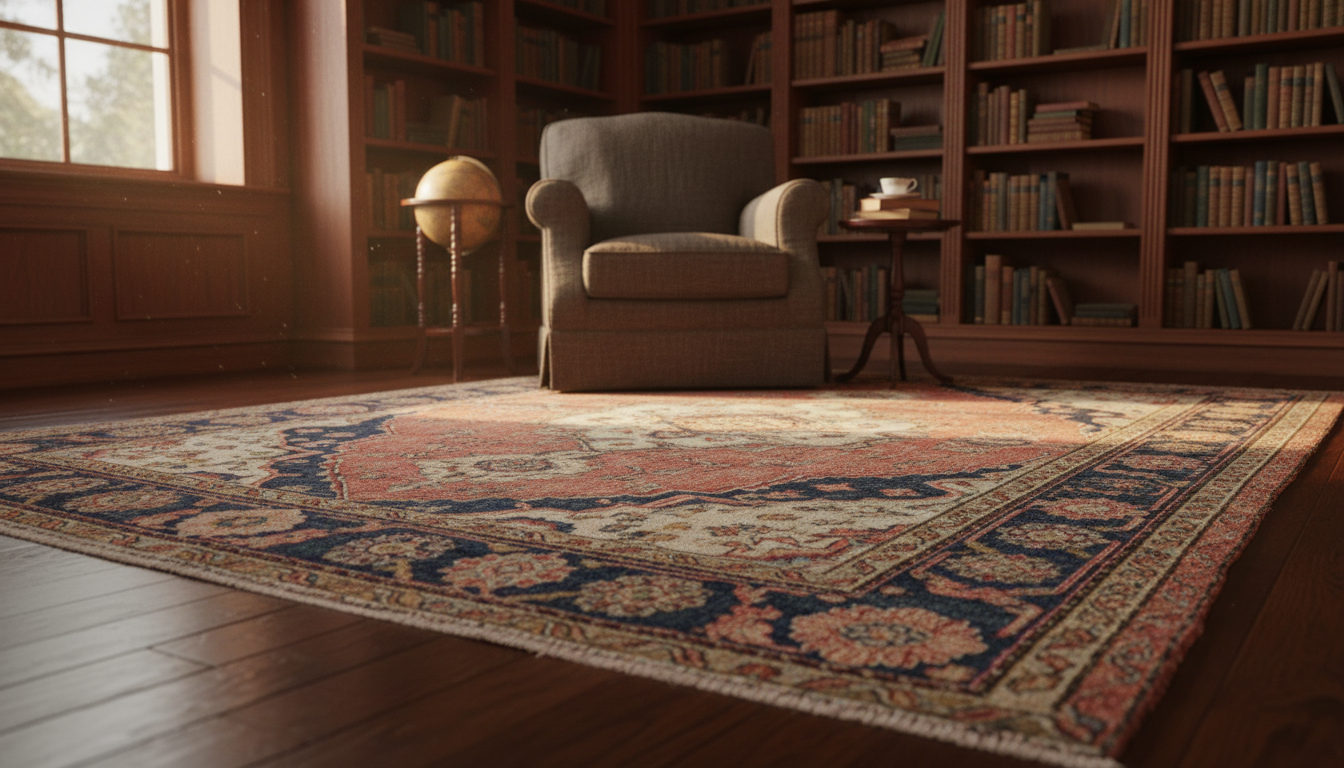
There is a specific, quiet gravity that a room gains when it includes something that has survived a century. In 2026, we are seeing a definitive departure from the “fast furniture” era. Interior designers are leaning heavily into the Antique Revival, sourcing rugs that tell a story through their weathered patinas and “perfectly imperfect” weaves. This movement isn’t just about nostalgia; it’s a response to the hyper-digital world, a craving for the tactile authenticity of hand-spun wool and vegetable dyes that change hue depending on the angle of the sun.
The beauty of this trend lies in the juxtaposition. We’re seeing 19th-century Persian Tabriz rugs or sun-faded Oushaks placed in ultra-modern architectural settings—think cold concrete floors softened by lanolin-rich Highland wool. The goal is to create a home that looks like it was curated over a lifetime, rather than purchased in a single weekend. Designers like Kate Hartman and Erin Hackett Nordholt have championed this “collected” look, noting that a vintage rug acts as the connective tissue between disparate design eras.
For those who find true antiques out of reach, the “New Vintage” has emerged. These are high-end, artisan-made pieces that utilize traditional hand-knotting techniques and “stone-washing” processes to achieve that coveted heirloom feel without the fragility of a 100-year-old textile. Whether it’s a genuine antique or a masterfully crafted revival, these rugs anchor a room with a depth of color that synthetic fibers simply cannot replicate.
“In 2026, a rug is no longer treated as a background element; it is an investment in heritage. We are seeing a massive shift toward rugs with low Light Reflectance Values (LRV)—deep, moody terracottas and oxidized indigos—which provide a grounded, sophisticated base for the ‘quiet luxury’ aesthetic that continues to evolve.”
— Elena Vance, Textile Historian and Lead Curator
Styling the Antique Aesthetic
When incorporating a vintage or antique-inspired piece, balance is your greatest tool. If you’re working with a rug that features a busy, intricate Heriz pattern, keep your furniture silhouettes clean and architectural. This prevents the room from feeling like a museum and instead makes it feel like a curated gallery.
- The Living Room: Let the rug dictate the palette. Pull the most understated color from the rug’s weave—perhaps a muted sage or a dusty ochre—and use it for your throw pillows or window treatments.
- The Dining Room: Opt for a low-pile antique. Not only does this make it easier to slide chairs, but the natural variations in a vintage weave are incredibly forgiving when it comes to the occasional spill.
- Layering: A smaller, high-value vintage rug looks stunning when centered over a larger, neutral jute or sisal base. This is a favorite trick of designers to cover more floor space while still highlighting a “hero” piece.
If you’re looking to start your own collection, the curated selections at thebohorugs.com offer that sought-after blend of artisanal craftsmanship and timeless soul, perfect for grounding a contemporary home with a sense of history.
When shopping for high-quality vintage-inspired rugs, look for “oxidized” wool. This is a process where the wool is slightly eroded to mimic the way natural wear occurs over decades. It creates a beautiful high-low texture that gives the rug a 3D quality. Pro Tip: To ensure your rug doesn’t get lost in a room with a lot of natural light, choose a piece with a saturated border; it frames the space and prevents the “washed out” look that can happen with lighter vintage styles.
Designers are increasingly moving toward Bio-Acetate and organic wool blends for these revival pieces to ensure sustainability is woven into the very fabric of the trend. The result is a floor covering that doesn’t just look old—it feels substantial, heavy, and purposeful.
Trend 4: Floor Art and Abstract Narratives
The Evolution of the ‘Fifth Wall’
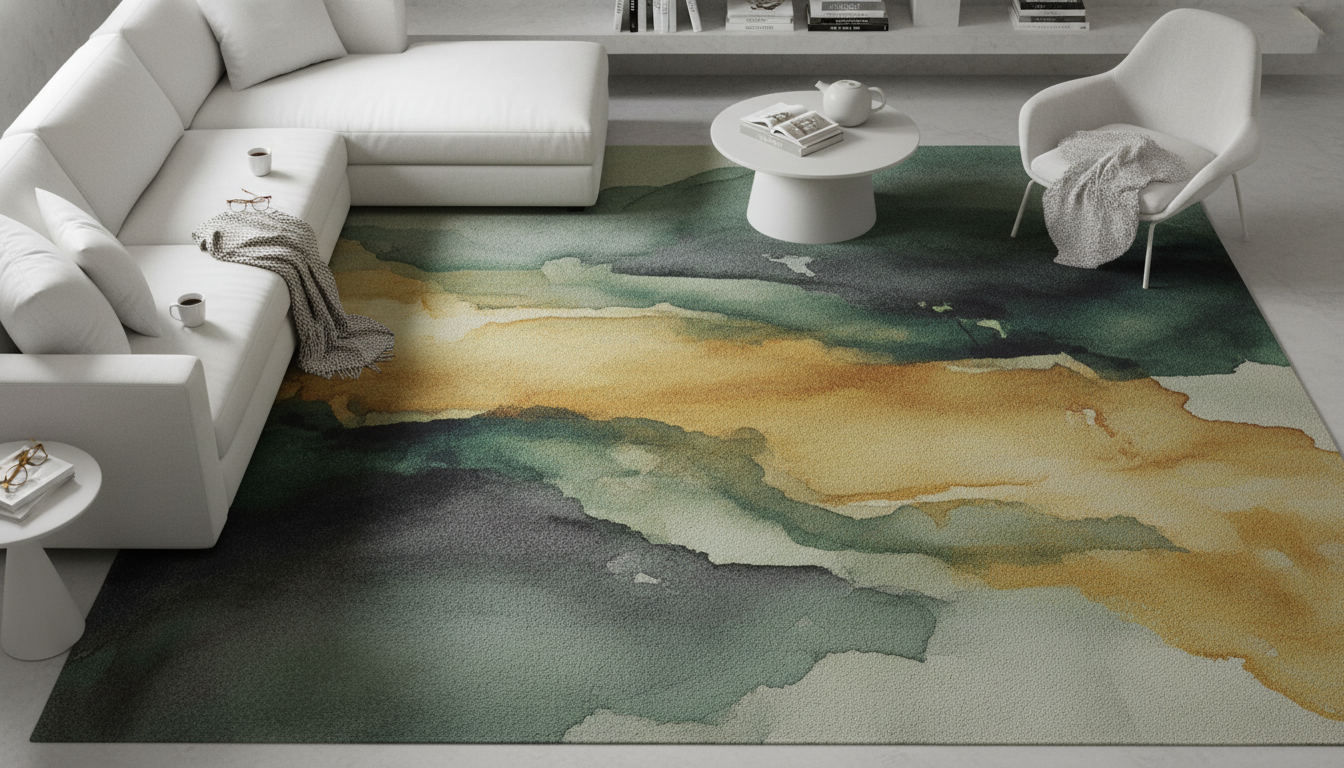
For years, rugs were often relegated to the background—quiet supporters of a room’s furniture. In 2026, we’re seeing a complete reversal of that hierarchy. Designers are now treating the floor as a “fifth wall,” a canvas for non-linear expressions and painterly compositions that feel more like a gallery piece than a household textile. This isn’t about repeating trellis patterns or safe geometrics; it’s about abstract narratives that use varying pile heights and high-contrast yarns to mimic the movement of oil on canvas.
We’re moving away from the rigid symmetry of the past and embracing what industry insiders call “asymmetrical grounding.” These rugs often feature oversized, gestural strokes and blurred edges that break the traditional boundaries of a room. Whether it’s a piece that looks like weathered stone or one that resembles watercolor bleeding across Bio-Acetate fibers, the goal is to inject a sense of movement into static spaces.
“The 2026 abstract trend isn’t just a visual choice; it’s an emotional one. We are seeing a huge demand for rugs that feel ‘unfinished’ or ‘fluid,’ which mirrors our collective desire for more organic, less clinical living environments,” says Julianne Silva, Lead Curator at the International Textile Collective. “It’s about the soul of the hand-tufted process showing through every irregular line.”
Mastering the Non-Linear Palette
When styling these “floor paintings,” the trick is to let the rug dictate the room’s energy. In a minimalist setting, an abstract rug with saturated earth tones—think deep ochre, burnt umber, and hints of oxidation—serves as the anchor. To make the most of this trend, consider these placement strategies:
- Contrast the Silhouette: Pair a rug featuring fluid, curving abstract shapes with sharp-edged, architectural furniture to create a sophisticated visual tension.
- Mind the LRV: Pay attention to the Light Reflectance Value (LRV) of the rug’s base color. A deep, abstract navy can ground a high-ceilinged room, while a lighter, “cloud-wash” abstract can make a smaller studio feel expansive.
- Let it Breathe: Avoid overcrowding the rug with heavy coffee tables. Opt for glass or slender-legged furniture to ensure the “art” remains visible.
If you’re looking for pieces that bridge the gap between traditional craftsmanship and modern art, the curated gallery at thebohorugs.com offers a stunning range of hand-knotted abstract designs that use hand-spun wool to create that coveted painterly texture.
When selecting an abstract rug, look for multi-level carving. This is where the weaver shears certain colors lower than others, creating a 3D shadow effect. In 2026, this tactile depth is what separates a high-end designer piece from a standard print. It catches the natural light throughout the day, making the pattern appear to shift as the sun moves across the room.
Trend 5: Earthy Pigments and Bold Chromatics
The Departure from “Safe” Neutrals
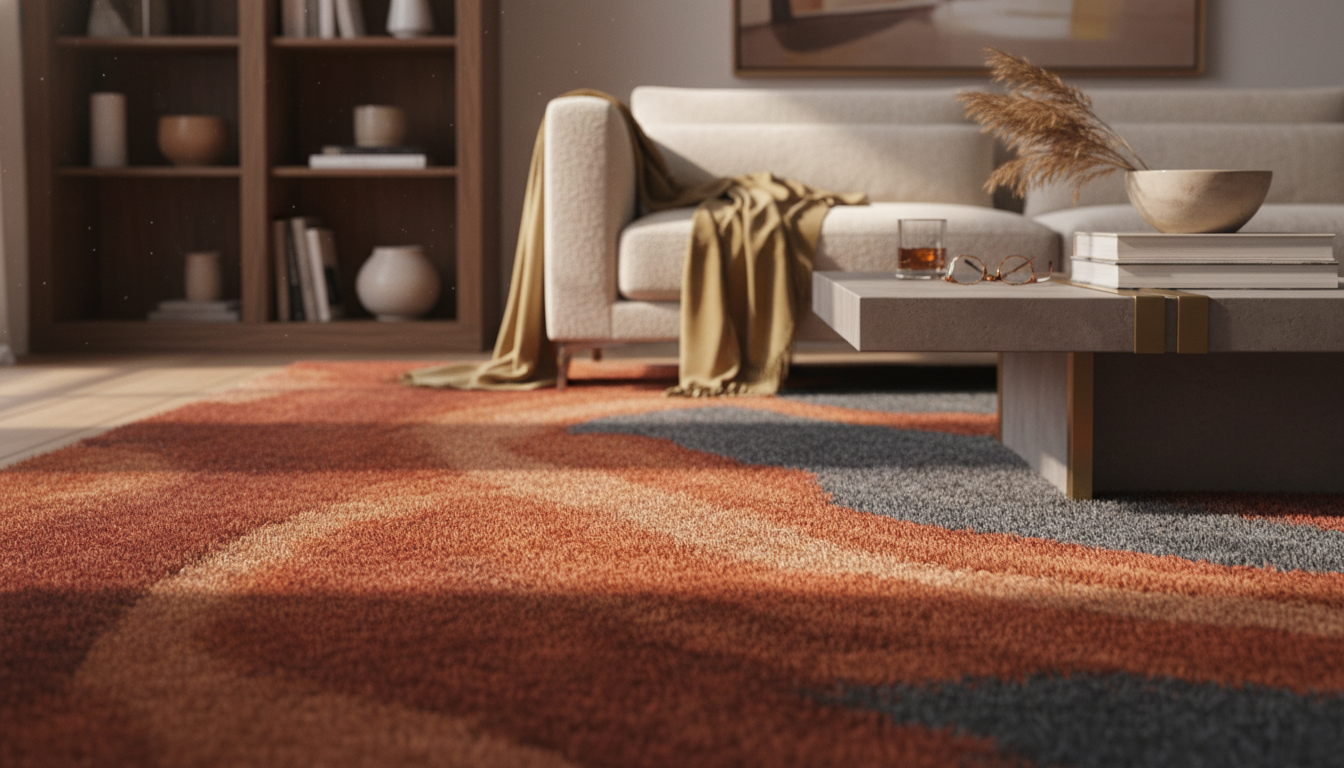
For years, the design world was held captive by the “Greige” movement—a decade defined by safe, desaturated palettes that prioritized resale value over personal expression. In 2026, that safety net has been officially dismantled. We are seeing an unapologetic embrace of saturated earth tones and bold chromatics that serve as the heartbeat of a room rather than a quiet background player.
This shift isn’t just about brightness; it’s about depth. Designers are leaning into pigments that feel ancient and organic. Think of the Light Reflectance Value (LRV) of a deep Sage Green—sitting somewhere in the low 20s—which absorbs light to create a velvety, cocoon-like atmosphere. We’re moving toward colors that have “weight,” like terracotta, bruised plum, and ochre, often achieved through traditional dyeing methods that allow for natural variegation in the yarn.
The Return of Pigment-Rich Artistry
The allure of these rugs often lies in the chemistry of their creation. Many of the most sought-after pieces in 2026 utilize vegetal dyes derived from Rubia tinctorum (madder root) for those perfect rust tones or fermented indigo for midnight blues. These natural pigments interact with wool fibers in a way that synthetic dyes simply cannot replicate, offering a “living” color that shifts beautifully under different lighting conditions throughout the day.
As Elena Vance, Senior Textile Historian and Curator, notes: “The 2026 palette is a visceral reaction to our digital saturation. We are craving colors that feel like they were pulled from the soil. When you place a hand-knotted rug in a deep, oxidized copper or a mossy forest green into a room, you aren’t just adding a floor covering; you are anchoring the space with a sense of geological time.”
Styling the Saturated Floor
Integrating high-pigment rugs requires a thoughtful approach to balance. To avoid overwhelming the senses, designers are using these bold foundations to “color-drench” or to provide a stark, sophisticated contrast to minimalist architecture.
- The Tone-on-Tone Approach: Match your wall paint to the secondary undertone of your rug. If your rug features a burnt sienna base, a clay-plaster wall finish creates a seamless, high-end gallery feel.
- Balancing Visual Weight: When using a rug with high chromatic intensity, opt for furniture with “breathing room”—think slim-profile mid-century legs or transparent glass coffee tables that allow the rug’s artistry to remain visible.
- Textural Contrast: A bold color feels more sophisticated when paired with varied pile heights. Look for rugs at thebohorugs.com that utilize silk accents within a matte wool field; the way the light hits the silk creates “highlights” in the bold pigment, adding three-dimensional movement to the floor.
To master the bold color trend without it feeling chaotic, follow the updated designer ratio: 60% of the room in a foundational neutral (like warm oatmeal or stone), 30% in your primary rug pigment (the earthy bold), and 10% in a sharp, unexpected accent color (like a pop of cobalt blue or acid yellow) found within the rug’s weave.
Whether you are drawn to the fiery warmth of a Moroccan sunset or the cool, grounding depths of an evergreen forest, the 2026 color story is about courage. It’s about choosing a piece that resonates on an emotional level. Browsing the curated palettes at thebohorugs.com, you’ll find that these aren’t just trends; they are investment pieces designed to age into a beautiful patina, much like a fine wine or a cherished piece of art.
Trend 6: Performance Fibers for High-Traffic Luxury
Resilience Meets High-End Refinement
For years, the design world lived by a silent compromise: you could have a rug that was a work of art, or you could have one that survived a spilled glass of Bordeaux and a Golden Retriever. In 2026, that boundary has completely dissolved. We are seeing a sophisticated evolution in **textile engineering** where performance fibers are no longer just “utility” items—they are the new standard for luxury living. The 2026 shift is defined by what designers are calling the **”Silk-Touch Synthetic.”** By utilizing advanced **micro-denier polyester** and **solution-dyed acrylics**, weavers are now able to mimic the exact luster and hand-feel of high-end viscose or genuine silk, but with a molecular structure that repels liquids and resists UV fading. This isn’t just about being “washable”; it’s about a rug that maintains its structural integrity and **Light Reflectance Value (LRV)** even in the highest-traffic zones of a sun-drenched estate.“We’ve moved past the era where performance meant plastic,” notes Elena Vance, a Senior Textile Historian. “The 2026 collections are integrating **recycled PET polymers** with traditional hand-looming techniques from the Atlas Mountains. You get the soulful, irregular character of an artisanal piece with the ‘bulletproof’ nature of modern chemistry.”
Where Durability Meets Design
Designing for a high-traffic home doesn’t mean retreating to drab greys or flat weaves. Designers are now placing these high-performance pieces in unexpected, formal environments.- The Formal Dining Room: Gone are the days of panicking over dinner parties. A performance rug with a low-pile triexta blend provides a soft underfoot experience while allowing chairs to slide effortlessly without catching fibers.
- The Modern Mudroom: Entryways are seeing a surge in sculpted performance rugs. Look for pieces that use varying pile heights to create 3D patterns—hiding dirt in the texture while remaining incredibly easy to steam clean.
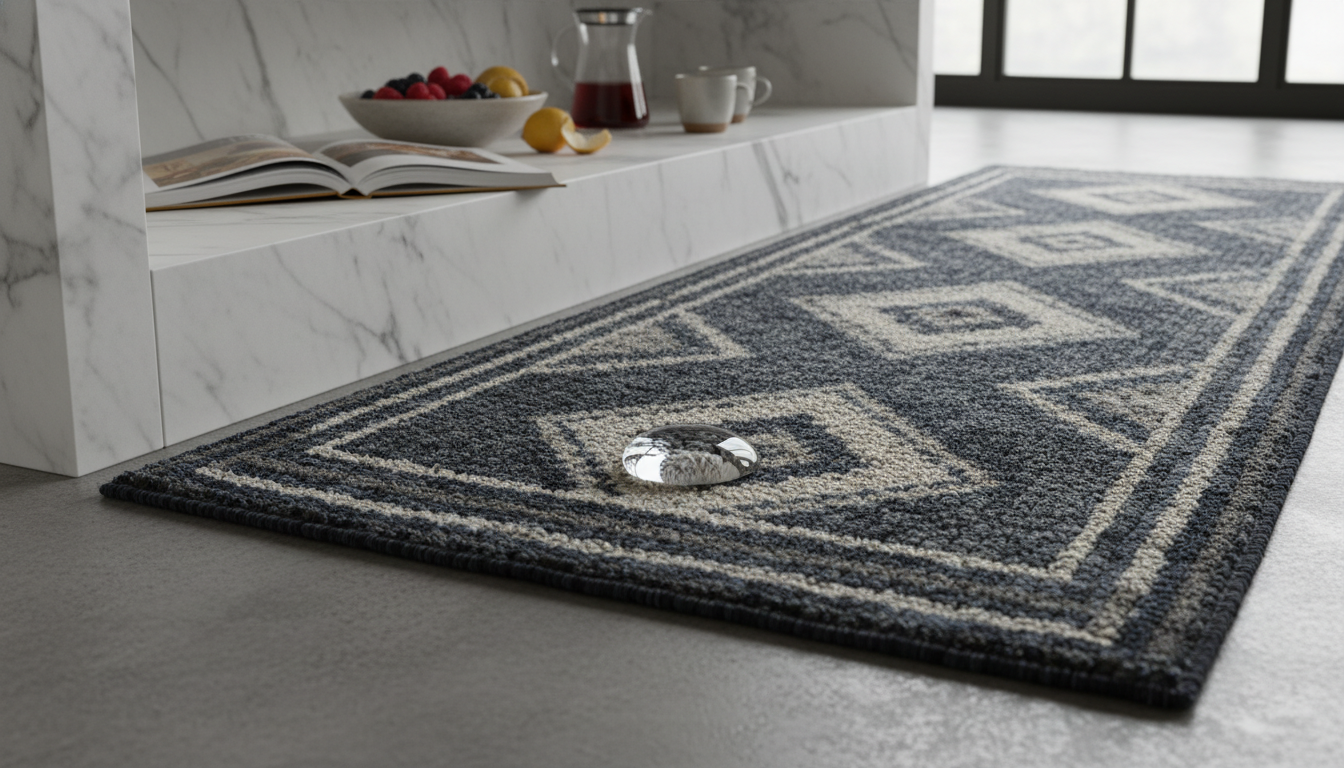
- Kitchen Runners: The “kitchen rug” has become a 2026 staple. A high-performance runner from thebohorugs.com offers that essential layer of warmth against cold cabinetry while standing up to the inevitable grease and spills of a chef’s kitchen.
When shopping for high-traffic luxury, look at the density, not just the thickness. A high-quality performance rug should have a high stitch count (the number of knots or tufts per square inch). Press your thumb firmly into the pile; if it bounces back instantly without leaving a “crush mark,” it has the resilience needed for a 2026 living space.
Shop the Look: Explore our curated Performance Collection featuring artisanal weaves that defy the elements without sacrificing style.
Trend 7: The ‘Wrong Rug’ Theory in Practice
High-Low Juxtaposition
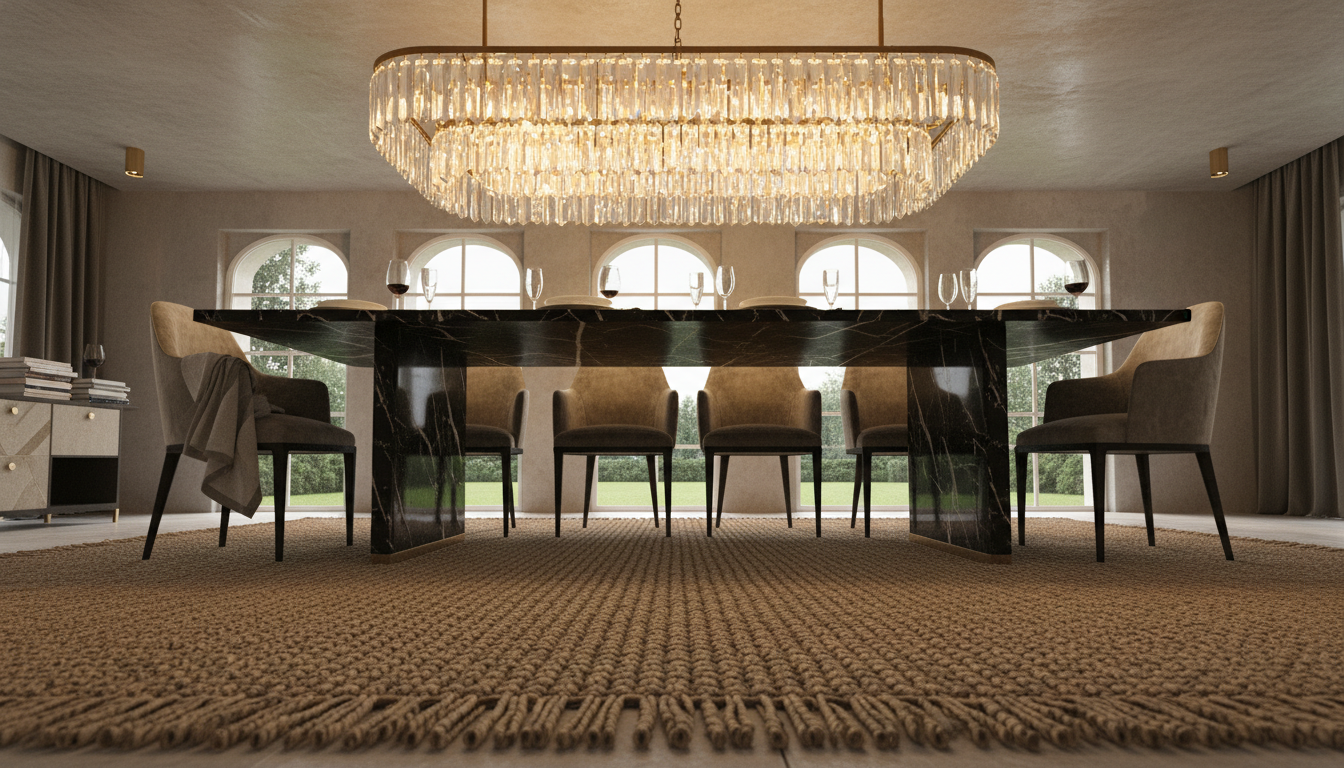
The “Wrong Rug” theory is most effective when it bridges the gap between the organic and the opulent. Think of a grand, crown-molded dining room featuring a polished mahogany table and velvet-upholstered chairs. Rather than a classic Persian, you anchor the space with a chunky, hand-twisted seagrass or a 1,200-denier natural jute rug. This choice strips away the stiffness of formal architecture, making the room feel approachable yet undeniably sophisticated. As textile historian Julianne Moorefield notes, “In 2026, luxury is defined by authenticity rather than price tag. By introducing a ‘humble’ material into a ‘noble’ room, you highlight the quality of both. The raw, unbleached texture of a natural fiber makes the sheen of a silk pillow or a marble fireplace pop with newfound intensity.”Mastering the Tension
To pull this off without looking like an accident, focus on the scale. For **trending area rugs 2026**, the “wrong” rug should be oversized, nearly touching the baseboards to prove the choice was intentional. When sourcing these pieces, look for premium weaves that offer a softer underfoot experience. Many of the artisanal collections at thebohorugs.com feature refined natural weaves that provide this exact designer-grade tension without sacrificing comfort.When styling a natural fiber rug in a formal space, consider the Light Reflectance Value (LRV). Natural jute and abaca fibers have a low LRV, meaning they absorb light rather than bounce it. This makes them the perfect “matte” backdrop for high-shine furniture finishes like brass, lacquer, or glass, which is a hallmark of the designer rug trends we are seeing this year.
- The Living Room: Pair a minimalist, curved bouclé sofa with a dark-stained sisal rug for a moody, grounded aesthetic.
- The Bedroom: Use a flatweave jute rug as a base, then layer a small, plush sheepskin near the bedside to soften the transition.
- The Entryway: Set the tone for the house by placing an organic-shaped hemp rug under a traditional crystal light fixture.
Ready to experiment with contrast? Shop our natural fiber collection to find the perfect foundation for your “Wrong Rug” transformation.
Trend 8: 3D Textures and Sculpted Piles
The Sensory Shift to Tactile Maximalism
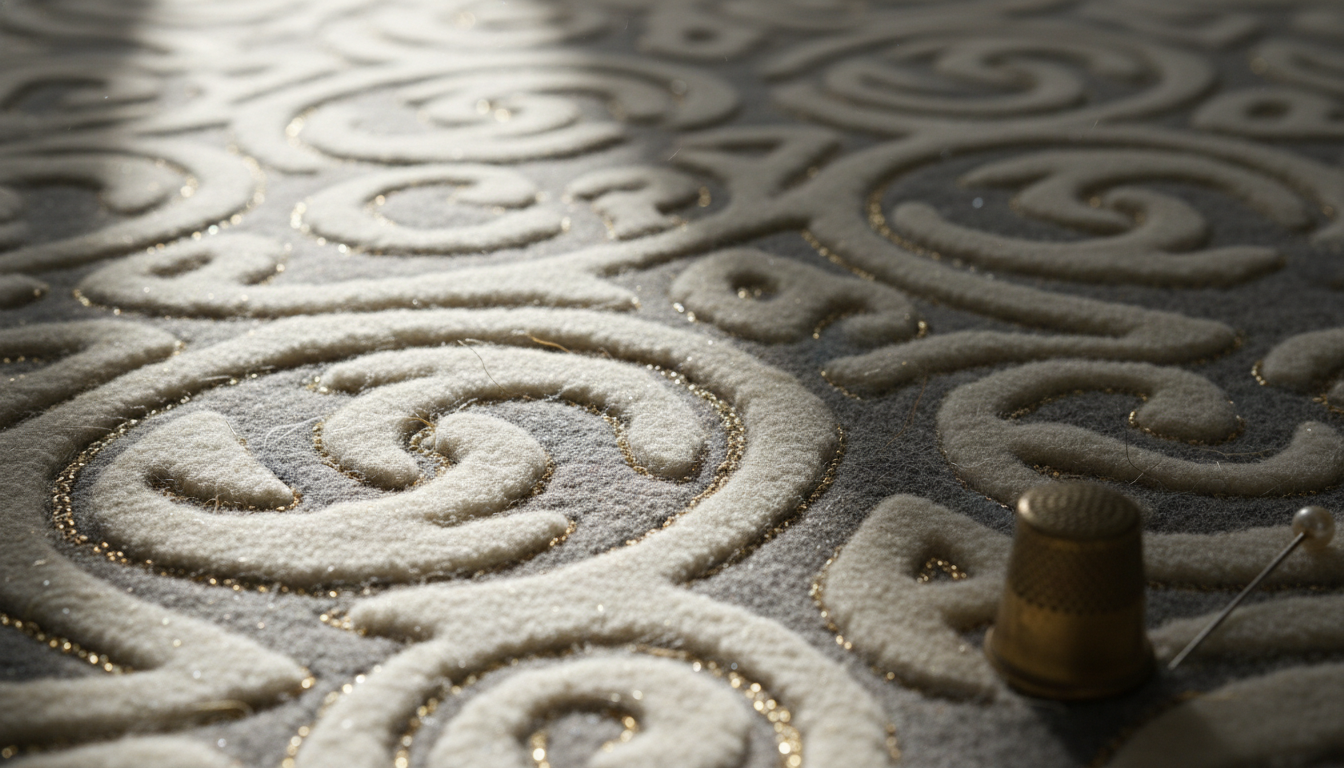
The design world is moving away from the era of “flat” interiors. In 2026, the floor is no longer just a backdrop; it’s a topographical map for the feet. We are seeing a massive pivot toward what designers call **Tactile Maximalism**, where the luxury of a rug is measured by its physical depth rather than its pattern alone. This trend celebrates the “high-low” effect—not in price, but in pile height. By varying the height of wool and silk fibers, weavers are creating 3D landscapes that change throughout the day as sunlight hits the room. The allure lies in the interplay of shadow and light. A rug with a sculpted, ribbed surface or a chunky bouclé weave doesn’t just sit in a room; it interacts with it. “We’re seeing a renewed obsession with the ‘haptic’ quality of a home,” notes Elena Vane, Lead Textile Archivist. “In 2026, high-end clients are gravitating toward hand-carved relief patterns—think 1970s conversation pits reimagined with the refinement of modern **bio-acetate fibers** and sustainable New Zealand wool.”Engineering Depth with Hybrid Weaves
This isn’t your standard shag rug from decades past. The 2026 iteration is sophisticated and architectural. Artisans are utilizing **asymmetrical shearing**—a process where certain sections of the rug are hand-cut shorter than others—to create organic, moss-like textures or geometric ridges. When styling these pieces, the goal is to create a “texture-on-texture” story. A heavily textured rug from thebohorugs.com serves as the perfect anchor for sleek, mid-century modern furniture. The contrast between a smooth walnut coffee table and a deeply recessed, sculpted pile creates a visual tension that feels curated rather than accidental. This trend works exceptionally well in monochromatic rooms; when you remove the distraction of color, the 3D texture becomes the primary design element.- Ribbed & Linear: Perfect for lengthening small hallways or adding a sense of order to minimalist bedrooms.
- Hand-Carved Florals: A subtle way to introduce patterns without the busyness of traditional prints.
- Bouclé Solids: These offer a sophisticated, pebbled appearance that hides footprints while providing immense underfoot comfort.
When choosing a 3D textured rug, consider the Light Reflectance Value (LRV) of your floor. Sculpted piles rely on shadows to “pop.” If you place a textured cream rug in a room with flat, overhead lighting, you’ll lose the effect. Position these rugs in areas with strong natural side-lighting—like near a floor-to-ceiling window—to emphasize the architectural depth of the weave.
Where Form Meets Function
Beyond the aesthetics, there is a practical brilliance to the 3D trend. These rugs are masterclasses in durability and camouflaging. Because the surface is already multi-dimensional, the inevitable crushing and wear-and-tear that happens in high-traffic zones actually blends into the design. Whether you are sourcing a piece with **Ghiordes knots** for a formal study or a plush, high-pile wool for a nursery, the focus remains on the “lived-in” luxury that only genuine texture can provide. For those looking to dip their toes into this trend without overcommitting, look for tonal rugs that use different yarn thicknesses. This creates a subtle “3D” effect that feels timeless. You can explore a curated selection of these multidimensional pieces at thebohorugs.com, where artisanal craftsmanship meets the 2026 demand for tactile elegance. Shop the Look: Explore our Sculpted & High-Pile Collection →Trend 9: Organic Shapes and Curved Silhouettes
The Shift Toward Biomorphic Living
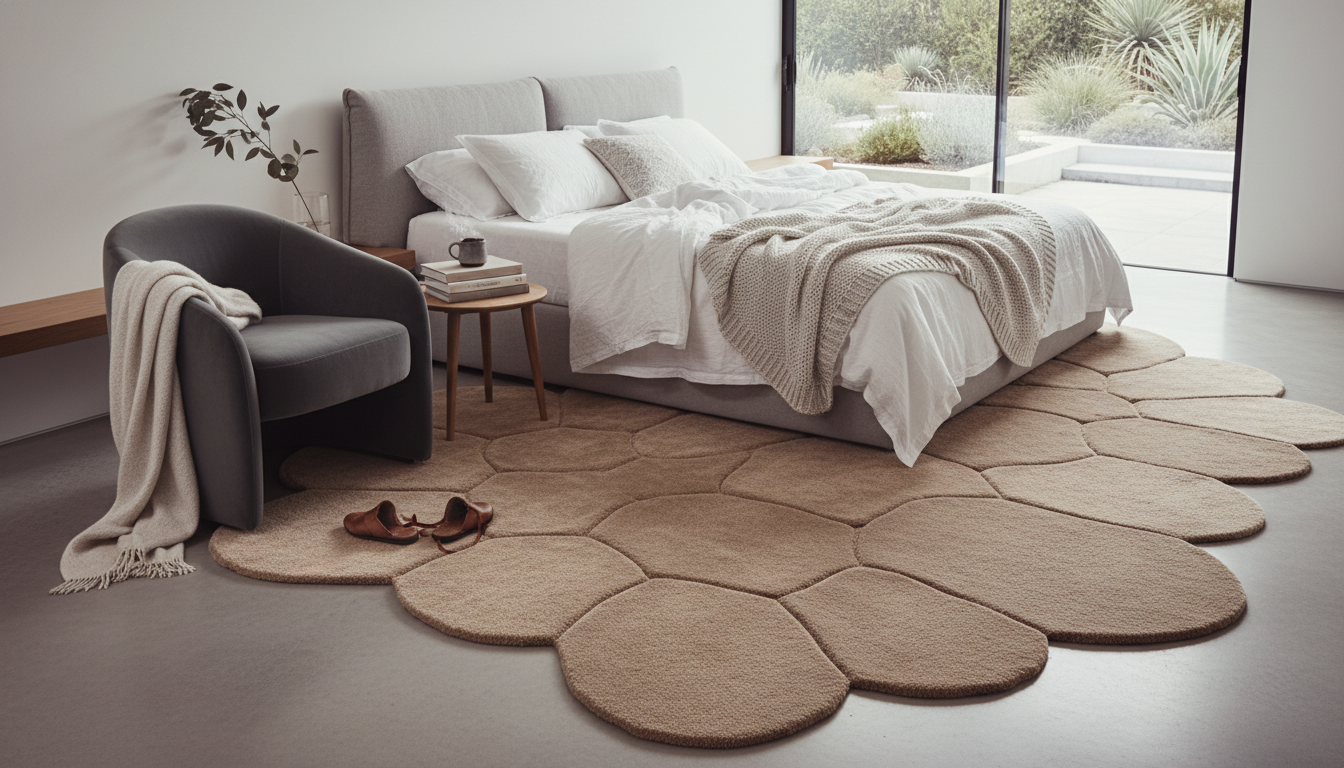
For decades, the rug industry was a world of right angles. We lived within the safety of the 8×10 rectangle, a geometric anchor that mirrored our walls. But as we move into 2026, interior designers are staging a quiet rebellion against the “box.” The rise of organic shape rugs is less about a passing fad and more about a fundamental shift in how we perceive comfort. These pieces—defined by undulating edges, asymmetrical “puddle” silhouettes, and softened kidneys—serve to break the rigid architectural lines of modern apartments and open-plan homes. The beauty of an organic silhouette lies in its ability to lead the eye. Unlike a standard rectangle that stops the gaze at its border, a curved rug flows into the room, creating a sense of movement. We’re seeing a significant uptick in high-twist New Zealand wool constructions that allow these irregular edges to maintain their structural integrity without curling over time.Sculptural Softness Underfoot
Designers are no longer treating the floor as a flat plane; they’re treating it as a gallery floor. In 2026, the trend has evolved from simple circles to complex, biomorphic forms that mimic natural elements—think smoothed river stones or the topographical maps of the Atlas Mountains. These shapes work exceptionally well in “awkward” spaces, such as entryways with radiating staircases or minimalist living rooms where a sharp-edged rug would feel too clinical. “We are seeing a move away from ‘decorating’ and toward ‘spatial energy,'” says Julian Thorne, a leading textile historian. “An organic shape rug acts as a visual solvent. It dissolves the harsh corners of a room, making a space feel more expansive and human-centric. When you source hand-tufted pieces, like those curated by thebohorugs.com, the variation in pile height often follows the curve, adding a three-dimensional depth that a standard machine-made rug simply cannot replicate.”Technical Precision in the Curve
Achieving the perfect organic shape requires more than just a creative cut. To ensure the rug doesn’t look like a “mistake,” the finishing is paramount. The 2026 aesthetic favors a low Light Reflectance Value (LRV) in matte fibers, which ensures the shadows cast by the irregular edges don’t create visual clutter. Many of these top-tier designs now incorporate a blend of Bio-Acetate fibers—a sustainable, silk-like material that adds a subtle shimmer to the “valleys” of a textured, curved rug, mimicking the way light hits a natural spring.- Visual Flow: Use organic shapes to bridge the gap between two different seating zones without the “choppy” look of multiple rectangles.
- Contrast: Pair a curved, asymmetrical rug with a sharp, mid-century modern sofa to create a sophisticated tension between the furniture and the floor.
- Small Space Hack: An irregular rug can actually make a small room feel larger because the brain can’t easily “measure” the floor space by looking at the rug’s boundaries.
When styling an organic or curved rug, the traditional “front-legs-only” rule goes out the window. To make an irregular shape look intentional rather than accidental, aim to have either all furniture legs on the rug or the rug entirely floating in the center of a conversational cluster. If a curve disappears halfway under a heavy cabinet, you lose the sculptural impact of the silhouette. Look for artisanal collections at thebohorugs.com that offer oversized organic shapes to ensure your furniture has room to breathe within the curve.
Trend 10: The Investment Piece: Hand-Knotted Heritage
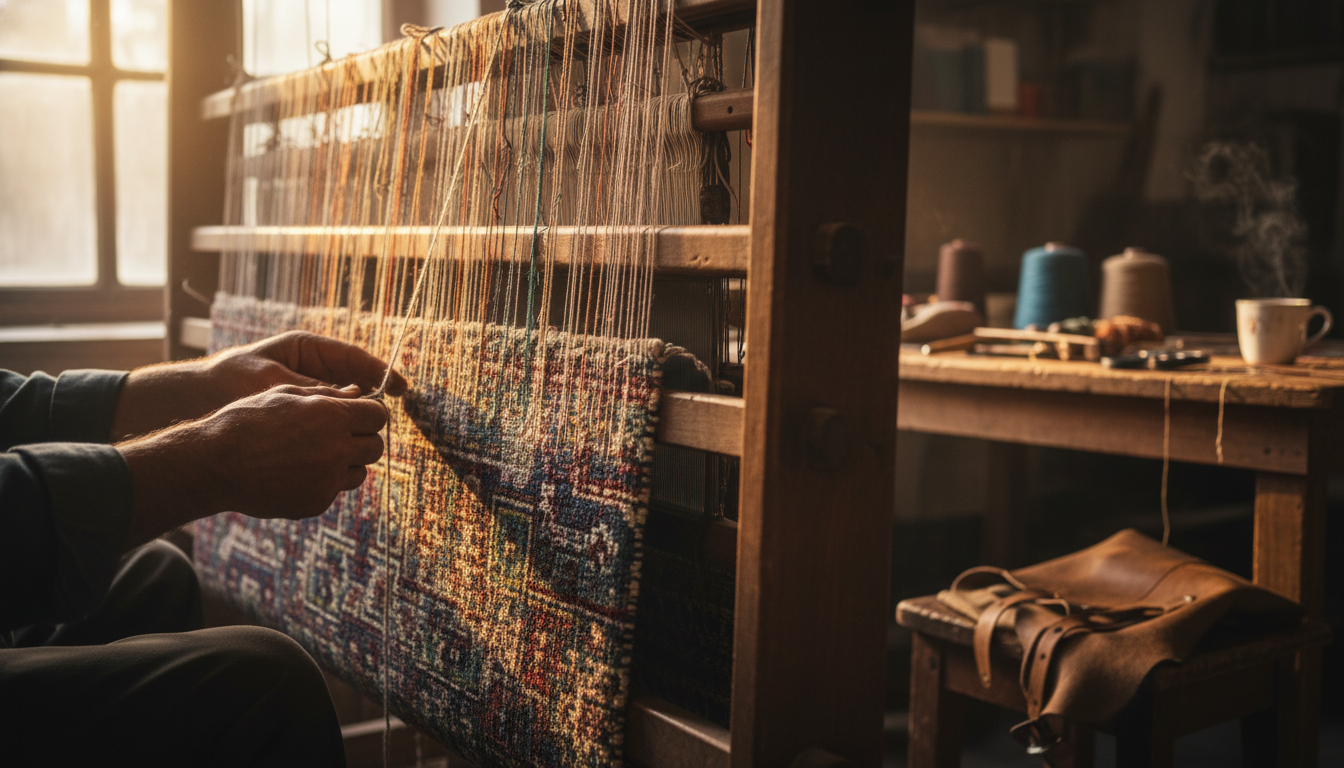
We are witnessing a definitive end to the era of “disposable decor.” In 2026, the design world is pivoting sharply away from machine-loomed synthetics that lose their luster in three years, moving instead toward the soulful permanence of the hand-knotted rug. This isn’t just a purchase; it’s a procurement. High-end designers are treating these pieces as the “anchor” of a room—an architectural element that happens to be made of fiber.
The Return of Slow-Craft Artistry
The 2026 shift is deeply rooted in material integrity. We’re seeing a surge in demand for rugs that utilize centuries-old techniques, such as the asymmetrical Persian knot or the heavy, tactile weaves found in the Atlas Mountains. These pieces are often crafted from high-altitude Ghazni wool—prized for its incredibly high lanolin content, which acts as a natural stain repellent—or blended with real silk for a Light Reflectance Value (LRV) that changes the rug’s hue as you walk across the room.
Unlike power-loomed alternatives, these heritage pieces possess “abrash”—the subtle, beautiful variations in color that occur when hand-dyed yarns are woven together. In a world of digital perfection, these slight “imperfections” are the ultimate status symbol of authenticity.
“In 2026, my clients aren’t asking about patterns; they’re asking about provenance. They want to know the hands that tied the knots and the valley where the wool was sourced. An investment rug is essentially a painting for the floor that you can actually live on.”
— Julian Thorne, Textile Historian & Design Consultant
How to Spot a “Forever” Rug
When you’re browsing the curated galleries at thebohorugs.com, look for density and drape. A true investment piece should feel heavy but supple. In 2026, the trend is leaning toward low-shear Oushaks and muted Tabriz patterns that have been “distressed” not by machines, but through traditional herbal washing. This process softens the fibers and mutes the pigments (think sage greens, sun-bleached terracottas, and dusty indigos) to ensure the rug looks like it has been in your family for generations, even if it arrived this morning.
To verify a high-value hand-knotted piece, always look at the back. The pattern on the underside should be almost as clear as the pattern on the top. If you see a plastic mesh or a hard canvas backing, it’s a machine-made imitation. A true heritage rug from our premium collection will show the individual knots, proving its 100% organic construction.
Styling the Masterpiece
To let an investment piece shine, give it breathing room. In a formal dining room, ensure the rug extends at least 30 inches beyond the table edge so the chairs stay on the “art” even when pulled out. In a minimalist primary suite, a large-scale, hand-knotted wool rug provides the necessary warmth to balance sharp architectural lines and cold glass surfaces. You aren’t just covering the floor; you’re laying down a legacy.
Elevate Your Space
Discover the artistry of handmade luxury. Each rug is a masterpiece of tradition and modern design.
Expert Q&A
What is the dominant rug color for 2026?
We are seeing a major shift toward ‘Earthy Saturated’ tones. Think deep terracotta, moss green, ochre, and rust. These colors provide a grounding element that neutrals lack.
Is the ‘layered rug’ look still popular in 2026?
Yes, but with a twist. Instead of just layering for the sake of it, 2026 is about contrasting textures—placing a high-pile Moroccan rug over a very flat, sleek sisal base.
What are organic shape rugs?
Organic shape rugs move away from rectangles and circles, featuring asymmetrical, pebble-like, or wavy edges that mimic natural forms like ponds or stones.
How do I style the ‘Wrong Rug Theory’?
Place a rug that feels ‘too casual’ or ‘too raw’ in a space that is very formal. For example, a chunky jute rug in a dining room with velvet chairs creates an immediate sense of designer-led cool.
Are vintage rugs still trending?
Absolutely. The demand for ‘pre-loved’ or antique rugs with authentic wear is higher than ever, as homeowners prioritize character and sustainability over mass-produced items.
What materials are best for high-traffic areas in 2026?
New-age performance wool and ‘hybrid’ fibers that blend recycled plastics with natural silk provide the durability needed for families without sacrificing a luxury feel.
Should a rug be under all furniture legs?
In 2026, the trend is ‘Oversized’. Ideally, all legs of your furniture should sit comfortably on the rug to create a unified ‘island’ effect in the room.
What is 3D rug texture?
It refers to ‘sculpted’ rugs where the pile height varies to create patterns. It’s a way to have a monochrome rug that still feels visually complex and interesting.
Can I put a rug over wall-to-wall carpet?
Indeed. This is a key 2026 styling tip to add texture and define zones in apartments or homes with existing carpeting.
Are cool greys out of style for rugs?
Cool, industrial greys have largely been replaced by ‘Greige’ or warmer, sandy tones that feel more inviting and less sterile.
What is biophilic rug design?
It’s design that mimics nature, using undyed wools, mossy textures, and patterns that resemble forest floors or riverbeds.
How do I choose between a hand-knotted and a machine-made rug?
In 2026, the focus is on longevity. A hand-knotted rug is an investment that lasts decades and can be repaired, whereas machine-made is often better for temporary styles or budget-conscious refreshes.
What size rug is trending for living rooms?
Large-scale is the rule. 9×12 and 10×14 are the new standards as people seek to make their rooms feel larger and more cohesive.
Are fringes coming back?
Yes, but in an exaggerated, oversized way. Thick, braided tassels or long, shaggy fringes are being used as a design statement rather than a subtle finish.
How do you clean the new textured rugs?
High-low pile rugs require a vacuum without a beater bar to avoid pulling the longer fibers. Professional cleaning every 18 months is recommended for 3D textures.
Written by TheBohoRugs Interior Design Team
Experts in handmade rugs, boho interiors, and modern home decor.